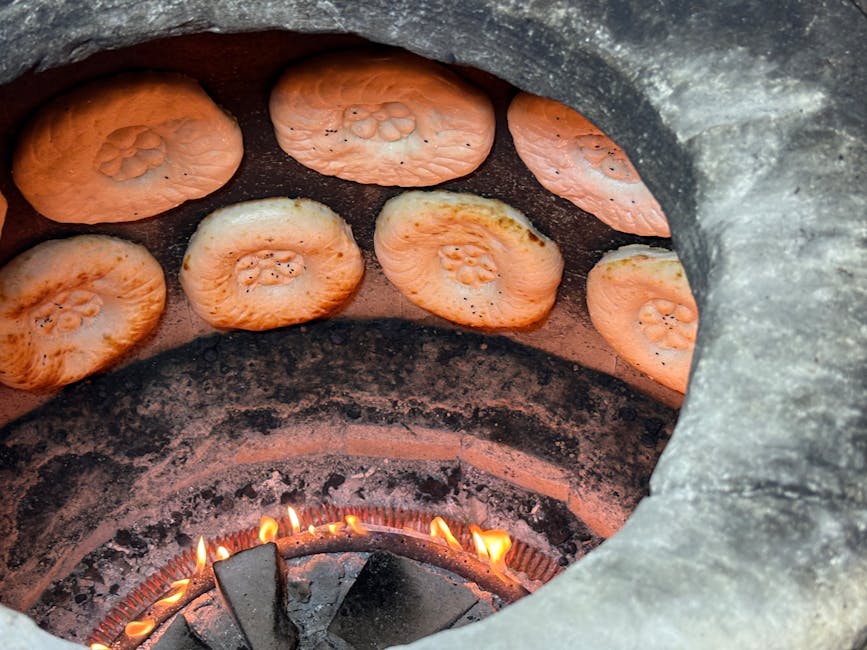
The Oldest Oven Still in Daily Use
The tandoor — a cylindrical clay oven heated by charcoal or wood fire at its base — has been in continuous use for approximately 5,000 years, making it one of humanity's oldest cooking technologies. Archaeological evidence from the Indus Valley civilization (modern-day Pakistan and northwestern India) shows clay ovens nearly identical in design to the tandoors used in Delhi restaurants today. The basic principle hasn't changed because it didn't need to: a hollow clay cylinder traps radiant heat from a live fire, reaching internal temperatures of 450-480°C (840-900°F), while the clay walls retain moisture that prevents food from drying out. The combination of extreme radiant heat and ambient humidity produces cooking results that no conventional oven, no matter how expensive, can replicate.
The physics of the tandoor are elegant. The fire at the base heats the clay walls, which radiate heat inward from all sides simultaneously, cooking food from every direction at once. This is fundamentally different from a conventional oven, where heat circulates by convection (hot air moving around the food) and cooking is uneven. In a tandoor, a piece of chicken on a skewer receives equal heat from the front, back, sides, top, and bottom — the only comparable modern technology is a commercial pizza oven, and even that doesn't reach tandoor temperatures. The extreme heat sears the surface of proteins almost instantaneously, creating a charred, smoky exterior while the interior stays remarkably moist. This is why tandoori chicken, when properly made, has a crust that's almost black with char but flesh that's pink, juicy, and tender underneath.
Tandoori Chicken: The Red Standard
Tandoori chicken — the dish that introduced tandoor cooking to the world — was popularized (though not invented) at Moti Mahal restaurant in Delhi in the 1950s, by a Punjabi cook named Kundan Lal Gujral who had brought his tandoor and his recipes from Peshawar after the Partition of India. The preparation is deceptively simple: chicken pieces (traditionally a whole bird, cut in half) are marinated in yogurt, ginger, garlic, and a spice mixture that includes cumin, coriander, turmeric, garam masala, and Kashmiri chili (which provides the iconic red color without excessive heat). The marinated chicken is skewered on long metal rods and lowered into the tandoor, where it cooks for 12-15 minutes — an astonishingly short time for bone-in chicken that would take 40-50 minutes in a conventional oven.
The yogurt in the marinade is critical and does more than flavoring. Yogurt's lactic acid tenderizes the meat over the marination period (4-24 hours), while its proteins and fats create a coating that chars beautifully in the tandoor's heat, producing the characteristic blackened spots on the chicken's surface. The Kashmiri chili — a long, mild, deeply red pepper — contributes color without aggression, and the turmeric adds an earthy undercurrent. At Bukhara in ITC Maurya Hotel, Delhi — one of the world's most acclaimed Indian restaurants — the tandoori chicken is cooked in a massive tandoor visible from the dining room, and the chicken arrives at the table on a wooden platter, still sizzling, with a charred exterior and flesh so moist that it virtually falls off the bone. The dal bukhara (black lentils slow-cooked for 18 hours) gets the headlines at Bukhara, but the tandoori chicken is the reason the restaurant exists.
Naan and the Gravity Trick
The tandoor's most visible daily product across South and Central Asia isn't meat — it's bread. Naan, the leavened flatbread that accompanies virtually every North Indian meal, is cooked by slapping raw dough against the interior wall of the tandoor, where it sticks and bakes in 60 to 90 seconds. The cook (tandoorchi) stretches a ball of dough between his hands, slaps it against a curved pad, and reaches into the oven's mouth — where the air temperature exceeds 400°C — to press the dough against the clay wall. Gravity pulls the dough downward slightly as it bakes, creating naan's characteristic teardrop shape. When the bread blisters, puffs, and develops charred spots on its surface, the cook uses a long metal hook to peel it from the wall and retrieve it.
The skill involved in this process is easy to underestimate. The tandoorchi works with bare hands or minimal protection, reaching into an oven that is hot enough to ignite paper, and must judge the dough's readiness by sight and instinct. Too long on the wall and the naan burns and falls into the fire. Too short and the dough is raw inside. The window is narrow, and the tandoorchi typically manages 200-300 pieces of naan per service, each one requiring the same arm-into-the-inferno maneuver. At Karim's in Old Delhi — operating since 1913 in a narrow lane near the Jama Masjid mosque — the tandoor has been burning continuously for so many decades that the clay has developed a patina of carbonized flour and ghee that contributes its own flavor to the bread. The naan here arrives at the table glistening with butter, blistered and charred in spots, soft and chewy in the center, and it is the best argument for tandoor cooking that exists: bread this good cannot be made in any other oven.
Beyond Chicken: The Tandoor Menu
The tandoor cooks far more than chicken and bread, though those two applications dominate its international reputation. Seekh kebab — ground lamb mixed with onions, herbs, and spices, molded around metal skewers and cooked in the tandoor — benefits from the extreme heat by developing a crispy exterior while the interior stays juicy and loosely textured. Fish tikka — marinated chunks of fish (usually salmon, pomfret, or cod) cooked on skewers — acquires a smoky char that complements the fish's delicate flavor without overwhelming it. Paneer tikka — cubes of Indian cottage cheese marinated in spiced yogurt — gains a charred, slightly smoky surface while maintaining its creamy, squeaky interior.
The tandoor secret nobody mentions: The best tandoor dishes are the ones cooked at the end of service, when the charcoal has burned down slightly and the temperature drops from scorching to merely extreme. The gentler heat produces more even cooking and more complex char patterns.
In Central Asian cuisines (Uzbek, Afghan, Tajik), the tandoor (called tandir or tanoor) is used to bake samsa — meat-filled pastries that are stuck to the oven wall like naan and bake to a flaky, golden finish that no conventional oven replicates. Uzbek tandir lamb — a whole leg or shoulder lowered into the tandoor on chains and slow-roasted for hours in the residual heat after the bread service — produces meat so tender it separates from the bone at a touch, with a smoky, clay-infused flavor that's unique to the cooking method. The tandoor, in all its regional variations, remains the most versatile and effective cooking vessel ever devised from mud.
The Home Tandoor Question
Can you replicate tandoor cooking at home? Not exactly, but you can get closer than most people assume. A conventional oven maxes out at 250-300°C (480-575°F), which is significant shortfall from a tandoor's 480°C. However, a pizza stone preheated for an hour at maximum oven temperature, combined with the broiler on high, creates a reasonable approximation for naan — slap the dough onto the scorching stone and let the broiler char the top, and you'll get something resembling tandoor-baked bread in about 3 minutes. For meats, the highest-heat method available at home is a charcoal grill with the lid closed, which can reach 350-400°C and produces the charred, smoky results that a tandoor achieves. It won't be identical — the clay walls of a real tandoor contribute a mineral, slightly earthy flavor that steel and stone can't provide — but it's in the right neighborhood.
Purpose-built home tandoors do exist — clay pots mounted on stands, heated by gas or charcoal, available from Indian kitchen suppliers for $200-500. They work remarkably well and produce authentic results, but they require outdoor space, generate significant heat and smoke, and take 45 minutes to an hour to reach operating temperature. They're a commitment. But if you've ever eaten naan from a real tandoor and then tried to recreate it in your kitchen oven, you know the gap. It's the gap between listening to a recording and hearing live music. The recording is good. The live performance changes your relationship with the song.