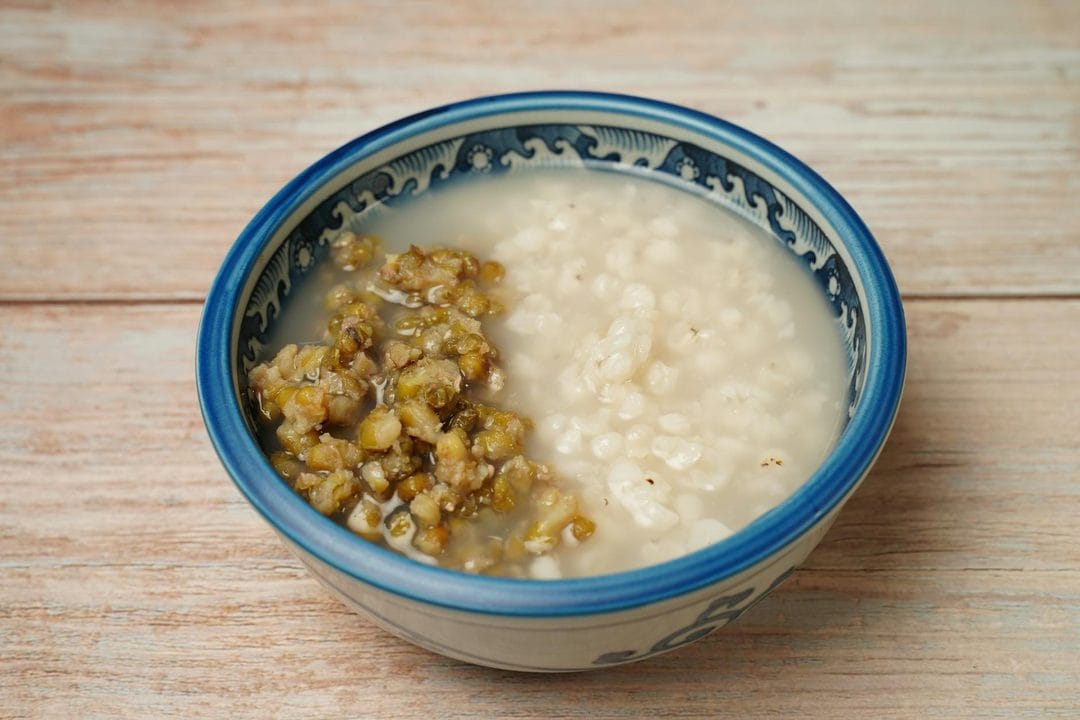
One Name, Eight Completely Different Bowls
Order congee in Guangzhou and you'll get a silky white porridge, often with century egg and preserved pork, ladled from a pot that's been simmering for hours until the rice has dissolved almost entirely into the liquid. Order congee in Bangkok and a version called jok will arrive — slightly thicker, topped with a soft-boiled egg, julienned ginger, and a tangle of deep-fried garlic, eaten for breakfast beside a glass of sweet iced coffee. In Jakarta, bubur ayam shows up in a styrofoam cup from a motorbike vendor at 6:30 AM, topped with shredded chicken, crispy shallots, crackers, and a thick sweet soy sauce that you'd never encounter in any Chinese version. In Seoul, juk is eaten when you're sick — plain or with abalone and sesame oil, slow and serious in a way that feels more medicinal than culinary.
These are not variations on a theme in the way that regional pasta shapes are variations on a theme. They share a cooking method — rice cooked in far more water than a normal ratio, until the grain breaks down — and almost nothing else. The flavour philosophies, the toppings, the textures, the occasions, and the cultural meanings have diverged so completely across Asian cooking traditions that calling all of them congee or porridge obscures more than it reveals.
The Cantonese Standard That Became the Reference Point
Cantonese congee — 粥 in written form, juk in Cantonese, zhou in Mandarin — sets the benchmark that most people outside Asia picture when the word congee appears. The key characteristic is texture: the rice simmers for anywhere between 90 minutes and several hours until it breaks down into a smooth, slightly viscous liquid, thick enough to coat a spoon. In the best congee restaurants in Hong Kong or Guangzhou, the cook stirs constantly during the final stage to develop a consistency that is simultaneously liquid and somehow not watery.
The toppings are protein-forward and deliberately contrasting in texture: silky century egg against the smooth congee, a tender slice of fish fillet that was added raw to the hot pot and poached in the last two minutes, crunchy strips of fried dough called youtiao on the side. The bowl arrives plain and white and you are the one responsible for seasoning it — light soy sauce from the bottle on the table, white pepper from the dispenser, a scattering of spring onion and ginger that you add yourself. The control over the final bowl is yours. This is important in Cantonese food culture in a way that is easy to miss: the restaurant provides a canvas, and the diner completes it.
The best place to understand why this matters is a congee specialist restaurant at 7:00 AM on a weekday in Mong Kok or Sheung Wan — places like Sang Kee Congee Shop, open since 1955, or Hon Kee Congee, which serves until noon. The clientele is roughly half construction workers eating before a shift and half elderly residents who've been coming for forty years. The bowl costs around HKD 35–55. It is not a tourist attraction.
The Thai Version and the Case for Ginger
Thai jok diverged from its Chinese immigrant origins somewhere in the nineteenth century and arrived at a distinctly Thai result. The rice is cooked to a similar breakdown point as Cantonese juk, but the broth carries more aromatics — ginger is essential in a way it isn't in Cantonese versions, and the seasoning includes fish sauce rather than soy sauce, which shifts the whole flavour profile toward something saltier and more funky in the best possible sense.
The signature topping is a raw egg cracked directly into the hot bowl, which barely cooks in the heat and leaves a half-set yolk sitting in the centre. The combination of deep-fried garlic, crispy shallots, white pepper, and that half-cooked egg against the gingered porridge is one of the best breakfasts in the region — and also one of the cheapest. A street cart version in Bangkok costs around ฿35–50. The jok served inside the central market at Or Tor Kor, near the Chatuchak weekend market, is notably better than most hotel breakfast versions, which tend to be blander and more tourist-adapted.
Indonesia's Bubur Ayam and the Art of the Topping Architecture
Indonesian bubur ayam operates on different aesthetic logic entirely. Where Cantonese and Thai versions favour a clean, minimal presentation, bubur ayam is maximalist by design — a base of white porridge almost entirely hidden beneath a layered architecture of toppings that includes shredded poached chicken, a soft-boiled egg, fried tofu cubes, kecap manis (the thick sweet soy sauce that is essential to Javanese cooking), crispy shallots and garlic, celery leaves, rice crackers called kerupuk, and sometimes a hard-boiled egg alongside the soft one.
The result looks chaotic and tastes like many things happening simultaneously — which is, for Indonesian food culture, precisely the point. The bubur itself is relatively neutral, providing a backdrop against which all the toppings play. Indonesian cooking philosophy across many dishes shares this structure: a mild, starchy base that becomes a vehicle for complex, contrasting condiments. Bubur ayam just happens to be the breakfast form of that principle.
The street version, served from a pushcart or small warung, is genuinely different from the fast-food chain version — McD in Indonesia serves a bubur ayam that is perfectly acceptable and much milder and less interesting than the version you'll find at the Pasar Santa market in South Jakarta or at any of the canal-side warungs in Yogyakarta.
Korean Juk: Medicinal, Seasonal, and Slow
Korean juk stands apart from the rest because it's not primarily a breakfast food and not a street food. It occupies a specific cultural register: the food you eat when you're recovering from illness, after surgery, during fasting, or as a deliberate act of self-care. The most prestigious version is jeonbok-juk — abalone porridge — made with fresh abalone, sesame oil, and a rice that is cooked with enough restraint that individual grains remain partially intact. A bowl at a dedicated juk restaurant like Bon Juk in Myeongdong costs around ₩12,000–16,000 and is expected to feel like a medical-grade act of nourishment.
The colour is the first thing you notice: abalone juk has a greenish tint from the abalone viscera mixed into the cooking, which turns the rice a shade somewhere between sage and olive. The sesame oil floated on top adds a nutty warmth that nothing else in the porridge spectrum produces quite the same way. It is almost aggressively non-flashy in presentation — a plain stone bowl, no garnish beyond a few sesame seeds — and the modesty of the presentation is part of what signals seriousness.
There is a vegetable version called hobakjuk, made with pumpkin, that is eaten at the winter solstice festival Dongji. The seasonal and ceremonial dimension of Korean porridge culture has no real equivalent in the Cantonese, Thai, or Indonesian versions — those are every-morning practicalities. Korean juk is eaten when the occasion calls for it specifically.
Why Summer Is Actually the Right Season for All of Them
The conventional wisdom that porridge is winter food doesn't hold in Asia. All four traditions — Cantonese, Thai, Indonesian, Korean — treat congee as an active summer choice for reasons that make practical sense once you understand them. A light, warm bowl of congee is easier on digestion than a plate of rice or noodles in extreme heat, rehydrates gently, and sits lighter than fried alternatives.
In traditional Chinese medicine, congee is categorised as cooling in energetic effect, particularly when cooked plain or with ginger and spring onion. Whether you subscribe to that framework or not, the empirical result is that congee cooks and hawker operators across Southeast Asia see their breakfast rush peak in the May–June pre-monsoon period, when the heat is at its worst and the market instinct for heavy, greasy food drops sharply.
If you've been treating congee as an edge-case dish or a sick-day food and you're in any city from Hong Kong to Jakarta right now, this is the season to actually pay attention to it. Find the specialist — not the hotel breakfast buffet version — and you'll understand why this simple cooking method has produced eight genuinely distinct answers across the same geography.