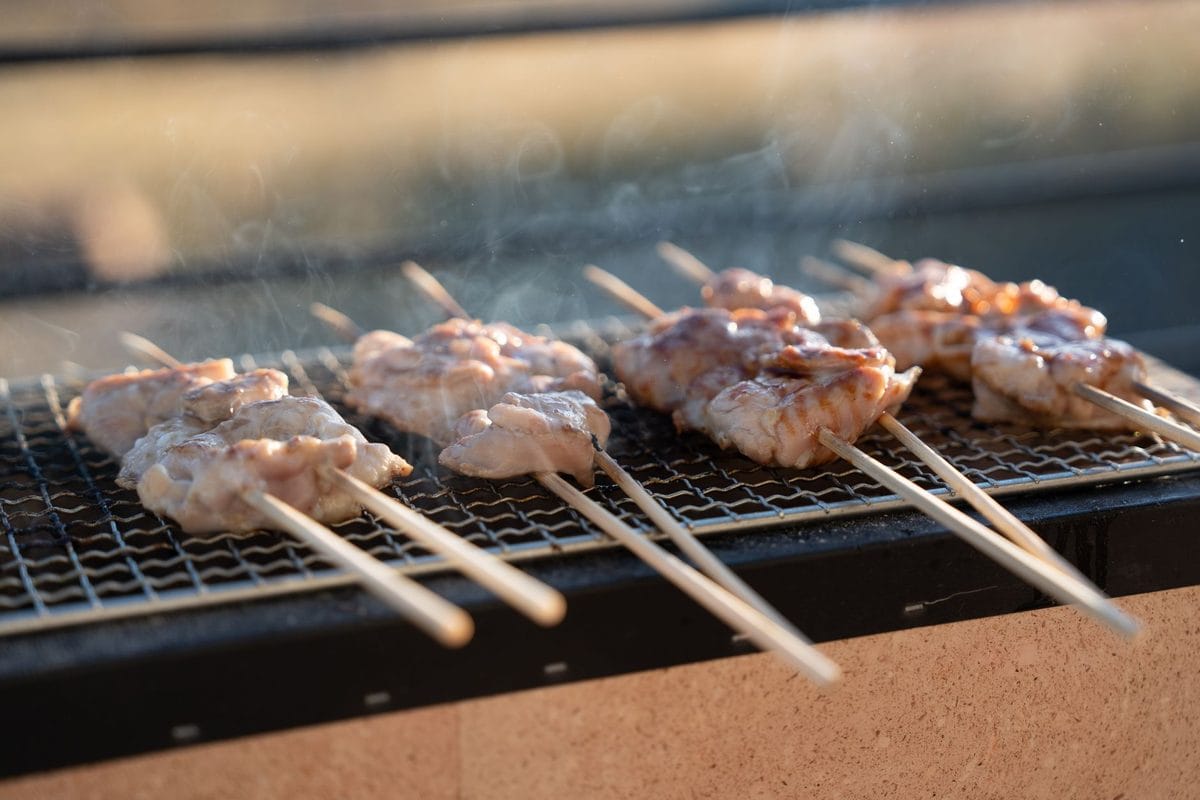
There is a particular sound that means dinner is close in half the cities of Asia: fat hitting charcoal, a quick hiss, then the smell that pulls you across a street you weren't planning to cross. The grilled skewer is one of the most widespread street foods on the continent, and yet it is almost never the same thing twice. What goes on the stick, what gets brushed over it, and how the fire is built all change the moment you move from one country to the next — and the differences are far more deliberate than they look.
Start with the fire itself, because everything else follows from it. The yakitori cook in Tokyo works over binchotan, a dense white charcoal that burns long and clean and gives off intense radiant heat with almost no smoke or flame. That choice is the whole philosophy: binchotan sears the surface of a piece of chicken while leaving the inside barely set, which is exactly why a good yakitori-ya can serve you chicken at varying degrees of doneness and treat each cut as its own ingredient. Compare that to the Thai street vendor grilling moo ping over open, smoky coals, where the smoke is not a flaw to be minimised but a flavour to be chased, soaking into pork that has been marinated in coconut milk, garlic and palm sugar overnight.
The marinade tells you where you are
You can often guess the country from the glaze before you taste the meat. Japanese yakitori leans on tare, a soy-and-mirin sauce that thickens over weeks as skewers are repeatedly dipped into the same pot — the older the tare, the deeper the house's reputation. Indonesian and Malaysian satay arrives with peanut sauce on the side, the meat itself carrying turmeric, lemongrass and candlenut. Korean dak-kkochi splits the difference with a sweet-spicy gochujang glaze that caramelises hard at the edges.
A few skewers worth knowing across the region:
- Yakitori (Japan) — chicken broken down into a dozen named parts, from negima to the prized chicken oyster, each grilled to its own ideal point.
- Satay (Indonesia, Malaysia, Thailand) — marinated meat with peanut or cucumber-relish accompaniment, and a contested origin that several countries claim with real feeling.
- Chuan'r (China) — the cumin-and-chilli lamb skewers of Xinjiang that conquered late-night streets from Beijing to Chengdu.
- Moo ping and gai yang (Thailand) — coconut-marinated pork and grilled chicken sold by the bag with sticky rice, a breakfast as much as a dinner.
Why the stick survived when the kitchen modernised
Grilling on a stick is the oldest cooking technology there is, and it persisted in Asian cities for a reason that has nothing to do with nostalgia. A skewer needs no plate, no cutlery and barely any space — a cart, a grill, a stool. That economy is what let the food cluster around night markets, train stations and the mouths of alleys, where rent is impossible and footfall is everything.
The catch is that the best versions are getting harder to find. Binchotan is expensive and slow to make, and younger cooks increasingly reach for gas, which is cleaner to run but loses the radiant char that defined the dish. The same pressure shows up in Bangkok, where landlord crackdowns on pavement vendors have thinned the moo ping carts that used to sit on every other corner.
If you want the real thing, my advice is to follow the smoke and the queue rather than the sign. A stall with a line of office workers at 7 p.m. and a grill that's been seasoned black is telling you everything the menu can't. Order the cuts you don't recognise — the chicken oyster, the grilled gizzard, the bits of pork the locals reach for first — because those are the skewers that separate a stand that knows its fire from one that's just feeding the crowd.
And eat them standing up, over the cart, while they're still too hot. A yakitori skewer that has sat in a takeaway box for fifteen minutes is a sad, steamed shadow of the thing that came off the binchotan. Some food is built to travel. This is not it.