The City That Eats Itself Broke
Osaka has a word for its relationship with food: kuidaore — to eat oneself into ruin. The term, often translated as "eat until you drop," carries both pride and self-awareness. Osaka's identity as Japan's culinary capital (a title Tokyo disputes but Osaka inhabits with more conviction) is built on a working-class food culture that values quantity and satisfaction alongside quality, producing a street food tradition that's more democratic, more boisterous, and more calorie-dense than anything in the polished restaurant culture of the capital. Where Tokyo whispers "omakase," Osaka shouts "okawari!" (another helping!). The city's gift to Japanese food culture is a set of dishes designed to be eaten standing up, in crowds, with your hands, for very little money, and with an abandon that the reserved Tokyo dining scene would find unseemly.
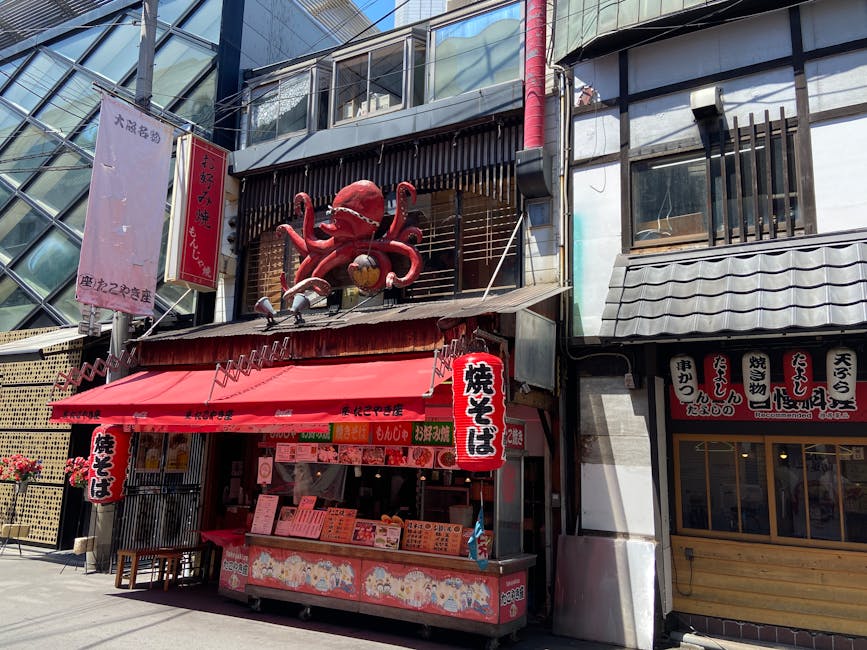
The epicenter is Dotonbori, the neon-lit canal street in Osaka's Namba district that functions as both tourist attraction and legitimate food destination. The giant mechanical crab above Kani Doraku restaurant, the running man of Glico, and the rows of illuminated food stalls create a sensory environment that feels like a food-themed amusement park — which is not far from the truth. But behind the neon, the food is serious. Dotonbori's stalls and the surrounding streets of Namba, Shinsaibashi, and Shinsekai offer the full spectrum of Osaka's street food canon: takoyaki, okonomiyaki, kushikatsu, kitsune udon, and dozens of variations on the theme of fried, grilled, or sauced things eaten while walking.
Takoyaki: The Octopus Ball Obsession
Takoyaki — spherical wheat-flour dumplings with a piece of octopus in the center, cooked in a specialized cast-iron pan with hemispherical molds — is Osaka's most iconic street food and one of those dishes where the cooking technique is as entertaining as the eating. The cook pours batter into the oiled molds, drops a chunk of octopus, pickled ginger, and tenkasu (tempura scraps) into each well, then uses a pointed pick to turn each ball continuously as it cooks, building up layers of crispy batter on the outside while the inside remains creamy and almost liquid. The turning technique — rapid, precise, 20 balls at once — is hypnotic to watch and requires months of practice to master.
A perfectly made takoyaki has a thin, crispy shell that gives way to a molten, creamy interior and a chewy piece of octopus at the center. It's served six or eight to a boat-shaped paper tray, drizzled with takoyaki sauce (similar to Worcestershire but sweeter), Japanese mayonnaise, and a shower of bonito flakes that wave in the rising steam as if they're alive. You eat them with a toothpick, and the first bite invariably burns the roof of your mouth because the filling is approximately the temperature of lava and you've been warned but you didn't listen. At Wanaka in Namba, the takoyaki are made with a dashi-rich batter that elevates them from snack to savory experience. Six pieces cost ¥500 ($3.40). At Creo-Ru near Shinsekai, the takoyaki are even more molten and less crispy — almost soup inside — representing the "trotoro" (creamy) school of takoyaki that divides Osakans as passionately as pizza thickness divides New Yorkers and Chicagoans.
Okonomiyaki: The Savory Pancake War
Okonomiyaki translates loosely as "grilled however you like it," and Osaka takes this literally. The Osaka-style version is a thick, round pancake made from a batter of flour, dashi, eggs, and shredded cabbage, mixed with your choice of additions (pork belly, shrimp, squid, cheese, mochi, kimchi), cooked on a flat griddle (teppan), and topped with okonomiyaki sauce, mayonnaise, bonito flakes, and aonori (green seaweed flakes). The batter-to-cabbage ratio is important: too much batter and the pancake is dense and heavy; too much cabbage and it falls apart. The sweet spot is a pancake that's crispy on the outside, fluffy and cabbage-dense on the inside, with the toppings creating a glossy, umami-rich surface.
The Hiroshima style — which Osakans consider incorrect and Hiroshimans consider superior — layers the ingredients rather than mixing them: a thin crepe, a mountain of cabbage, pork, noodles (yakisoba), and egg, pressed together on the griddle into a layered stack. The result is more structured and noodle-forward than the Osaka style, and the debate over which version is better has been running for decades with no resolution in sight. At Mizuno in Dotonbori — a 60-year-old restaurant with a constant line — the Osaka-style okonomiyaki is cooked on a teppan in front of you, and the yamaimo (mountain yam) in the batter gives it an extraordinary lightness. The "Mizuno yaki" with pork, shrimp, and squid costs ¥1,450 ($10) and is large enough to split between two people, though you won't want to.
Kushikatsu: The Deep-Fried Democracy
Kushikatsu — deep-fried skewered everything — is Shinsekai's contribution to Osaka's food canon. The concept is simple: take any ingredient (pork, beef, shrimp, lotus root, quail egg, cheese, asparagus, renkon, sweet potato), skewer it, coat it in a light panko-like batter, and deep-fry it until golden. Serve with a thin, tangy Worcestershire-based sauce for dipping. The variety is the point: a typical kushikatsu meal involves ordering 10-20 different skewers, each one a different ingredient, creating a progression of textures and flavors that keeps the meal interesting despite the uniform frying technique.
The single most important rule of kushikatsu: NO DOUBLE DIPPING. The communal sauce pot on the counter is shared by all diners, and dipping a half-eaten skewer back into the sauce is a violation so severe that signs in multiple languages (Japanese, English, Chinese, Korean) are posted at every kushikatsu restaurant. If you need more sauce, use the provided cabbage leaves to scoop sauce from the pot onto your food. This cabbage-as-spoon system is unique to kushikatsu culture and is one of those rules that seems arbitrary until you realize that communal sauce pots would be a hygiene disaster without it. At Daruma in Shinsekai — the most famous kushikatsu chain in Osaka, operating since 1929, with its iconic angry-faced mascot — the sauce is thin, vinegary, and cuts through the fried richness effectively. A meal of 15 skewers with a beer runs about ¥2,500 ($17).
Kitsune Udon: The Comfort Bowl
Osaka's udon culture is distinct from the chewy, thick sanuki udon of Shikoku. Osaka udon uses softer, thicker noodles in a lighter, sweeter broth made with konbu (kelp) dashi and light soy sauce — a broth so gentle it's almost transparent. The signature preparation is kitsune udon — noodles topped with a large piece of abura-age (fried tofu skin) that's been simmered in a sweet soy broth until it's plump and glossy. The sweetened tofu releases its flavor into the broth as you eat, gradually sweetening and enriching the soup. At Usami Tei Matsubaya in Namba — operating since 1893 — the kitsune udon costs ¥810 ($5.55) and arrives in a lacquer bowl with the abura-age draped elegantly over the noodles. The broth is so clear you can see the noodles through it, and the sweetness is subtle, more suggestion than statement.
Shinsekai After Dark
Shinsekai — the neighborhood built in 1912 as Osaka's entertainment district, modeled after New York's Coney Island and Paris's Montmartre — has the gritty, slightly rough character that central Osaka's tourist zones lack. The Tsutenkaku Tower looms overhead, pachinko parlors buzz on every block, and the food stalls stay open past midnight. The evening eating here tilts toward hearty, drinking-food territory: kushikatsu paired with beer, doteyaki (beef tendon simmered in miso until it collapses into sticky, savory strands), and horumon (grilled offal — intestines, heart, and liver from beef and pork — served with tare sauce and a cold Asahi).
Shinsekai's food is proudly working-class, priced for the neighborhood's residents rather than tourists, and served without any of the presentation aesthetics that characterize Japanese food elsewhere. Paper plates, plastic cups, fluorescent lighting, and a noise level that requires shouting to be heard across a table. It's the anti-omakase — food that doesn't ask to be admired, just eaten, and eaten quickly, so the next customer can have your seat. This is Osaka at its most honest: a city that loves food not as an art form or a status symbol but as fuel for living loudly and well, eaten standing up, with sauce on your chin.