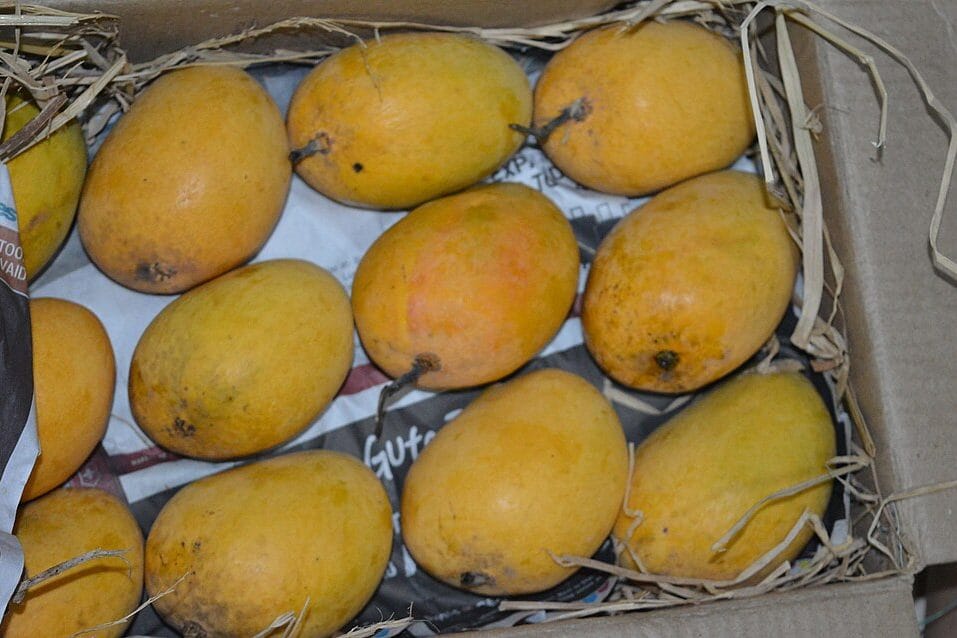
In a wholesale market in Mumbai's Vashi district this month, traders are moving crates of hard, green mangoes that nobody intends to eat as fruit — within the week, most of them will be shredded, salted and packed into pickle brine. Four thousand kilometres southeast, in Bangkok's Thong Lo neighbourhood, a queue forms outside Mae Varee most afternoons for a completely different mango: soft, golden-yellow, sliced and served warm over coconut sticky rice. Same species, same month, two entirely different jobs. Mid-July sits right at the point where these two mango worlds are most visible at once — India's savoury season is closing out as the monsoon arrives, while Southeast Asia's sweet season is still running strong.
One Fruit, Two Timelines
A mango doesn't become "a mango" the moment it's picked — it becomes one of two almost unrelated ingredients depending on when in its life it leaves the tree. Picked unripe, while the flesh is still hard, sour and starchy, it behaves like a vegetable: it holds its shape under a knife, releases very little juice, and carries an acidity sharp enough to cut through oil, chilli and salt. Left to ripen fully, the same fruit turns soft, fibrous in places, and sugar-heavy, with almost none of that acid left. Cooks in different parts of Asia settled on opposite answers to a simple question — which stage do you want on your plate? — and built entire regional food cultures around that choice.
India, broadly, chose the unripe end of that spectrum for savoury cooking and reserved full ripeness for dessert and drink. Southeast Asia leans the other way: ripe mango dominates, though — and this matters — it's not the whole story, because green mango shows up constantly across Thailand, Vietnam and the Philippines too, just in salads rather than jars. The split isn't a hard border. It's a strong regional lean with real exceptions on both sides, and the exceptions are often the most interesting dishes on the table.
India's Sour Half: Pickle, Chutney and the Kairi Season
Walk through a Maharashtrian or Gujarati kitchen in June and you'll find kairi — raw green mango — everywhere: grated into a sweet-sour chutney with jaggery and roasted cumin, simmered into aam panna (a smoky, tangy summer drink made with mint and black salt), or shredded raw into rice and dal to cut through the heat. Further south, Andhra Pradesh's avakaya is arguably the most serious use of the raw fruit in the country — chunks of unripe mango packed in mustard oil with red chilli powder and fenugreek, left to cure for weeks until the oil turns crimson. It's brutally sour and painfully spicy, and it's meant to be. A single spoonful next to plain rice and ghee is a complete meal in a lot of Andhra households, not a garnish.
This is also, not coincidentally, a race against the calendar. Alphonso and Kesar, the two varieties that dominate western Indian markets, come off the trees mainly between April and June from the Konkan coast, and by the time the southwest monsoon reaches Maharashtra — typically early-to-mid June, moving north through the following weeks — heavy rain starts splitting fruit on the branch and knocking quality down fast. Pickle-makers deliberately buy the last raw, unripe mangoes just before that window closes, because a mango that's caught even one good soaking starts turning starchy in a way that ruins the texture of a pickle. A box of decent Alphonso can run anywhere from ₹700 to ₹1,500 depending on grading and region, and by mid-July in Mumbai's retail markets, what's left on the stalls is mostly the tail end of the season — smaller, cheaper, and increasingly destined for pulp rather than eating whole.
Southeast Asia's Sweet Half: Sticky Rice, Shakes and Guimaras
Cross into Thailand and the same fruit's job description flips. Khao niaow mamuang — mango sticky rice — is built entirely around ripeness: coconut-sweetened glutinous rice served with thick slices of Nam Dok Mai mango, a variety specifically prized for having almost no fibre and a floral, honey-like sweetness once fully ripe. Underripe Nam Dok Mai is nearly unusable for the dish; the texture is wrong and the sugar hasn't developed. Vendors know this well enough that a shop's reputation often rests on how consistently it sources fruit at exactly the right stage, not a day earlier.
The Philippines takes the sweet-mango obsession even further. Guimaras island, off the coast of Iloilo, has built its entire tourism identity around growing what's widely considered the country's best mango — sweeter and less fibrous than fruit grown elsewhere in the archipelago, largely thanks to the island's dry limestone soil. Mango float, a no-bake icebox dessert layering ripe mango slices with cream and crushed graham crackers, only works with fruit at genuine peak ripeness; anything less and the dessert turns watery instead of rich. Go for ripe Carabao or Guimaras mango if you're making one at home — the common substitute of semi-ripe fruit from a supermarket bin is the single most common reason home versions turn out disappointing.
Where the Two Worlds Blur
The savoury-versus-sweet split breaks down as soon as you look at green mango salads. Thailand's som tam mamuang and Vietnam's gỏi xoài both use shredded unripe mango exactly the way Indian kitchens do — for its acid and crunch, not its sugar — tossed with fish sauce, chilli, dried shrimp or roasted peanuts depending on the region. The Philippines does something similar with green mango dipped straight into bagoong, a fermented shrimp paste, as a roadside snack rather than a cooked dish. So the real geography isn't "India eats it raw, Southeast Asia eats it ripe" — it's that India mostly stops at raw for savoury use, while several Southeast Asian countries move fluidly between both stages depending on the dish, sometimes on the same table at the same meal.
Buying Mango Right Now
If you're shopping for eating mango this month rather than pickling fruit, skip Totapuri and other fibrous, mostly-sour varieties sold cheap at the tail end of the Indian season — they're bred for pulp and juice production, not for eating out of hand, and they'll disappoint anyone expecting Alphonso-level sweetness. In Southeast Asia, buy Nam Dok Mai or Chok Anan a day or two before you plan to eat it and let it finish ripening at room temperature rather than in the fridge, which stalls the process and locks in a starchier texture. A few things to watch for when picking fruit at a stall:
- A ripe mango gives slightly under gentle thumb pressure near the stem — a rock-hard fruit is still days away
- Smell the stem end; a sweet, slightly resinous scent means it's close to ready, no scent at all usually means it was picked too early
- Colour is a weak signal on its own — some fully ripe Thai and Filipino varieties stay green-skinned, so don't rely on yellow alone
- Skip anything with soft, sunken patches or a fermented smell, which usually means the inside has started to turn before the outside caught up
Buy raw mango for pickling with the opposite checklist: hard as a green apple, no give at all, and skin that's still fully green with no yellow blush starting at the stem.
A Season That Runs Out Twice
Both mango traditions are hitting a wall this month — just from opposite directions.
India's window is closing because the monsoon is arriving and ruining what's left on the trees, while Southeast Asia's peak is winding down for the opposite reason: the region's main dry-season harvest is largely finished, and what follows through August and into autumn is a smaller, second flush that never quite matches the March-to-June fruit for sweetness. Buy what's good now, in whichever direction you're cooking. Neither season waits.