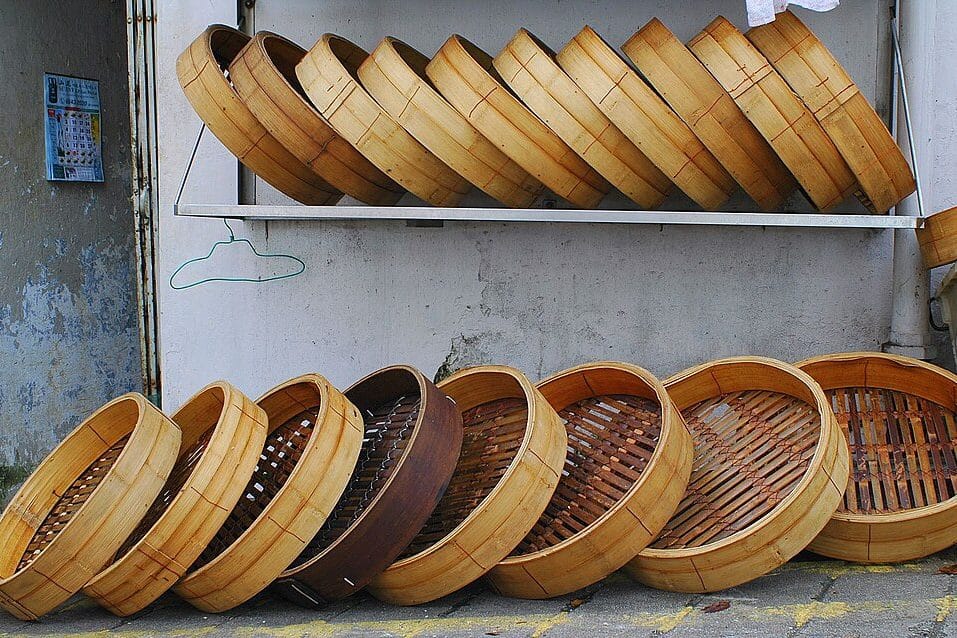
Walk down almost any market lane in Guangzhou, Ho Chi Minh City or Manila this July and you will hear the same sound before you see anything: a low, steady hiss coming from a stack of baskets. No open flame, no smoke, no spitting oil — just water working under a lid. Ask a vendor in Xiguan why she still cooks that way in the middle of the hottest, wettest month of the year, and she will look at you like the question answers itself. It does, once you stand next to a wok station for five minutes at 33°C and 88% humidity and compare it to standing next to her steamer stack instead.
Why fire loses in July
A commercial wok burner throws off enough radiant heat to push the air directly around it past 45°C, according to kitchen-ventilation studies cited by Hong Kong catering suppliers who sell industrial extraction hoods rated for exactly that load. A bamboo steamer stack, by contrast, keeps its heat contained inside the baskets themselves — the cook standing over it is dealing with rising vapor, not a wall of dry heat radiating outward. That difference matters enormously when the ambient temperature is already uncomfortable and the vendor has no air conditioning, which describes most of the stalls actually doing this cooking. It also explains a pattern that shows up across completely unrelated cuisines: whenever a country's hottest, most humid stretch of the year arrives, steamed food quietly takes over more of the menu, and grilling or deep-frying gets pushed toward evening, when the air finally cools.
There is a second, less obvious reason steaming wins in the wet season, and it has nothing to do with the cook's comfort. Frying and grilling both need dry conditions to work properly — batter goes soggy, charcoal struggles to catch, marinades slide off skewers before they can char. Monsoon humidity in Vietnam, southern China and the Philippines regularly sits above 80% through July and August, and that moisture in the air fights every technique that depends on a dry, hot surface. Steam has the opposite relationship with humidity: it simply does not care. A basket of dumplings cooks exactly the same whether the street outside is bone-dry or dripping, which is precisely why steamed food became the default in places where the rainy season lasts four months, not four days.
The bamboo circuit out of Guangdong
Cantonese dim sum built the template the rest of the region borrowed from. Bamboo steamers, still handmade in workshops around Guangzhou from strips of local moso bamboo, get stacked three or four high over a single pot of boiling water, so one burner cooks an entire table's order of har gow, siu mai and char siu bao at once. At Tim Ho Wan — the Hong Kong chain that held a Michelin star at prices most starred restaurants can't touch — a basket of three har gow still runs under HK$30, and that pricing only works because the kitchen isn't burning gas per dish the way a wok station does. Order the char siu bao before the pan-fried turnip cake, not after; the bao needs to hit the table while the dough is still faintly springy, and a kitchen running a full steamer rotation loses that window fast once orders back up.
Skip the places that serve dim sum out of metal tins lined with paper doilies. Bamboo absorbs a little moisture from the food and releases a faint, grassy smell back into it — plastic and metal don't do that, and the difference is obvious the moment you compare a har gow from each. Cheap tourist-facing dim sum houses swapped to metal years ago because bamboo baskets wear out and need replacing every few months; the good kitchens replace them anyway.
Leaf, not lid
Southeast Asia took the same principle — contained steam, no direct flame — and swapped the bamboo lid for something that grows locally in far greater volume: the banana leaf. Indonesian pepes and its Malay-Peninsula cousin otak-otak both wrap fish or minced protein with turmeric, lemongrass and chili paste inside a folded banana leaf, then either steam the parcel or set it briefly over coals just long enough to char the leaf's edges. The leaf does two jobs the wrapper itself can't: it seals in the aromatics that would otherwise cook off into the pot, and it works as a disposable, biodegradable container a street vendor can hand across a counter without owning a single plate. In a country where a fresh banana leaf costs close to nothing and a stack of ceramic dishes costs a great deal to wash and replace, that math decides the technique long before flavor does.
The Philippines runs its own steamed tradition in parallel, mostly with rice rather than leaf-wrapped protein. Puto — small, slightly sweet steamed rice cakes, often studded with a sliver of salted egg or cheese — sit in bamboo baskets at bakeries like Goldilocks for around ₱15 to ₱25 apiece, cheap enough that a dozen becomes an ordinary afternoon snack rather than a special-occasion purchase. Siopao, the Filipino answer to Cantonese bao, gets steamed to order at countless corner stalls in Manila, and the good vendors keep the water at a bare simmer rather than a rolling boil, because a hard boil shakes the baskets and can crack the bun's skin before it's fully cooked.
The custard logic in Japan and Korea
Move north and steaming shifts from wrapped parcels to something closer to a savory custard. Japanese chawanmushi — egg, dashi, a little mirin, poured into a small lidded cup with a piece of shrimp or ginkgo nut hidden at the bottom — cooks at a much gentler temperature than a bamboo basket ever runs, usually somewhere around 85–90°C rather than a full boil, because a hard boil turns the egg grainy instead of silken. At a mid-range izakaya you'll pay roughly ¥400–600 for one, a small enough price that it functions almost like a palate cleanser between grilled skewers. Order it early in the meal rather than late — the texture holds for maybe ten minutes before the surface starts to weep, and a chawanmushi that's sat too long is a genuinely worse dish than one eaten fresh.
Korea's gyeranjjim does the same egg-and-steam trick with a rougher hand, whisked with a little water or anchovy stock and steamed directly in an earthenware pot called a ttukbaegi until it puffs up like a soufflé that's about to collapse — which it does, within about a minute of leaving the heat, so it arrives at the table still rising. It shows up as banchan at Korean barbecue joints almost as a matter of course, usually with no separate charge, which says something about how cheap the technique is once you own the pot. And Korea's steamed rice cakes, siru-tteok, layered with sweetened red bean between rounds of pounded rice and cooked in a perforated earthenware steamer called a siru, trace back to ancestral rite offerings — a use case that had nothing to do with beating the heat and everything to do with tradition, which is a reminder that not every steamed dish on this list exists purely for climate logic.
Idli and the fermentation clock
South India's idli complicates the "steaming beats frying in heat" argument in an interesting way, because the batter itself — ground rice and urad dal, left to ferment overnight — actually ferments faster in hot, humid weather, not despite it. A batter that takes ten or twelve hours to rise properly in a cool Delhi winter can be ready in six or seven during a humid Chennai July, and that faster fermentation is one reason idli stalls in South India run at a pace northern vendors can't match. A plate of two or three idli with sambar and coconut chutney costs somewhere around ₹30–50 at a typical Chennai udupi restaurant, and the whole dish — batter, steamer, banana-leaf lining in the more traditional stalls — is built around humidity working for the cook instead of against her.
That's the exception worth sitting with for a second: steaming isn't universally the rainy-season answer everywhere on this list. Deep-fried snacks — pakora in North India, banana fritters in Indonesia, tempura in Japan — see a genuine sales spike during monsoon downpours too, because there's a separate craving logic at work where hot oil and rain-cooled air feel good together in a way that has nothing to do with kitchen temperature. Steaming wins the daytime, street-level, high-volume cooking; frying still owns the rainy evening.
What the vendor's ledger actually says
Strip away the flavor arguments and the pattern across every one of these dishes comes down to the same three numbers a street vendor actually cares about: fuel cost per serving, container cost per serving, and how many orders one burner can cook at once. A stacked bamboo or metal steamer turns a single flame into six, eight, sometimes twelve simultaneous orders, which no wok or grill can match. A banana leaf or a disposable earthenware pot removes the dishwashing labor and the ceramic-breakage cost that a plate-based menu carries. And because steamed food doesn't need a dry cooking surface, none of that math falls apart the one week a year when the sky won't stop opening up.
None of this is nostalgia dressed up as economics. Walk past a Bangkok noodle cart on a July afternoon when the rain has just started and the vendor selling steamed kanom is doing a brisker trade than the one running a wok three stalls down, simply because her setup never had to pause. The lid comes off, the vapor clears, and the next order goes straight in — no oil to reheat, no flame to relight, no smoke to clear before the next customer can even see the menu.