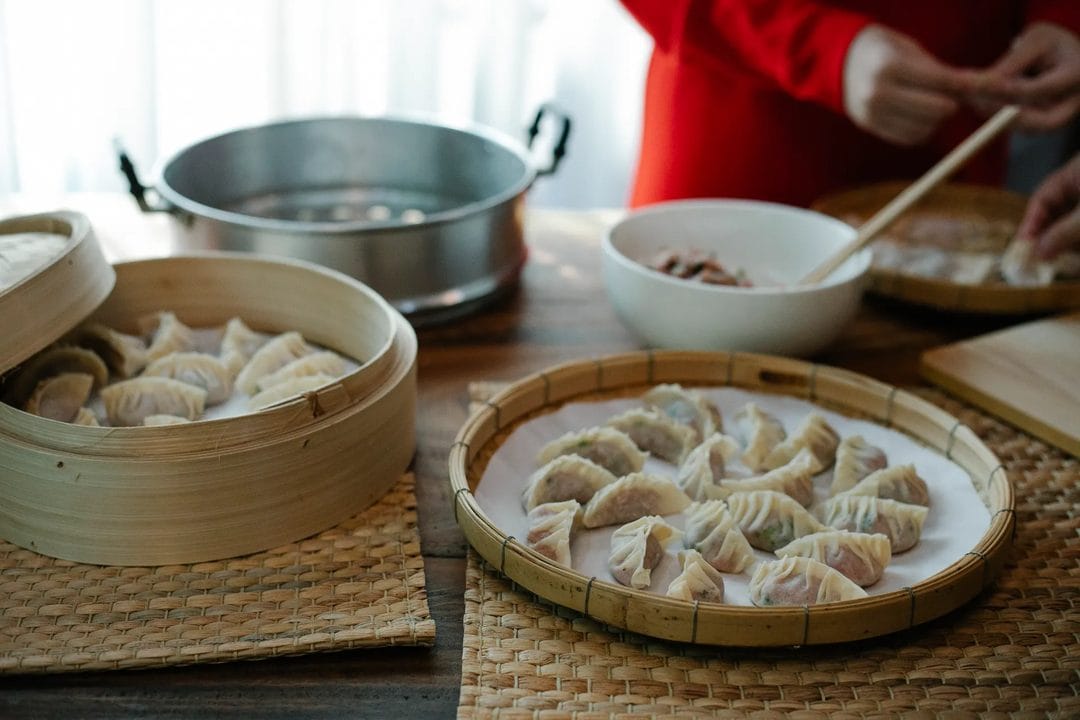
Fold dough around a filling, seal the edge, cook it in water, steam or oil, and you've technically made a dumpling anywhere on earth. But watch what happens once that basic move crosses a border in Asia — the filling changes, the wrapper thickness changes, the cooking method changes, and within a few hundred kilometres you're eating something that shares almost nothing with its neighbour except the fold itself. Shanghai does it with a spoonful of hot broth trapped inside the skin. Seoul does it with a griddle and a slick of sesame oil. Hanoi does it with translucent tapioca starch instead of wheat. The fold is the only constant in a dish that otherwise refuses to sit still.
China's Two Dumpling Economies
Northern China built its dumpling culture around jiaozi, and the fact that a plate of them shows up on the table at Lunar New Year isn't decoration — the pleated shape is meant to resemble old silver ingots, and eating them is supposed to carry the year's fortune into the next one. A home cook in Beijing will pinch the wrapper into a dozen small pleats along one edge, leaving the other side smooth, and the filling is almost always pork and Chinese chive, sometimes cut with napa cabbage for moisture. Boiled jiaozi cost next to nothing to make at home — a kilo of flour and a few hundred grams of pork feeds a family for under $3 — which is part of why the dish never became a restaurant showcase the way its southern cousin did.
Shanghai took the same basic wrapper-and-filling logic and built something structurally different: xiaolongbao, the soup dumpling, where a spoonful of pork-and-aspic jelly gets sealed inside raw dough and then steamed until the jelly melts into broth. You eat these with a spoon underneath the dumpling, not a bare hand and definitely not a quick bite — puncture the wrapper wrong and the broth ends up on the table instead of in your mouth. Din Tai Fung built an entire global chain on getting this one fold exactly right, and the standard the restaurant set — eighteen pleats per dumpling, a wrapper thin enough to see the filling through — is still the benchmark cooks in Shanghai measure themselves against, whether they admit it or not.
Japan Took the Fold and Added a Skillet
Gyoza arrived in Japan by way of Chinese immigrants and returning soldiers after the Second World War, and the dish that resulted is thinner-skinned, garlic-heavier, and finished in a way jiaozi almost never is: pan-fried on one side until the bottom forms a lace-thin crust, then steamed the rest of the way with a splash of water under a lid. That crust is the entire point. Order gyoza at a ramen counter in Osaka and the plate arrives fused together at the base — a single golden sheet connecting six or eight dumplings — and pulling one free without tearing the crust is a small skill in itself.
Skip the fry step and you've made something closer to Chinese jiaozi with a Japanese filling. Get the crust right and you've made gyoza.
The filling leans on cabbage rather than napa, and the garlic-and-ginger ratio runs noticeably higher than in Chinese versions, which is why a plate of gyoza smells different from across the room before you've even sat down. Gyoza restaurants in Utsunomiya — the city that markets itself as Japan's unofficial gyoza capital, with a bronze gyoza statue outside the train station to prove it — sell them by the plate of six for around ¥250-300, cheap enough that ordering three plates and calling it dinner is completely normal.
Korea's Mandu Did Something Nobody Else Tried
Mandu shows up in more forms than almost any other dumpling in the region, and Korean cooks never really settled on one correct way to finish them. Mandu-guk floats them whole in a beef or anchovy broth, usually around the Lunar New Year alongside tteokguk. Mandu-jeon presses the same dumplings flat and pan-fries them until both sides crisp, closer to a dumpling-pancake hybrid than anything China or Japan produces. And gun-mandu — the pan-fried version sold at street stalls — gets finished with a splash of water partway through frying, the same steam-then-crisp logic gyoza uses, but the wrapper is thicker and the filling runs heavier on tofu and glass noodles than the pork-forward Chinese and Japanese versions.
Buy a bag of frozen mandu at a Korean supermarket and you'll usually find kimchi mandu next to the standard pork-and-vegetable kind, which doesn't really have an equivalent anywhere else on this list — the fermented cabbage brings enough acidity and funk that the dumpling barely needs a dipping sauce. Bibigo, the CJ CheilJedang brand that now sells frozen mandu in supermarkets from Los Angeles to London, built its entire international expansion on convincing non-Korean shoppers that mandu deserved shelf space next to the far more familiar gyoza — and going by the sales figures the company has reported since 2020, that bet paid off.
The Southeast Asian Detour
South of China, the dumpling idea keeps traveling but the wrapper stops being wheat. Vietnam's banh bot loc swaps the dough for tapioca starch, which turns translucent and slightly chewy once steamed — you can see the shrimp and pork filling right through the wrapper before you've even picked one up. Banh bot loc tran, the unwrapped version served loose rather than folded in a banana leaf, is a Hue specialty that street vendors in Ho Chi Minh City have adopted and sell for roughly 20,000-30,000 VND a plate.
Indonesia went a different direction entirely with pangsit, a wonton-style dumpling almost certainly brought over by Hokkien and Teochew traders centuries ago, now fried crisp and served over bakmi noodle soup or as a standalone snack with sambal on the side. The Philippines took a related path with siomai, which sits closer to Cantonese shumai in shape but gets a squeeze of calamansi and a shake of soy sauce that no Cantonese cook would recognize as traditional — and honestly, that's the better way to eat it. Street-cart siomai in Manila, sold for as little as ₱15-20 a piece, has drifted so far from its Cantonese ancestor that calling it a variation almost undersells how much the dish has become its own thing.
None of this is a tidy family tree. A Cantonese purist would argue that pangsit and siomai barely count as dumplings anymore, closer to fried snacks that happen to share a folding technique. They'd have a point — and it wouldn't change how good a plate of crisp pangsit tastes with a spoonful of sambal on the side.
What Actually Separates a Good One From a Great One
Skip pleating altogether and just pinch the edges shut — plenty of home cooks do exactly that, and the dumpling still works. What you can't skip is filling temperature: warm filling against cold dough tears the wrapper from the inside during cooking, which is the single most common mistake in home dumpling-making across every version on this list, from jiaozi to mandu. Chill the filling, keep the dough at room temperature, and the fold holds regardless of which country's technique you're following.
Buy pre-made wrappers if you're not folding for a crowd — CJ, Wei-Chuan and Twin Marquis all sell perfectly serviceable round wrappers in the refrigerated section of most Asian grocery stores, and there's no shame in it. Making your own dough only pays off once you're folding in batches of fifty or more, which is exactly what happens at the family gatherings where this dish actually gets made in bulk, three generations standing around a table pleating jiaozi while the water comes to a boil in the next room.