The Flavor You Can't Bottle
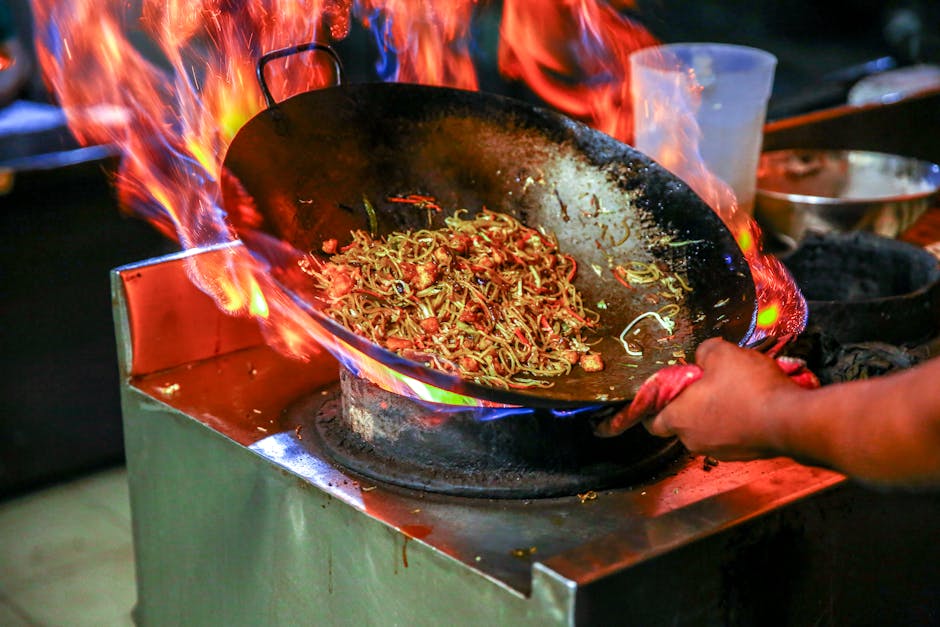
Stand outside any dai pai dong in Hong Kong — those open-air street kitchens that cling to survival in Sham Shui Po and Central — and watch the cook work a carbon steel wok over a jet-engine burner. The flame wraps around the wok's bowl like a liquid, the oil hits the surface and vaporizes in a fraction of a second, and when the ingredients land in that inferno, something happens that no amount of seasoning or technique can replicate at low temperatures. The food ignites briefly, a fireball erupts above the rim, and in that moment of controlled chaos, the dish acquires a flavor that the Cantonese call wok hei — literally "the breath of the wok." It tastes like smoke, but not the smoke of a barbecue or a campfire. It's more ephemeral than that, almost floral, with a seared sweetness that vanishes within minutes of the food leaving the wok.
Wok hei is the single characteristic that separates transcendent Chinese stir-fry from merely good Chinese stir-fry. It's the reason your home version of beef chow fun never tastes quite like the one from the restaurant down the street, despite using identical ingredients and following the recipe precisely. The difference isn't in what goes into the wok — it's in what happens to it once it's there. And what happens requires heat that most residential kitchens simply cannot produce.
The Science of Extreme Heat
A professional Chinese restaurant wok station generates between 100,000 and 150,000 BTUs of heat. For comparison, a high-end home gas burner produces around 18,000 BTUs. This isn't a minor gap. It's the difference between a candle and a blowtorch, and it explains why Chinese cooking has never been fully domesticated in the way that, say, Italian or French cooking has. The extreme heat serves several purposes simultaneously. First, it triggers the Maillard reaction — the chemical process that browns proteins and creates hundreds of new flavor compounds — almost instantaneously. In a restaurant wok, the Maillard reaction happens in seconds rather than minutes, producing a sear that's deep and complex without overcooking the interior of the food.
Second, and more importantly for wok hei, the extreme heat vaporizes the oil and juices that splash against the wok's sides and rim, creating aromatic compounds that are immediately captured by the tossing motion. When a skilled wok cook flips ingredients into the air, the vaporized oils pass through the flame above the wok and undergo pyrolysis — breaking down into new volatile compounds that coat the food as it falls back into the bowl. This is the actual mechanism of wok hei: the food is literally being seasoned by its own combustion products, catalyzed by the flame and the wok's curved shape. The entire process takes perhaps four to five seconds per toss, and a single stir-fry might involve thirty to fifty tosses over a two-minute cooking time.
Why the Wok Itself Matters
You cannot achieve wok hei in a stainless steel pan, a non-stick skillet, or a cast iron Dutch oven. The vessel must be a thin carbon steel wok, and ideally one that has been seasoned through years of use until its surface is black, smooth, and essentially non-stick from accumulated layers of polymerized oil. This seasoning layer — called the patina — does more than prevent sticking. It contributes flavor. A well-seasoned wok carries the ghost of every dish ever cooked in it, a cumulative umami deposit that professional Chinese cooks guard jealously. Washing a wok with soap is considered somewhere between a faux pas and a crime in traditional Chinese kitchens. You scrub it with hot water and a bamboo brush, dry it over the flame, and rub it with a thin layer of oil. That's it.
The shape matters too. A round-bottomed wok concentrates heat at the very center while the sloped sides create temperature zones. A cook pushes already-seared ingredients up the cooler sides while new ingredients hit the blazing center, maintaining constant contact between raw food and maximum heat without letting the cooked food burn. This spatial management — knowing where to place ingredients on the wok's surface at any given moment — is a physical skill that takes years to develop, which is why wok cooks in Hong Kong and Guangzhou are among the most respected and best-paid kitchen workers in Asia.
The Dishes That Demand It
Not every Chinese dish needs wok hei. Braised dishes, soups, and steamed preparations have nothing to do with it. But certain stir-fries are defined by it to such a degree that without wok hei, they're barely recognizable. Beef ho fun — wide rice noodles tossed with sliced beef, bean sprouts, scallions, and dark soy sauce — is the classic test. The noodles should have charred edges but a soft, silky center. The bean sprouts should be barely cooked, still crunchy, with a smoky kiss on their surface. The beef should be seared dark on the outside and pink within. If any of these elements is wrong, the dish fails. At Kwan Kee Bamboo Noodle Shop in Sham Shui Po, Hong Kong, the beef ho fun arrives with visible char marks on the noodles and a smoky aroma that hits you before the plate does. The entire cooking time for the dish is about 90 seconds.
Cantonese-style fried rice is another wok hei showcase. Each grain of rice should be individually coated in a thin layer of egg and oil, with a slight crunch on the exterior and a soft interior. The rice should smell smoky and slightly caramelized, not oily or steamy. When you eat a properly wok-hei'd fried rice, the first sensation isn't flavor — it's aroma. That charred, almost nutty smell is wok hei working through your olfactory system, priming your palate for what's coming. At Yat Lok in Central, Hong Kong (famous for its roast goose), the house fried rice is an afterthought on the menu but demonstrates wok hei as clearly as any beef ho fun.
Getting Closer at Home
I won't pretend you can replicate restaurant wok hei on a home stove. You can't. But you can get significantly closer than most home cooks achieve, and the techniques involved will improve every stir-fry you make even without the smoke and flame. First, get a 14-inch flat-bottomed carbon steel wok. Round-bottomed woks don't work on flat Western stovetops because they don't make sufficient contact with the burner. Season it according to the instructions that come with it — usually heating it until the metal changes color, then rubbing with oil and repeating several times.
The single most important rule of home wok cooking: Never put more than 200 grams of food in the wok at once. Overcrowding drops the temperature instantly and you end up steaming instead of searing.
Second, preheat the wok until it's screaming hot — you should see the first wisps of smoke rising from the surface before any oil goes in. Add a high-smoke-point oil (peanut, avocado, or refined coconut) and immediately swirl it up the sides. The oil should shimmer and ripple within two seconds. If it doesn't, you're not hot enough. Third, cook in very small batches. A home burner cannot recover heat fast enough to handle the thermal mass of a full restaurant portion. Fourth, and this is the trick most people miss: tilt the wok toward the flame so that the oil on the far side catches fire briefly. That momentary ignition is the closest you'll get to wok hei at home. It works on gas stoves only — electric and induction users are unfortunately out of luck for this particular technique.
The Clock Is Always Running
Wok hei is not just a flavor — it's a temporal phenomenon. The smoky, charred notes that define a great stir-fry begin dissipating the moment the food leaves the wok. By some estimates, a wok hei stir-fry loses 50% of its aromatic impact within five minutes of plating. This is why the best Chinese restaurants serve stir-fries immediately, often with the waiter speed-walking from the kitchen, and why takeout stir-fries never taste as good as dine-in versions even from the same kitchen. It's also why the dai pai dong experience — eating two meters from the wok, with the dish arriving within seconds of being cooked — remains the gold standard for wok hei appreciation. The flavor is inseparable from the moment.
At Tung Po in North Point, Hong Kong, the chef cooks directly in front of diners in what can only be described as a performance. The wok burner roars like a jet engine, flames leap above head height, and dishes arrive at the table so freshly cooked that the plates are almost too hot to touch. The wind-sand chicken — deep-fried chicken chunks tossed in a dry wok with salt, garlic, and chilies — carries a wok hei so intense you can smell it from two tables away. You have perhaps three minutes to eat it at its peak. After that, it's still good fried chicken. But the breath of the wok has moved on.