The Market That Refused to Disappear
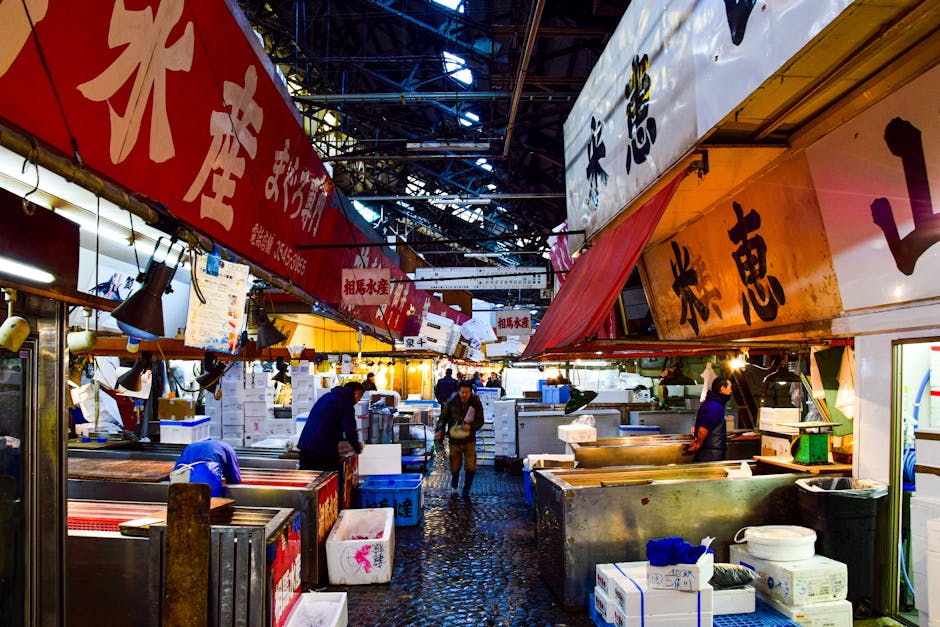
When Tokyo's iconic Tsukiji fish market relocated its wholesale operations to the gleaming, climate-controlled Toyosu Market in October 2018, food writers around the world published eulogies. "The end of an era," they said. "Tokyo loses its culinary soul." The obituaries were premature. The wholesale market — the cavernous inner section where tuna auctions happened at 5 a.m. and forklifts competed for space with bewildered tourists — did indeed move to Toyosu. But the outer market, the dense maze of over 400 small shops, restaurants, and food stalls that surrounded the wholesale area, stayed exactly where it was. And without the 5 a.m. chaos, the industrial traffic, and the constant tension between commercial fish buyers and selfie-taking visitors, the outer market has quietly become a better food destination than it was during Tsukiji's heyday.
The outer market occupies several blocks adjacent to Tsukiji Honganji temple, a short walk from Tsukiji Station on the Hibiya Line. It's a dense grid of narrow lanes lined with small shops selling fresh seafood, kitchen tools, dried goods, pickles, tea, and prepared food. Some shops have been here since the 1930s. Others opened in the post-2018 period, taking advantage of spaces freed up by businesses that did follow the wholesale market to Toyosu. The result is a mix of deep tradition and calculated reinvention, and the food — from a ¥300 ($2) grilled scallop on a stick to a ¥5,000 ($34) omakase sushi breakfast — is uniformly excellent.
Sushi for Breakfast: Earning the Line
The sushi restaurants along the outer market's edges operate on a different rhythm than restaurants in Ginza or Shinjuku. They open early — 6 or 7 a.m. — serve through lunch, and close by 2 p.m. The philosophy is simple: the fish arrived from Toyosu this morning, and it will be on your plate within hours of leaving the auction floor. At Sushi Dai and Daiwa Sushi, the two most famous names, this freshness philosophy comes with a price tag of patience — waits of 2 to 3 hours are standard, and during peak tourist season, people start lining up at 4 a.m. for restaurants that don't open until 7. My honest recommendation: skip both. They're excellent but not three-hours-of-your-life excellent.
Instead, walk two lanes deeper into the market and find Tsukiji Sushi Sei, a small counter restaurant that serves an omakase (chef's choice) breakfast of 10 pieces of nigiri plus a maki roll and miso soup for ¥4,200 ($29). The wait rarely exceeds 30 minutes, the fish is sourced from the same Toyosu suppliers, and the rice — seasoned with a red vinegar that gives it a faint blush and a sharper acidity than white vinegar versions — is cooked in small batches throughout service. The chu-toro (medium fatty tuna) melts into the rice on contact, and the uni (sea urchin) from Hokkaido is sweet, creamy, and tastes like the ocean distilled into a single golden spoonful. Sushi for breakfast sounds indulgent until you realize that this is how Tsukiji workers have started their mornings for decades — a quick omakase before the day's real work begins.
The Grazing Lane: Eating Standing Up
The outer market's central lanes are designed for tachigui — eating while standing — and the best way to experience them is to treat the entire market as a single meal, buying one or two items from each stall and assembling a breakfast or lunch from twenty different sources. The Japanese phrase is tabearuki (walk-eating), and while it's technically frowned upon in most Japanese contexts (eating while walking is considered rude), Tsukiji outer market is the rare sanctioned zone where everyone does it. Here's a route that works.
Start at Yamachou, a tamago-yaki (Japanese omelet) specialist on the main lane. Their dashimaki tamago — a rolled omelet made with dashi stock, cooked layer by layer on a rectangular pan — is served on a stick, still warm, slightly sweet, and impossibly fluffy. It costs ¥200 ($1.40) and functions as a gentle breakfast opener. Move to Saito Suisan for a grilled scallop: a single large Hokkaido hotate, still in its shell, grilled over charcoal and brushed with soy butter. The scallop is sweet, caramelized on the edges, and the butter-soy glaze pools in the shell like a sauce you'll want to drink. Three hundred yen ($2). Then find the croquette shop — Tsukiji Kondo — and get the uni croquette: a panko-crusted shell stuffed with creamy bechamel and chunks of sea urchin. It's golden, crunchy, molten in the center, and costs ¥500 ($3.40). Eating it over a piece of wax paper while leaning against a wall is one of Tokyo's great small pleasures.
The Knife Shops: Where Chefs Go Quiet
Tsukiji's outer market is one of Tokyo's premier destinations for Japanese kitchen knives, and the shops here cater primarily to professional chefs rather than tourists. Aritsugu, operating since 1560, sells hand-forged knives that start at ¥15,000 ($103) for a petty knife and climb to ¥200,000+ ($1,380+) for premium yanagiba (sashimi knives) made from white steel by named smiths. The staff will ask what you cook, how you hold a knife, and whether you're right- or left-handed before recommending anything, and they'll engrave your name on the blade in kanji if you buy. Masamoto, another venerable shop nearby, specializes in the thin, single-bevel blades that sushi chefs use — knives so sharp they can split a piece of tuna along the grain without crushing a single cell.
Watching a chef buy a knife at Tsukiji is like watching a violinist choose a bow. They pick it up, feel the balance point, run a thumb along the spine, test the flex. They might hold it for five minutes without saying a word. The shopkeeper watches but doesn't push. This is a transaction built on knowledge and trust, not salesmanship, and the knives themselves — ground on whetstones, tempered in water, sharpened to a molecular edge — represent a craft tradition that predates the market by centuries. You don't need a ¥50,000 knife to cook well. But holding one in your hand, feeling the weight and precision that 400 years of metallurgical knowledge produced, changes how you think about cutting food.
Dried Goods, Pickles, and the Hidden Pantry
The sections of the outer market that tourists tend to skip — the dried goods shops, the pickle vendors, the tea merchants — are where Tsukiji reveals its true function as a working pantry for Tokyo's restaurant industry. Shops like Akiyama sell katsuobushi (dried bonito flakes) in whole blocks that look like pieces of dark wood and feel nearly as hard. The shopkeeper shaves flakes from the block with a specialized plane, and the fresh shavings — translucent, waving gently in the air from their own residual heat — taste completely different from the pre-shaved packets sold in supermarkets. The flavor is smoky, deeply savory, and faintly sweet, and watching the shavings flutter onto dashi-simmering demonstrations in the back of the shop is a reminder that Japanese cooking's obsession with freshness extends to its dried ingredients.
The pickle shops (tsukemono-ya) offer an education in Japanese fermentation that goes far beyond the ubiquitous gari (pickled ginger) you know from sushi restaurants. Bettarazuke — sweet, milky, rice-bran-fermented daikon — has a texture like firm butter and a flavor that walks the line between sweet and funky. Narazuke — vegetables preserved in sake lees for months or years — develops a deep, boozy, amber-colored complexity that's as close to cheese as anything in Japanese cuisine. Shibazuke — eggplant and cucumber pickled with red shiso leaves — is tart, crunchy, and electric purple. These pickles cost between ¥300 and ¥800 ($2-5.50) per package and are the kind of Japanese food souvenir that actually survives the trip home, unlike the sushi.
What Toyosu Took and What It Left
The honest assessment is that Tsukiji lost something when the wholesale market moved. The predawn energy, the spectacle of enormous frozen tuna being auctioned under fluorescent lights, the sight of specialized turret trucks zipping through narrow aisles at terrifying speed — that industrial theater is now at Toyosu, and while Toyosu has a visitor gallery, it lacks the raw, unfiltered chaos that made Tsukiji feel like you were witnessing the nervous system of a great city's food supply. What Tsukiji kept is arguably better suited to what most visitors actually want: excellent food at fair prices, eaten slowly in a walkable neighborhood that doesn't require a 4 a.m. alarm clock.
The outer market's survival also preserved something important about Tokyo's urban fabric. In a city that demolishes and rebuilds constantly, the narrow lanes of Tsukiji — with their weathered signage, their cramped shops, their elderly vendors who remember the market before the war — represent a continuity that's increasingly rare. The grilled scallop you eat at Saito Suisan tastes better because of the context: the temple bell from Tsukiji Honganji audible over the crowd noise, the steam rising from a dozen different kitchens, the click of chopsticks and the murmur of satisfied eating in three or four languages. That context isn't transferable to a modern facility with efficient ventilation and designated tourist walkways. Some markets need their imperfections.