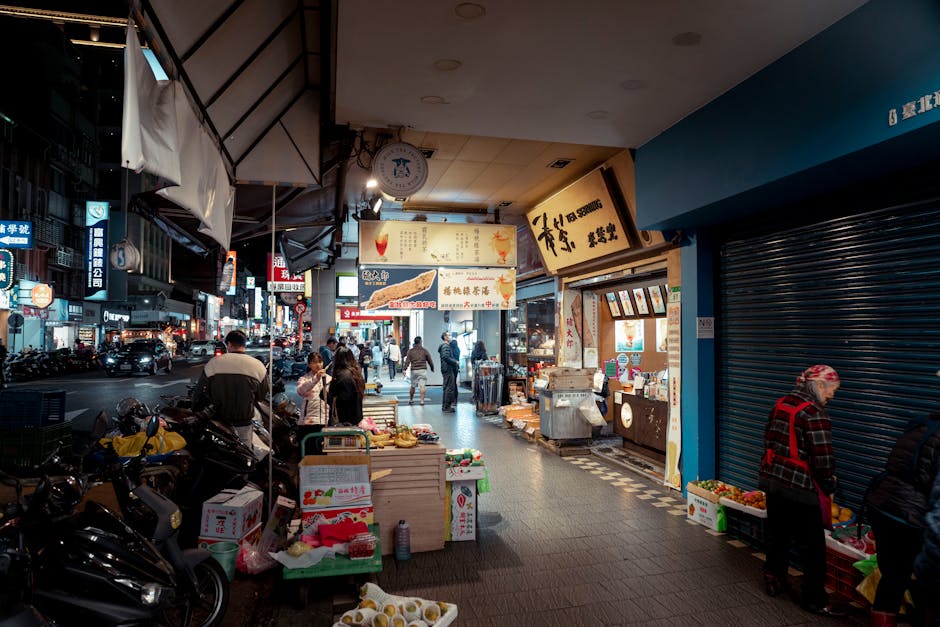
The Organized Chaos of Taiwanese Night Eating
The first time you walk into Shilin Night Market at peak hour — say, 9 p.m. on a Saturday — the experience is less "food market" and more "being swept into a river of people who all happen to be eating." The crowd pushes you forward in a slow current past hundreds of illuminated stalls, each one pumping out a different aroma: the caramelized sweetness of grilled corn, the eye-watering funk of stinky tofu, the medicinal herbal notes of slow-cooked pork ribs in Chinese herbs, the butter-and-sugar cloud around a wheel cake station. Neon signs in Chinese characters stack vertically up the buildings. Smoke rises from charcoal grills and mixing with steam from dumpling pots. Your brain short-circuits from sensory input. This is normal. This is Taipei.
Taiwan has over 300 registered night markets, but the Taipei metro area concentrates the best of them within a city that's easy to navigate by MRT (subway). The four essential markets — Shilin, Raohe, Ningxia, and Tonghua — each have distinct personalities. Shilin is the largest and most tourist-oriented but still harbors excellent food if you know where to look. Raohe is the most photogenic, a single straight lane with a temple at one end and a concentrated row of stalls along a 600-meter stretch. Ningxia is the locals' market, small and serious about food rather than games or shopping. Tonghua (also called Linjiang) is the university-district market, younger and more experimental. You could spend a week eating your way through just these four and barely repeat a dish.
Shilin: The Colossus
Shilin Night Market sprawls across several city blocks and includes both outdoor stalls and an underground food court. The underground section is where most tourists end up, directed there by hotel concierges and guidebooks, and while it's serviceable, the best food is above ground in the winding alleyways behind the main market building. The stall you want is Hai You Pork Ribs Medicinal Soup, a perpetually crowded spot that serves a single dish: pork ribs simmered for hours in a broth of dang gui (angelica root), goji berries, jujube dates, and a proprietary blend of Chinese herbs. The ribs are fork-tender and the broth is dark, fragrant, and genuinely restorative — sweet from the jujube with a bitter herbal undertone that lingers. Sixty NT ($2).
The other Shilin essential is da bing bao xiao bing — literally "big pancake wraps small pancake." A thin, crispy scallion pancake is wrapped around a smaller, thicker, chewy pancake that's been stuffed with your choice of fillings (go for the basil chicken). The textural contrast between the shatteringly crisp outer layer and the soft, doughy interior is addictive, and at 55 NT ($1.75) it's essentially a meal. Skip the large fried chicken cutlets that every second stall seems to sell — they're impressive visually (literally the size of your face) but tend to be over-breaded and under-seasoned. The real chicken to eat at Shilin is pepper chicken, cut into bite-sized pieces and fried with a crust of white pepper, basil leaves, and garlic that shatters between your teeth.
Raohe: One Lane, Zero Wrong Turns
Raohe Street Night Market is a single lane running between Songshan Ciyou Temple and Raohe Street proper, and its linear layout means you can walk the entire market in 15 minutes (or two hours if you stop to eat, which you will). The undisputed star is the black pepper bun vendor at the temple entrance — there's always a line of 20 to 30 people, and it moves fast because the operation is hypnotically efficient. Pork buns filled with black pepper, scallions, and sesame are slapped against the inside wall of a clay tandoor-style oven, where they bake until the bottom is charred and crusty while the top stays soft and pillowy. The pork filling is juicy, aggressively peppered, and the first bite releases a puff of steam that fogs your glasses. Fifty-five NT. This is the single best street food item in Taipei. That's not an opinion — it's a fact that happens to be subjective.
Further into Raohe, the stinky tofu stalls demand attention whether you want them to or not, because the smell is impossible to ignore. Fried stinky tofu — cubes of fermented tofu deep-fried until the exterior is golden and crunchy while the interior remains creamy — is served with pickled cabbage and chili sauce. The smell is far worse than the taste, which is actually mild, slightly tangy, with a texture somewhere between a crusted brie and a fried mozzarella stick. If you can get past the odor (and honestly, after a few bites, your nose adjusts), it's deeply satisfying. The Raohe version uses a lighter fermentation than some other markets, making it a better entry point for stinky tofu beginners.
Ningxia: The Purist's Market
Ningxia Night Market is two blocks long, has no games or clothing stalls, and attracts an almost entirely local crowd. The focus is exclusively on food, and the quality ceiling here is higher than at any other Taipei market. Tuan Yuan, a stall specializing in taro balls in sweet soup, draws people from across the city for dessert — the taro balls are handmade daily, chewy and dense with an intense taro flavor, served in a warm ginger syrup with sweet potato balls and red beans. But Ningxia's claim to fame is its oyster omelets and braised pork rice.
The oyster omelet (oh-ah-jian) is Taiwan's national street dish, and at Ningxia the best version comes from Lai Ji. Small, plump oysters — harvested from the brackish waters of Taiwan's southwest coast — are mixed into a batter of sweet potato starch, egg, and chrysanthemum greens, then cooked on a flat griddle until the starch forms a translucent, slightly gooey layer around the crisp egg exterior. The whole thing is doused in a sweet-and-sour chili sauce that cuts through the richness. The texture is unlike anything in Western cooking: simultaneously crispy, chewy, creamy, and slippery. It should be confusing but it's magnificent, and at 70 NT ($2.20) it's the dish I eat every single time I'm in Taipei.
The Lu Rou Fan Debate
Lu rou fan — braised pork belly over rice — is Taiwan's comfort food equivalent of mac and cheese, and Ningxia has three stalls that each claim to make the best version. The pork is cut into small cubes (not ground, never ground — that's a different dish), slow-braised in soy sauce, five-spice, rice wine, and fried shallots until the fat renders completely and the meat collapses into tender shreds suspended in a thick, glossy sauce. This sauce, poured over steamed rice, is the entire dish. Some stalls add a half-braised egg or pickled mustard greens on the side. The rice matters enormously — it must be short-grain, slightly sticky, and freshly steamed so it absorbs the sauce without turning to mush. At Fang Jia Shredded Chicken on the edge of the market, the lu rou fan uses a higher proportion of lean meat to fat than most, producing a less unctuous but more deeply flavored version. Thirty-five NT. Less than a dollar.
Tonghua: The Late-Night Graduate
Tonghua Night Market, officially called Linjiang Street Night Market, sits near several universities and has a younger, more adventurous energy than Ningxia's focused traditionalism. This is where you find the experiments: Japanese-Taiwanese fusion takoyaki with kimchi, matcha-flavored wheel cakes, cheese-stuffed scallion pancakes. Some of it works brilliantly, some of it is a gimmick, and part of the fun is sorting one from the other. The consistent standout is the grilled corn vendor at the market's south entrance, who brushes ears of white corn with a thick sauce made from soy paste, sugar, and a whisper of wasabi, then chars them over coals until the kernels blister and caramelize. The sweetness of Taiwanese white corn is startlingly intense — more like a dessert than a vegetable — and the soy-wasabi glaze adds savory heat that makes you eat the entire ear before you've walked ten meters.
Tonghua also has the best scallion pancakes (cong zhua bing) in Taipei, from a stall with no name and no sign, identifiable only by the perpetual line and the large flat griddle visible from the street. The pancake is rolled thin, studded with scallions, and fried in a shallow pool of oil until it forms concentric layers of crunch — flaky, laminated, almost like a savory croissant pressed flat. An egg is cracked on top during the final minute, and the whole thing is folded, slashed with chili sauce, and handed to you in a paper bag. You eat it standing, burning your fingers, watching the cook already making the next one.
Strategy and Stamina
The fatal mistake at Taipei night markets is eating too much too soon. You walk in, overwhelmed by options, buy three things in the first five minutes, eat them all, and spend the rest of the evening too full to try the stall that would have changed your life. Instead: walk the entire market once without buying anything. Look at what locals are eating. Identify four or five must-try items. Then walk it again, eating in order from light to heavy. Start with something brothy (medicinal soup, fish ball soup), move to a small fried item (pepper chicken, fried taro ball), then the substantial dishes (oyster omelet, black pepper bun), and save dessert (taro balls, shaved ice) for last. Bring a water bottle. The salt and chili content of night market food is calibrated for Taiwanese palates, which tend to have a higher spice tolerance than most visitors expect.
The markets run from roughly 5 p.m. to midnight, with peak crowds between 8 and 10 p.m. If you're crowd-averse, arrive at opening when the stalls are hot but the lanes are navigable. If you want the full experience — the noise, the crush, the sense of being part of a city that treats eating as a communal spectator sport — go at 9 on a weekend and let the current carry you. Your stomach will remember it longer than your camera roll.