Where Michelin Stars Cost Less Than a Latte
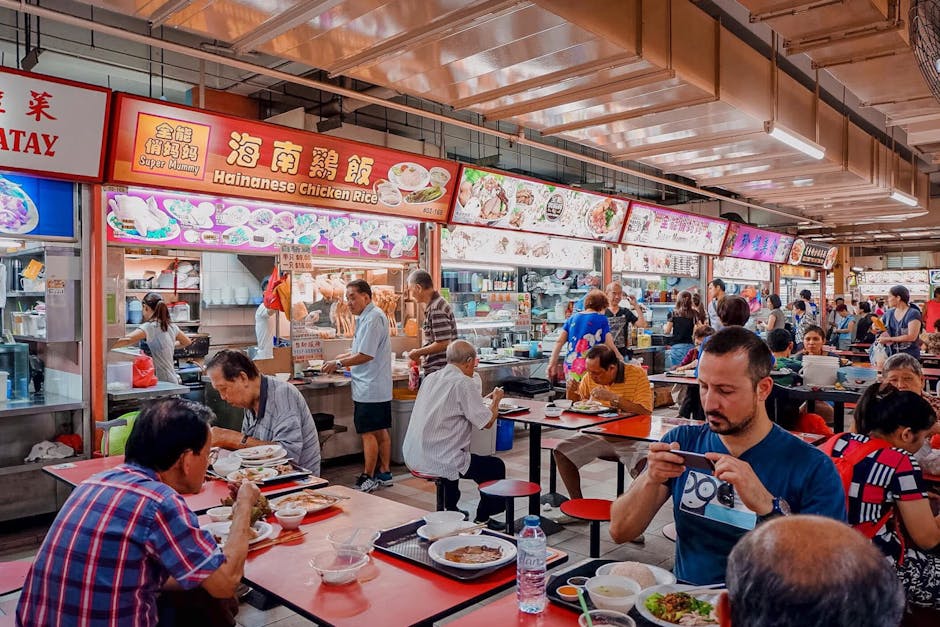
In 2016, the Michelin Guide awarded a star to Hawker Chan, a chicken rice and soya sauce chicken stall in Singapore's Chinatown Complex hawker center. The star made global headlines not because the food was extraordinary (it was, and still is) but because the price was: a plate of soya sauce chicken with rice cost S$2 ($1.50). The world's cheapest Michelin-starred meal wasn't served on linen with silverware — it was served on a melamine plate at a plastic table in a concrete food court where the ambient temperature was 34°C and the noise level made conversation a contact sport. The Michelin star forced the global food establishment to confront a truth that Singaporeans had known their entire lives: the best food in Singapore isn't in restaurants. It's in hawker centers.
Singapore has 114 hawker centers — government-built, covered, open-air food complexes that house anywhere from 30 to 200 individual stalls, each one a micro-restaurant specializing in one or two dishes. The hawker center is Singapore's most important social infrastructure: more than restaurants, more than parks, more than community centers, it's where Singaporeans eat, meet, and sustain a multicultural food culture that blends Chinese, Malay, Indian, Peranakan, and Western influences into a cuisine that belongs to no single ethnicity and to all of them simultaneously. In 2020, UNESCO inscribed Singapore's hawker culture on its Representative List of the Intangible Cultural Heritage of Humanity — the same designation given to French gastronomy and Japanese washoku.
The Big Three: Chicken Rice, Laksa, Char Kway Teow
Singapore's hawker food canon is deep, but three dishes define the core. Hainanese chicken rice — poached chicken served at room temperature over fragrant rice cooked in chicken fat and broth, with chili sauce, dark soy, and ginger paste — is the national dish by consensus if not by law. The chicken should be silky, just barely cooked through, with a thin layer of gelatin between the skin and flesh that wobbles when you cut it. The rice should be aromatic, each grain individually coated in chicken fat, fragrant with pandan leaf and ginger. At Tian Tian Hainanese Chicken Rice in Maxwell Food Centre — the stall that Anthony Bourdain declared his favorite — the chicken is so precisely poached that the flesh is glass-smooth and the skin is slippery with natural gelatin. A plate costs S$5 ($3.75). The queue at lunch exceeds 30 minutes on most days.
Katong laksa — the Singapore version, distinct from Penang and other Malaysian laksas — is a coconut curry soup with thick rice noodles (cut short enough to eat with a spoon, no chopsticks needed), shrimp, fish cake, cockles, and a topping of laksa leaf (Vietnamese coriander). The broth is rich, spicy, and deeply coconut-forward, with a complexity that comes from rempah — a spice paste of dried shrimp, candlenut, turmeric, galangal, lemongrass, and belacan (shrimp paste) that's fried in coconut oil before the coconut milk is added. At 328 Katong Laksa on East Coast Road, the broth is so thick with coconut cream that the spoon nearly stands up in it. S$6 ($4.50).
The Heritage Stalls
Singapore's most revered hawker stalls are family operations where the recipe has been handed down through generations and the cook has been making the same dish for 30, 40, or 50 years. At Outram Park Fried Kway Teow Mee in Hong Lim Market, the char kway teow is cooked over a single charcoal burner by a man who has been frying noodles at this stall since the 1980s. His version uses lard, dark soy, and a well-seasoned wok that's so old it's practically an ingredient itself. The smokiness — the wok hei — is more intense than any restaurant version because the charcoal burns hotter than gas, and the cook's arm has memorized the exact tossing motion that distributes heat evenly. S$4 ($3).
At Hill Street Tai Hwa Pork Noodle in Crawford Lane — another Michelin-starred hawker, awarded one star in 2016 and retaining it since — the bak chor mee (minced pork noodles) is a study in textural and flavor contrasts: springy mee pok noodles tossed in a mixture of vinegar, chili, and pork lard, topped with minced pork, sliced pork, liver, meatballs, and crispy fried sole fish. The vinegar gives the dish a sharp, sour backbone that cuts through the richness of the pork and lard. S$8 ($6) for the large — expensive by hawker standards, cheap by any other measure.
The Racial Harmony on a Plate
Singapore's hawker centers are among the few places where the city-state's multiracial society (roughly 75% Chinese, 14% Malay, 9% Indian) eats side by side, ordering from stalls of every ethnicity. A Chinese Singaporean eating nasi lemak from a Malay stall, a Malay Singaporean ordering roti prata from an Indian stall, an Indian Singaporean having bak kut teh from a Chinese stall — this cross-pollination is routine, unremarkable, and deeply significant. The hawker center is one of the few genuinely integrated social spaces in a country where residential neighborhoods and schools are ethnically mixed by government policy but social circles often segregate along ethnic lines. Food, in Singapore, is the common language.
This integration has produced fusion dishes that belong to no single tradition. Nasi lemak — Malay coconut rice with sambal, fried fish, peanuts, and egg — is as likely to be served at a Chinese-run stall as a Malay one, and the Chinese versions often add char siu or curry chicken. Mee goreng — fried noodles of Indian-Muslim origin — has been adopted by every ethnic group and varies from stall to stall in ways that reflect the cook's background. Chili crab — Singapore's most famous restaurant dish — was invented by Chinese Singaporeans but draws on Malay sambal, Indian chili pastes, and Western tomato sauce. The food doesn't respect ethnic boundaries because the cooks don't, and the result is a cuisine more diverse and internally varied than almost any other city's.
The Existential Crisis
Singapore's hawker culture faces a genuine succession problem. The average age of a hawker stallholder is 60+. The work — 12-hour days, 6 days a week, over a hot stove in tropical heat — is brutal, and the income (S$2,000-4,000/month, roughly $1,500-3,000, for most stalls) is modest by Singaporean standards. Young Singaporeans, most of whom hold university degrees and work in the knowledge economy, are not lining up to inherit their parents' noodle stalls. The government has launched programs — subsidized training courses, reduced-rent incubator stalls, social media marketing support — to attract younger hawkers, with some success. But the fundamental tension between Singapore's high cost of living and the low price point of hawker food makes the economics precarious for new entrants.
The fear is that Singapore's hawker culture will survive the UNESCO recognition but not the generational transition — that the stalls will gradually be replaced by operators who lack the decades of accumulated skill that make the current generation's food extraordinary, and that the food will decline from transcendent to merely adequate. Whether this fear is justified or merely nostalgic is uncertain. What's certain is that eating at Singapore's hawker centers in 2026 — at stalls run by cooks who've been perfecting their single dish for a lifetime — is eating at a cultural institution in its golden age, and golden ages don't announce when they're ending.