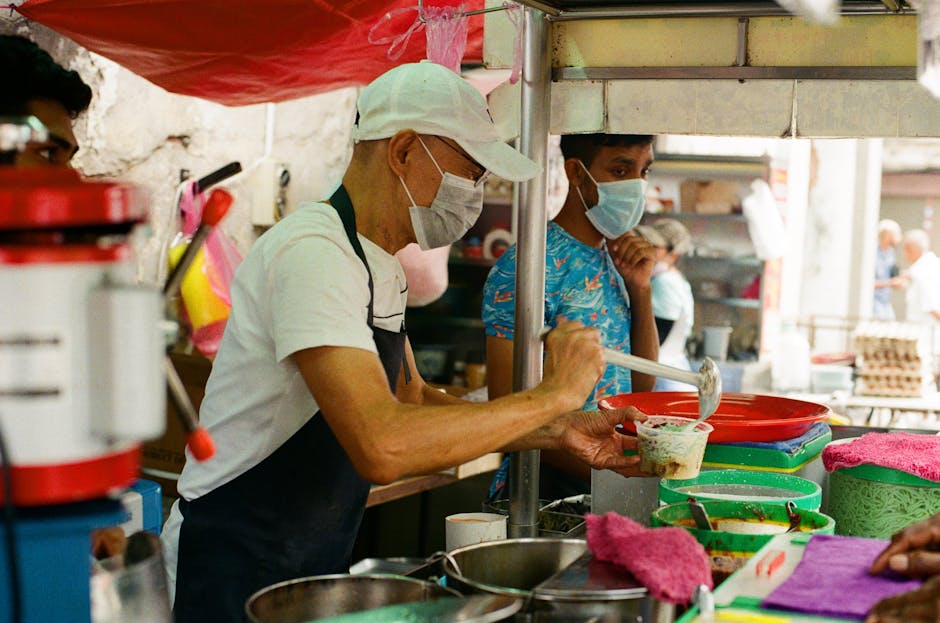
The Island That Eats for a Living
Penang has a problem, and the problem is that its food is too good. The island — technically Penang Island plus a strip of mainland called Seberang Perai — has built its entire tourism economy, cultural identity, and daily social life around hawker food to such a degree that conversations about Penang inevitably become conversations about eating. Taxi drivers have opinions about which char kway teow stall uses the right amount of lard. Hotel receptionists hand you food maps instead of sightseeing brochures. Friends argue about whether New Lane or Gurney Drive has better assam laksa with the intensity other people reserve for politics and football. UNESCO recognized George Town's hawker culture as part of its World Heritage status, and frankly, the street food is a more compelling reason to visit than the colonial architecture.
What makes Penang hawker food distinct from the rest of Malaysia — which is itself a country obsessed with food — is the intersection of Malay, Chinese, Indian, Thai, and Peranakan (Straits Chinese) culinary traditions on a small island where competition among hawkers has been fierce for over a century. The result is a set of dishes that exist nowhere else in quite the same form: char kway teow that's smokier and more complex than KL's version, laksa that uses a completely different base than the coconut curry laksa found in the south, and a noodle soup called Hokkien mee that bears zero resemblance to the stir-fried Hokkien noodles served in Singapore. Same names, different universes.
Char Kway Teow: The Smoky Flat Noodle Theology
Char kway teow is Penang's most sacred dish and the one most likely to start an argument. Flat rice noodles are stir-fried over extreme charcoal heat with dark soy sauce, light soy sauce, chili paste, garlic, prawns, cockles, Chinese sausage, bean sprouts, egg, and — crucially — lard. Pork lard. Rendered and crackling. The lard is non-negotiable in traditional Penang char kway teow; it provides the fat that the noodles fry in and contributes small, crunchy lard bits (called "lard croutons" by nobody except me) that punctuate each bite with pork richness. Muslim-friendly versions exist using vegetable oil, and they're good, but they're playing the game with one arm tied behind their back.
The best char kway teow in Penang is a matter of violent personal opinion. At Lorong Selamat, a stall run by a woman known as the Char Kway Teow Lady has been the subject of documentary films and newspaper profiles. Her version uses a wider noodle than most, cooked over charcoal in a well-seasoned wok that she's been using for decades. The smoky char on the noodles — wok hei at its most intense — is so pronounced that you can smell the plate approaching from three tables away. A plate costs RM8 ($1.70) and the wait can exceed 45 minutes during peak hours. Is it the best? Some say yes. Others swear by Siam Road, where the char kway teow is darker, sweeter, and more aggressively seasoned with chili. Both are extraordinary. The argument is the point.
Assam Laksa: The Sour Noodle Soup That Defines Penang
When people outside Malaysia say "laksa," they usually mean curry laksa — a coconut milk-based noodle soup found in Singapore and southern Malaysia. Penang assam laksa is a completely different dish: a sour, fishy, herbal broth made from tamarind (assam), mackerel, lemongrass, galangal, torch ginger flower, Vietnamese mint, and chili. The broth is thick and murky, with flakes of fish suspended in it, and the sourness hits you before anything else — a sharp, fruity acid that makes your mouth pucker and then floods with saliva. Thick round rice noodles sit in the broth, topped with shredded cucumber, pineapple, raw onion, lettuce, and a spoonful of hae ko (sweet, thick shrimp paste) that you stir in to add a dark, funky sweetness.
CNN once ranked Penang assam laksa as the 7th most delicious food in the world, and while such lists are inherently ridiculous, the ranking isn't wrong. The dish is a masterclass in balancing extreme flavors: sour from tamarind, salty from fish, sweet from pineapple and shrimp paste, aromatic from the ginger flower and herbs, spicy from chili. No single element dominates, and each spoonful of broth tastes slightly different depending on how much hae ko has dissolved into it. At Air Itam Market, near the Kek Lok Si temple, a stall run by a family that's been making assam laksa for three generations charges RM5 ($1.10) for a bowl that would cost $15 in any Western city and still be underpriced. The broth is made fresh each morning from whole mackerel, and by 2 p.m. it's usually gone.
The Nasi Kandar Experience
Nasi kandar is Penang's Indian-Muslim contribution to the hawker canon: steamed rice served with a selection of curries and side dishes, ladled over the rice so the gravies mingle and soak in. The name comes from the kandar — a wooden shoulder pole used by early Indian-Muslim vendors to carry rice pots through the streets of George Town. Today, nasi kandar restaurants range from humble hawker stalls to institutions like Nasi Kandar Line Clear on Penang Road, which has been operating since 1947 and regularly has lines stretching out the door at midnight.
The art of nasi kandar is in the banjir — the flood of curries over the rice. A skilled server ladles four or five different gravies onto your plate in a specific order, creating a layered sauce that's more complex than any single curry alone. Fish curry, chicken curry, dhal, a tamarind-based vegetable curry, and the legendary kuah campur (mixed gravy) that develops at the bottom of the curry pots from the combining of all the gravies throughout the day. This accidental sauce is so prized that regulars specifically ask for "kuah banyak" (lots of gravy) and consider the mixed gravy the best part of the meal. A loaded plate with fried chicken, a piece of fish, and vegetables runs RM12-18 ($2.50-3.80). Eat with your right hand — using your fingers to mix rice and curry is not just acceptable, it's the correct way.
The Morning Noodle Ritual
Penangites eat noodles for breakfast with a commitment that borders on religious observance. By 7 a.m., hawker centers across the island are packed with people eating Hokkien mee — a prawn noodle soup with a broth so intensely shrimpy that making it requires hours of simmering prawn heads, shells, and dried shrimp into a dark, orange-red concentrate. The noodles are a combination of yellow egg noodles and thick rice vermicelli, topped with prawns, pork slices, kangkung (water spinach), and a hard-boiled egg. Sambal chili is added to taste, and the correct amount is "more than you think." At Ah Leng on Presgrave Street, the broth is so concentrated that you can see oil beads floating on the surface, each one a tiny capsule of prawn flavor. A bowl costs RM7 ($1.50) and the stall closes by noon, sometimes earlier if the broth runs out.
Cendol and the Afternoon Cool-Down
By mid-afternoon, when Penang's equatorial heat reaches its daily crescendo, the cendol stalls become the most important food infrastructure on the island. Cendol is shaved ice, coconut milk, palm sugar syrup (gula melaka), and green pandan-flavored rice flour jelly worms — those soft, wriggly, brilliant green strands that give the dessert its name and visual identity. At Penang Road Famous Teochew Chendul, the stall that started the island's cendol arms race, the ice is shaved to snow-fine texture, the gula melaka is cooked until it's nearly caramelized, and the coconut milk is thick enough to coat a spoon. It costs RM3.50 ($0.75) and on a hot day — which is every day — it's the most effective temperature regulation device known to humanity. Red beans are optional. I consider them essential.
Why Penang Hawker Food Stays Excellent
The quality of Penang hawker food has remained remarkably high despite decades of tourism and the commercial pressures that typically dilute street food cultures. The reason is competition — not the Adam Smith kind, but the deeply personal, family-honor kind. Many Penang hawker stalls have been operated by the same families for three or four generations, and the reputation of each stall is inseparable from the family's social standing. A hawker whose char kway teow declines in quality will hear about it from neighbors, regular customers, and rival hawkers. The social cost of serving bad food is real and immediate in a community this small and food-obsessed.
The other factor is specialization. Unlike restaurants that serve 50-item menus, most Penang hawker stalls serve one or two dishes exclusively. The char kway teow man makes char kway teow. That's it. He's been making it for 30 years and his father made it before him. The accumulated knowledge in his wrist — knowing exactly when to toss the noodles, how long to let the egg set before folding, when the lard croutons are crispy enough — isn't a recipe. It's muscle memory built over decades and tens of thousands of plates. You can't replicate it in a commercial kitchen with standardized procedures and rotating staff, which is why chain restaurants that try to bottle Penang hawker food always produce something that tastes correct but not right.