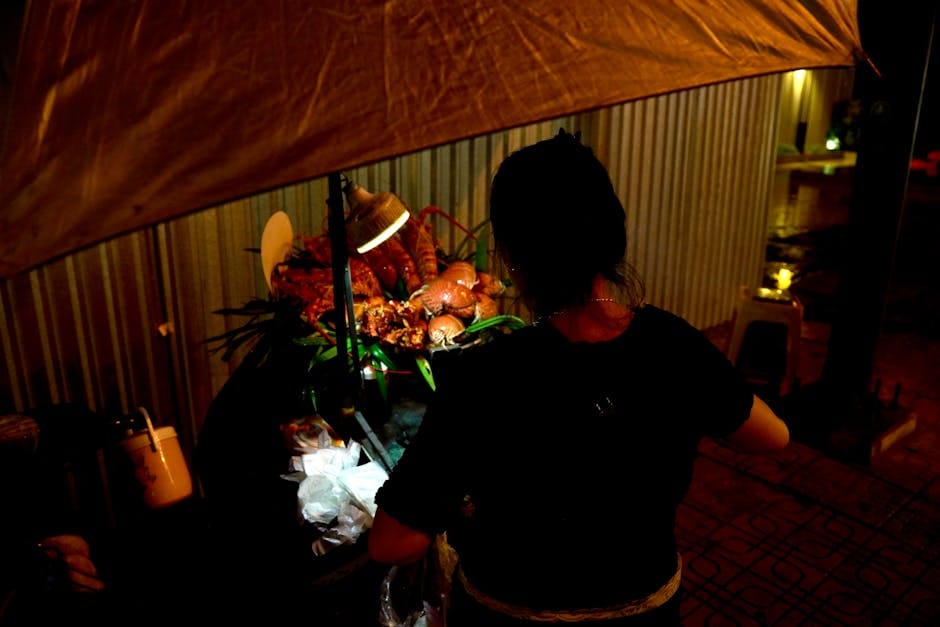
There's a moment at every great Asian night market — roughly 45 minutes after sunset, when the last daylight fades and the fluorescent tubes and LED strips take over — when the energy shifts. The vendors who've been setting up all afternoon start calling out orders. The grills that have been heating produce their first real smoke. The crowds thicken from scattered tourists to dense, purposeful rivers of hungry people. The noise becomes a wall — sizzling, shouting, music from competing speakers, the mechanical whir of juice machines, the rhythmic clang of wok against burner. This is when the night market becomes what it really is: Asia's most democratic, most chaotic, and most rewarding eating experience.
Taipei: The Night Market Capital
Taiwan treats night markets as civic infrastructure. They're not informal gatherings — they're registered, regulated, and woven into urban planning. Taipei alone has over a dozen major night markets, each with its own character and signature dishes. The city's relationship with night market food is so central to daily life that Taiwanese presidential candidates make obligatory campaign stops at Shilin Night Market the way American candidates eat pizza in New York.
Shilin Night Market
Shilin is the largest and most famous — a sprawling complex of outdoor stalls and an underground food court that serves as Taipei's default answer to "where should I eat tonight?" The greatest hits: da ji pai (giant fried chicken cutlet, bigger than your face, 70 NT/$2.20), oyster omelet (蚵仔煎, o-a-jian, 65 NT), stinky tofu (臭豆腐, chou doufu, 50 NT — if you can handle the smell, the flavor is transformative), and pepper pork buns (胡椒餅, hu jiao bing, 60 NT — baked in a tandoor-style oven, the pork filling seasoned with white pepper and scallions until it's violently good).
The underground food court is where the locals eat. The outdoor stalls are excellent but tourist-adjusted. The basement level — chaotic, steam-filled, with vendors shouting over each other — serves the same dishes at lower prices with less patience for indecision. Point at what you want, pay, move.
Raohe Night Market
Raohe is smaller, older, and more focused. The 400-meter covered street has a temple at one end and a concentration of food at the other that rivals Shilin's best without the crushing crowds. The pepper pork bun at Raohe's entrance — from the stall with the perpetual line — is arguably Taipei's best: the dough is thinner, the filling more generous, the baking more precise. The medicinal herbal soup stalls midway through the market serve pork rib soup with slow-simmered Chinese herbs (70 NT) that's both delicious and supposedly good for your circulation.
Bangkok: Organized Chaos
Bangkok's night market scene has evolved significantly from the old Patpong tourist market model. The current generation of night markets — Jodd Fairs, Talad Rot Fai, and the relocated Chatuchak Night Market — combines street food with craft vendors, bars, and live music in settings designed for extended evening hanging out rather than quick eat-and-leave.
Jodd Fairs (near MRT Phra Ram 9) is the current star — a sprawling open-air market that opened in 2022 and quickly became Bangkok's hottest nighttime food destination. The layout is intentionally labyrinthine, forcing you past hundreds of stalls selling everything from Japanese-style fluffy pancakes to Northern Thai laab to Korean corn dogs to the Thai-Chinese specialty khao kha moo (braised pork leg on rice, 60 baht/$1.70). The grilled seafood section — where you choose your fish, shrimp, squid, or shellfish from iced displays and it's grilled to order over charcoal — is spectacular and remarkably affordable (200-400 baht/$5.50-$11 for a loaded seafood plate).
The drinks at Bangkok night markets deserve mention. Thai craft beer (brands like Chalawan, Sandport, and Devanom) has exploded in availability, and many market stalls now offer local craft options alongside the standard Singha and Chang. Fresh coconut water, served in the shell, costs 40-60 baht and functions as both hydration and palate cleanser between spicy dishes.
Seoul: The Modern Night Market
Seoul's night market tradition is younger than Taipei's or Bangkok's, but what it lacks in history it compensates in energy. Myeongdong's street food stretches along the main shopping street with stalls selling tteokbokki (spicy rice cakes), hotteok (sweet filled pancakes), egg bread (gyeran bbang), tornado potatoes (a spiral-cut potato on a stick, deep-fried), and the Korean corn dog phenomenon — hot dogs (or mozzarella sticks, or a combination) coated in batter, rolled in various coatings (french fries, ramen noodles, cereal), and deep-fried to golden excess. Most items cost 3,000-5,000 won ($2.25-$3.75).
The Yeouido Bamdokkaebi (Goblin) Night Market, operating Friday and Saturday evenings from spring through autumn along the Han River, curates its food vendors rather than accepting all comers. The result is a higher average quality — K-food fusion dishes, international street food from resident expat cooks, and the Korean fried chicken stalls that draw lines 30 people deep.
A Taipei friend's night market rule: "Never eat at the first stall you see. Walk the whole market once. Note what has the longest lines. Go back to those stalls. The crowd knows."
Penang: The Hawker Night Shift
Penang's night food scene operates differently from purpose-built night markets. Instead, the island's famous hawker stalls shift into a different gear after sunset. Gurney Drive Hawker Centre, New Lane (Lorong Baru) Hawker Stalls, and Kimberley Street come alive after 6 PM with stalls that operate only at night.
Char kway teow — the flat rice noodle dish stir-fried with shrimp, cockles, egg, bean sprouts, and chives over extremely high charcoal heat — is Penang's nighttime signature. The best versions produce genuine wok hei — that smoky, slightly charred flavor that requires temperatures above 1,200°F and a cook who knows exactly when to toss the noodles. A plate costs 7-12 ringgit ($1.50-$2.60) and is worth fifty times that in technique.
Osaka: Dotonbori After Dark
Dotonbori at night is a sensory assault: giant animated signs (the Glico running man, the mechanical crab), neon reflections on the canal, and the concentrated smell of takoyaki, okonomiyaki, and grilled meat from hundreds of competing stalls and restaurants. It's touristy — there's no pretending otherwise — but the food is real, and the nighttime atmosphere is genuinely electric.
The takoyaki stalls are the essential stop. Takoyaki — spherical batter balls filled with octopus, cooked in a special dimpled griddle, turned constantly with a pick until golden on all sides — cost 500-800 yen ($3.40-$5.50) for a boat of 8. Eat them immediately, burning your mouth on the molten interior, because that's the only way. Tepid takoyaki is a different and lesser food.
The Night Market Survival Guide
Come hungry but pace yourself. The biggest mistake is overcommitting at the first stalls and missing the better options deeper in the market. Start with a small item — a skewer, a single dumpling, a small portion — then walk, observe, and gradually escalate.
Bring cash in small denominations. Card payment is increasingly available but not universal. Night market vendors make change from cash boxes, and showing up with a large bill for a 50-baht purchase gets you a look.
Follow the locals, not the signage. The stall with the handwritten sign in the local language and a crowd of local families is almost always a better bet than the stall with the Instagram-friendly English sign and professional photography.
Eat the weird thing. The stinky tofu. The grilled squid tentacle. The blood sausage. The thing you can't identify. Night markets are where culinary courage gets rewarded, because the vendors cooking unusual items for local clientele usually know exactly what they're doing.
Go late. Most night markets peak between 7 and 9 PM. If you arrive at 9:30 or 10, the crowds thin, the vendors are more relaxed, and some will offer slightly larger portions or better prices to clear inventory. The trade-off is reduced selection — some stalls close when they sell out — but the experience is less frenetic and more enjoyable.
Night markets aren't restaurants. The food is fast, it's eaten standing or on inadequate plastic stools, the hygiene ranges from excellent to questionable, and the noise level makes conversation optional. What night markets offer that restaurants can't is immersion — in a culture's street-level food identity, in the chaos that makes eating an adventure rather than a routine, in the fundamental human pleasure of eating something extraordinary from a stranger's hands in an unfamiliar place at night. That's worth a little chaos. That's worth the burned mouth from the takoyaki and the stained shirt from the sauce and the feet that hurt from standing. The night market is where the eating is best because the eating is real.