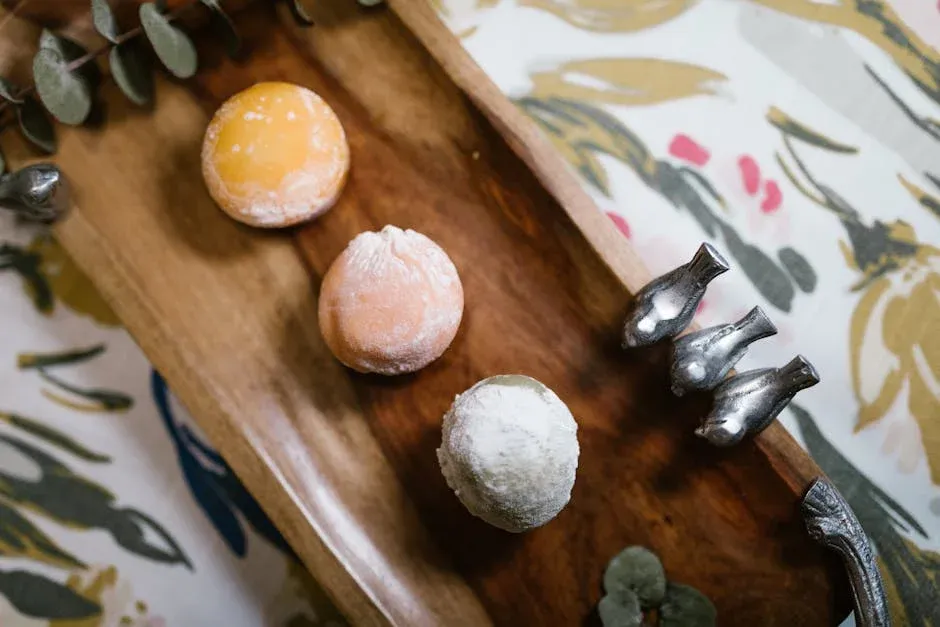
The Rice Cake That Tells Time
In a Tokyo department store basement — the depachika, Japan's cathedral of edible luxury — the wagashi (traditional sweets) counter changes its mochi display every two weeks. In early January, it's kagami mochi, the stacked round rice cakes that sit on household altars during New Year. By February, it shifts to sakura mochi, pink-tinted rice cake wrapped in a salt-pickled cherry leaf. March brings uguisu mochi, colored green with matcha and shaped like a warbler. April is hanami dango, tri-colored rice balls on sticks for cherry blossom viewing. And this continues through every month of the year, each season defined by a different mochi preparation that's as much a marker of time as the changing foliage. In Japan, mochi doesn't sit outside the calendar — it is the calendar, edible and seasonal and deeply encoded with cultural meaning.
The base material is simple: mochigome, a glutinous rice (misleadingly named — it contains no gluten, just high amylopectin starch that produces its characteristic stretch and chew) that's steamed and then pounded into a smooth, elastic mass. Traditional mochi-making — mochitsuki — involves two people working in rhythmic coordination: one pounds the steamed rice with a heavy wooden mallet (kine) in a stone or wooden mortar (usu), while the other reaches in between strikes to fold and turn the dough, risking fingers with each swing. The timing must be precise. The rhythm must be steady. The result is a dough so smooth and stretchy that it can be pulled into a string half a meter long before breaking. Modern production uses machines, but the mochitsuki tradition persists at shrines and community events, particularly during the New Year period, when the rhythmic thwack of mallet on rice is as seasonal as sleigh bells are in the West.
New Year: When Mochi Is Mandatory
Mochi's most important cultural role is during oshogatsu, the Japanese New Year celebration. Kagami mochi — two round rice cakes stacked with a bitter orange (daidai) on top — is placed on household altars and in prominent positions in homes and businesses as an offering to toshigami, the deity of the incoming year. The two rounds represent the outgoing and incoming years, and the daidai (a pun on "generations") represents continuity. On January 11th, in a ceremony called kagami biraki (mirror opening), the dried-out, cracked kagami mochi is broken apart — never cut with a knife, which carries associations with severing ties — and cooked in ozoni, the New Year's soup.
Ozoni is itself regionally variable in ways that fascinate and divide the Japanese. In the Kanto region (Tokyo and east), ozoni uses a clear dashi-and-soy broth with toasted square mochi that holds its shape in the soup. In the Kansai region (Osaka, Kyoto, and west), the broth is white miso-based, thick and sweet, and the mochi is round and boiled until soft. These are not minor variations — they represent genuinely different dishes that happen to share a name, and the Kanto-vs-Kansai ozoni debate is one of Japan's most enduring culinary arguments. My sympathies are with Kansai. The white miso version, with its silky broth and melting mochi, is sublime comfort food. But I say this quietly, because Kanto partisans are numerous and passionate.
Spring: Sakura and Kashiwa
Spring mochi tells the story of cherry blossoms and new beginnings. Sakura mochi comes in two main styles: the Kanto version (choumei-ji style), which wraps a smooth pink rice cake around sweet red bean paste and encloses everything in a salt-pickled cherry leaf; and the Kansai version (doumyouji style), which uses a coarser, more textured rice cake with visible grain that provides a satisfying chew. The cherry leaf is the defining element — its salt and slight bitterness contrast with the sweet bean paste, and the floral, almost perfumy aroma of the preserved cherry leaf is unmistakably spring. Whether you eat the leaf is a matter of personal preference. I eat it. The salt makes the whole thing work.
Kashiwa mochi, served in May for Children's Day (Kodomo no Hi), wraps sweet bean paste in a plain white mochi enclosed in an oak leaf. The oak leaf is not eaten (it's tough and bitter), but it imparts a subtle woody aroma to the mochi and serves a symbolic purpose: oak trees don't drop their old leaves until new growth appears, representing the continuity of generations. At Toraya, one of Tokyo's oldest and most prestigious wagashi shops (founded around 1500), the kashiwa mochi is made with a particularly fine mochi that's almost translucent, and the bean paste is a delicate koshian (smooth strained red bean) that's been passed through a sieve so many times it has the texture of silk. It costs ¥500 ($3.40) per piece and lasts approximately four seconds in my hands.
Summer: Cool and Light
Japan's humid, crushing summers demand mochi that's cool and refreshing rather than heavy and warm. Warabi mochi, made from bracken starch rather than glutinous rice, is served chilled and dusted with kinako (roasted soybean flour) and a drizzle of kuromitsu (black sugar syrup). The texture is different from true mochi — warabi mochi is translucent, jelly-like, and impossibly soft, wobbling on the plate like a savory panna cotta. It's served cold and has an almost cooling effect in the mouth, making it the perfect summer sweet. At Fumuroya in Kanazawa, the warabi mochi is made fresh daily and served within hours to maintain its delicate texture — by the next day, it firms up and loses the ethereal wobble that defines it.
Kuzumochi, made from kudzu starch, is another summer cooling sweet with a similarly jiggly, gelatinous texture. And mizu shingen mochi — the "raindrop cake" that went viral on Western social media around 2014 — is the ultimate expression of summer mochi: a dome of agar jelly so clear and delicate that it looks like a sphere of water, served with kinako and kuromitsu. It melts within 30 minutes of being served, which is a marketing constraint that adds to its allure. At Kinseiken in Yamanashi prefecture, where the original was developed, the mizu shingen mochi is served in a garden setting where the clear dome reflects the surrounding trees, and the ephemeral beauty of a sweet that literally disappears is very deliberately on-brand for Japanese aesthetics.
Autumn and Winter: Weight and Warmth
As temperatures drop, mochi preparations become richer and more substantial. Ohagi — lumps of partially pounded rice coated in sweet red bean paste, kinako, or black sesame — are associated with the autumn equinox and higan (Buddhist memorial days). The same preparation made in spring is called botamochi, named after the peony that blooms in spring, while the autumn version takes its name from the bush clover (hagi) that flowers in September. Same food, different name, different season — the naming convention itself is a calendar.
In winter, yaki mochi (grilled mochi) becomes ubiquitous. Dried mochi blocks are toasted on a grill or in a toaster oven until they puff up, the exterior becoming crisp and slightly charred while the interior turns molten and stretchy. Dipped in soy sauce and wrapped in nori, it's a simple, warming snack that appears in homes across Japan from November through February. The danger of mochi — and this is not a joke — also peaks in winter. Every New Year, Japanese emergency rooms report deaths caused by people (usually elderly) choking on mochi that's lodged in their throat. The Tokyo Fire Department issues annual warnings about proper mochi-eating technique: cut it into small pieces, chew thoroughly, and have water ready. Mochi's stretchiness, the very quality that makes it so texturally satisfying, becomes lethal when a large piece gets stuck. It's a uniquely Japanese hazard, and the casualty figures (typically 2-4 deaths per year) are reported with the same resigned regularity as typhoon damage statistics.
The Ice Cream Inside
Mochi ice cream — a ball of ice cream wrapped in a thin layer of mochi — is the form that most people outside Japan encounter first, and it's worth noting that this is a Japanese-American invention rather than a traditional Japanese preparation. Lotte, the Japanese-Korean confectionery giant, popularized mochi ice cream in Japan in the 1980s, but the version that conquered American freezer aisles was developed by Frances Hashimoto of Mikawaya bakery in Los Angeles. The combination works brilliantly: the thin mochi layer insulates the ice cream just enough to prevent instant melting, while adding a chewy textural element that plain ice cream lacks. At convenience stores across Japan (7-Eleven, Lawson, FamilyMart), the mochi ice cream selection runs to 15 or 20 varieties, with seasonal rotations that include sakura in spring, matcha year-round, and yubari melon (Hokkaido cantaloupe) in summer. They cost ¥150-200 ($1-1.40) each and represent one of the strongest arguments for the Japanese convenience store as a culinary institution.