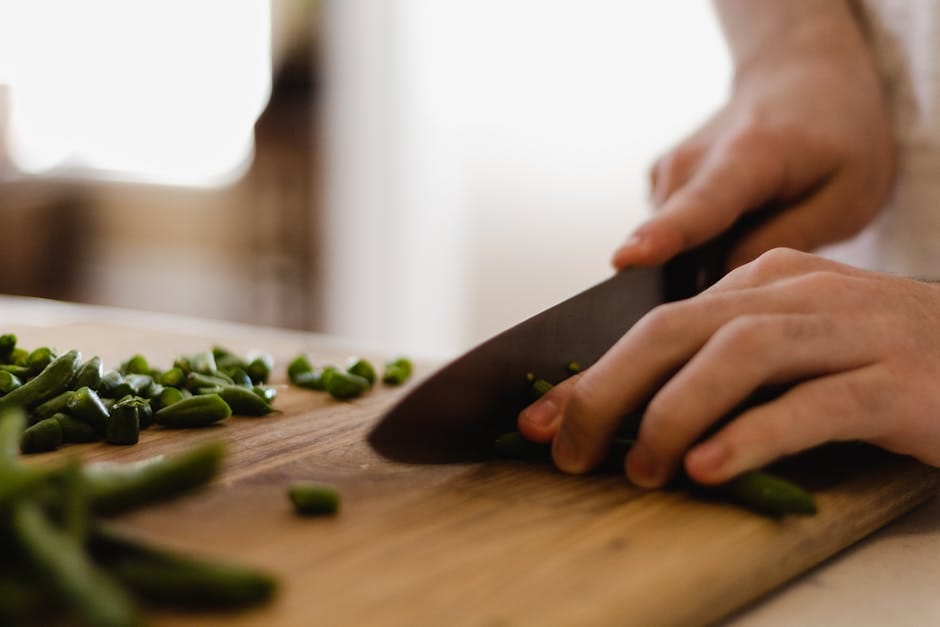
One Knife, Every Cut
Walk into a professional Chinese kitchen and you'll see one knife: the cai dao, the rectangular Chinese cleaver. It looks like a weapon — a broad, heavy blade with a squared-off tip that seems designed for hacking rather than finesse. In reality, the cai dao is the most versatile knife in any culinary tradition. Its thin, sharp edge julienne-cuts vegetables as precisely as a French chef's knife. Its broad face crushes garlic and ginger with a single press. Its weight powers through chicken bones and pork ribs. Its flat side scoops cut ingredients from the board to the wok. Its blunt spine cracks lobster shells. And its squared tip scrapes the cutting board clean. One knife. Every function that a Western knife block of eight knives performs. This isn't a limitation — it's a philosophy: mastery of one tool produces better results than casual familiarity with many.
The Japanese approach is different but equally principled. Japanese professional kitchens use multiple specialized knives — the yanagiba (long, thin, single-bevel blade for slicing sashimi), the deba (heavy, thick blade for breaking down whole fish), the usuba (thin, flat blade for vegetable work), and the santoku (all-purpose blade that's the closest Japanese equivalent to a Western chef's knife). Each knife is designed for a specific task and performs that task with a precision that a general-purpose knife can't match. The single-bevel grind (sharpened on one side only) on yanagiba and usuba produces a thinner edge than the double-bevel Western grind, allowing cuts so clean that the cell walls of the fish or vegetable aren't crushed — the cut surface is smooth and shiny rather than rough and oxidized.
The Cuts That Matter
Asian cooking uses several cuts that either don't exist in Western culinary vocabulary or are used far more frequently. The roll cut (rangiri in Japanese) involves rotating the vegetable 90 degrees between each diagonal cut, producing irregular chunks with maximum surface area — perfect for braising and stir-frying because the large exposed surfaces absorb sauce and develop browning. Root vegetables (carrots, daikon, lotus root) are almost always roll-cut in Japanese cooking, and the difference in a braised dish between roll-cut and straight-cut carrots is significant: the roll-cut pieces absorb more braising liquid and develop more flavor per piece.
The oblique cut (pian in Chinese) involves holding the knife at an angle to the ingredient and cutting thin, wide slices. For a Chinese stir-fry, this cut is essential: the thin, angled slices cook fast and evenly, presenting maximum surface area to the wok's heat. A piece of chicken breast oblique-cut into 3mm slices will cook in 45 seconds in a hot wok. The same breast cut into cubes takes 3 minutes and never develops the same sear. The cut determines the cooking time, which determines the texture, which determines whether the dish succeeds or fails. This is why Chinese cooking instruction traditionally starts with knife skills and stays there for months before any actual cooking happens.
The Matchstick and the Shred
Julienne cutting (si in Chinese, sengiri in Japanese) — cutting ingredients into thin matchstick strips — is used more frequently and more finely in Asian cooking than in Western. A Chinese julienne of ginger is thinner than a Western julienne: 1-2mm wide, versus the 3mm standard in French cooking. This thinness matters because ginger releases its aromatic oils faster when cut thinner, and in a quick stir-fry where the ginger is in the wok for perhaps 15 seconds, a 3mm julienne won't have time to fully release its flavor. The same principle applies to scallions, garlic, and chili: the thinner the cut, the faster the flavor release, and Asian stir-fry cooking is fundamentally about speed.
The chiffonade cut for herbs (particularly shiso, Thai basil, and Vietnamese coriander) is done more aggressively in Asian contexts. Where a French chiffonade of basil produces ribbons 3-4mm wide, a Vietnamese chiffonade of herbs for pho produces gossamer-thin shreds barely 1mm wide, which wilt on contact with hot broth and integrate into the soup rather than sitting on top as a garnish. The cut transforms the herb from a topping into an ingredient. At a pho stall in Saigon, the herb plate that accompanies each bowl contains herbs shredded so fine they look like green threads — each one sized for instant integration into the hot broth.
The Cleaver Technique
Using a Chinese cleaver requires a different grip and motion than a Western chef's knife. The grip: pinch the blade itself (the flat part near the bolster) between your thumb and forefinger, with the remaining three fingers wrapped around the handle. This pinch grip puts your hand closer to the balance point and gives finer control over the blade angle. The motion: for fine cuts, the cleaver moves in a forward-and-down rocking motion similar to a French knife, but with less rocking and more straight-down chopping. For heavy cuts (bone-in chicken, ribs), the motion is a controlled chop using the weight of the blade — you lift the cleaver and let gravity do most of the work, guiding rather than forcing.
The single most useful Asian knife skill: Learn to mince garlic and ginger with a cleaver or chef's knife until they're paste-fine, not dice-fine. The paste-fine mince (achieved by alternating between chopping and scraping the blade flat across the board) integrates into sauces and stir-fries invisibly, contributing flavor without texture. This is the standard in Chinese and Thai cooking, and it takes about 45 seconds per clove once you've practiced.
The Board and the Posture
Chinese cutting boards are traditionally round, thick blocks of wood (often tamarind or cypress) that sit directly on the counter without a non-slip mat — their weight holds them in place. The round shape is practical: you rotate the board as you work, keeping the cutting area in front of you without moving your body. Japanese cutting boards are rectangular and often made of hinoki (Japanese cypress), which is soft enough to be gentle on knife edges but firm enough to resist deep gouging. Both traditions favor end-grain or thick cross-grain boards that absorb blade impact rather than the thin plastic boards that dull knives faster.
The cutting posture in a Chinese kitchen is different from Western practice. The wrist stays relatively straight, and the cutting motion comes from the shoulder and elbow rather than the wrist. This might feel unnatural to someone trained in French technique, where wrist control and the rocking motion are emphasized, but the straight-wrist Chinese technique generates more downward force with less strain — essential when you're making 500 cuts per prep shift with a cleaver that weighs 350 grams. The claw grip for the guiding hand (fingers curled under, knuckles against the flat of the blade) is universal across all knife traditions and is the single most important safety technique regardless of which knife you use. Learn it. Practice it. Your fingertips depend on it.