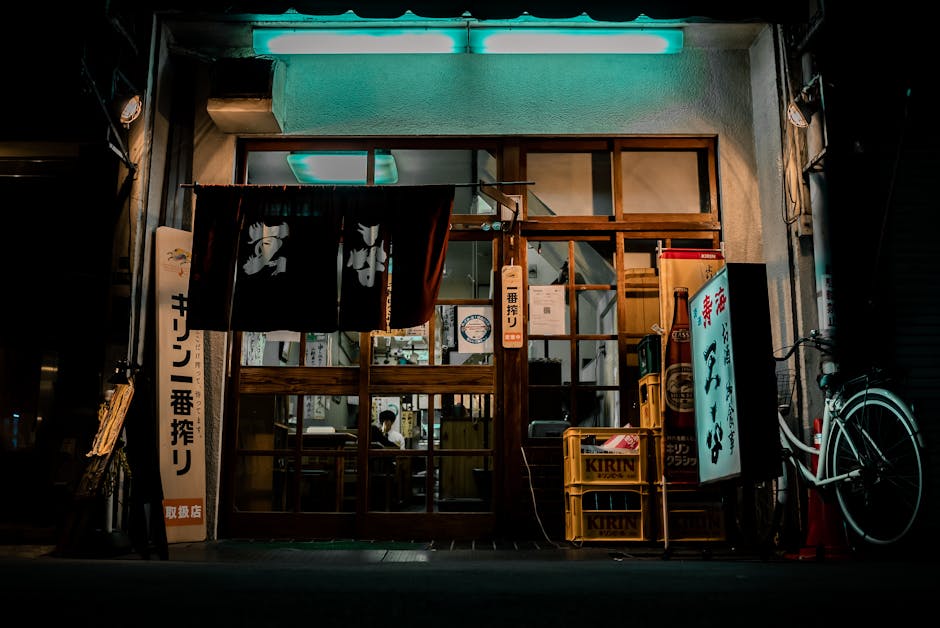
The After-Work Institution
At 6:30 p.m. on any weekday in any Japanese city, the red lanterns outside izakayas switch on, and Japan's real social life begins. The izakaya — literally "stay-sake-shop," a place where you sit and drink sake — is Japan's oldest and most democratic dining institution. Salary workers loosen their ties and order the first round of nama biiru (draft beer). University students crowd around low tables in the tatami room. A solo regular at the counter chats with the chef while picking at a plate of grilled chicken hearts. The noise level rises steadily as the evening progresses, and by 9 p.m. the place sounds nothing like the Japan of polite bows and quiet train cars. This is Japan off-duty, and the izakaya is where it happens.
Izakaya range from scruffy, 10-seat neighborhood bars that haven't changed their menu since the 1970s to polished chains like Torikizoku (where every item costs ¥350/$2.40) to upscale establishments with curated sake lists and seasonal kaiseki-influenced small plates. The format is consistent regardless of price: you sit, you drink, you order many small dishes, you stay for two to three hours, you leave happier than you arrived. The small-plate format is the key — izakaya food isn't a meal structured around a main course. It's a continuous stream of three-to-five-bite dishes ordered throughout the evening, arriving in whatever order the kitchen produces them, shared among the table, and selected to complement whatever you're drinking.
The Otoshi: Don't Fight It
Within minutes of sitting down at an izakaya, a small dish will appear that you didn't order. This is the otoshi (or tsukidashi) — a mandatory appetizer that functions as a cover charge. It might be a small bowl of edamame, a few slices of pickled daikon, or a more elaborate preparation like marinated octopus or chilled tofu with bonito flakes. It costs ¥300-500 ($2-3.40) and it will appear on your bill whether you eat it or not. This surprises many tourists, who perceive it as an unwanted charge. The correct perspective: the otoshi is a small, reasonable cover charge that includes a snack, and it's universal at izakayas (it's how the restaurant covers the cost of unlimited tea and water, plus the table time). Not fighting the otoshi is Rule One. Eat it. It's usually delicious.
The otoshi also serves a social function: it arrives immediately, giving you something to eat while waiting for your first proper order. In Japanese drinking culture, eating without drinking and drinking without eating are both considered bad form. The otoshi ensures that there's food on the table from the moment the first drink arrives, bridging the gap between ordering and eating and preventing the awkward interval of sitting with a beer and an empty table. Think of it as the kitchen's way of saying "we see you, here's something while we work." Once you reframe it that way, the otoshi stops feeling like a scam and starts feeling like hospitality.
The First Order: Toriaezu Nama
The phrase "toriaezu nama" — "draft beer for now" — is the standard opening line of any izakaya evening. The entire table orders draft beer as the default first drink, regardless of whether they actually prefer beer, because the uniformity of the first round is socially important. It allows the kampai (cheers) to happen immediately and simultaneously, and it prevents the awkward delay of one person waiting for a cocktail while everyone else is ready to toast. This ritual is so ingrained that servers at izakayas will often ask "toriaezu nama de ii desu ka?" (draft beer for now, OK?) as a single-option question rather than presenting a drinks menu. Just say yes.
After the first beer, the drink order diversifies. Sake (nihonshu) is the traditional izakaya drink, served warm (atsukan) or cold (reishu) depending on the type and the season. Shochu — a distilled spirit made from barley, sweet potato, or rice, typically 25% alcohol — is mixed with water (hot or cold), soda, or tea to produce a long drink called a chu-hai that's lower in calories than beer and less intoxicating than drinking straight. Highballs (whisky and soda) have surged in popularity at izakayas in the last decade, driven by Suntory's aggressive marketing of its Kakubin whisky. And for non-drinkers, most izakayas offer non-alcoholic beer, oolong tea, and soft drinks without any social stigma attached to ordering them. The Japanese drinking culture is more flexible about non-participation than its reputation suggests — the important thing is being present, not being drunk.
Ordering Strategy: Light to Heavy
Izakaya menus can be overwhelming — 50 to 100 items is standard at a medium-sized izakaya, and the menu is often hand-written in Japanese on wooden boards hanging on the wall, which doesn't help if you can't read kanji. The ordering strategy that most Japanese regulars follow: start with light, cold items (edamame, hiyayakko — chilled tofu with ginger and bonito, sashimi, salads), move to grilled items (yakitori — chicken skewers, grilled fish, grilled vegetables), then to fried items (karaage — fried chicken, korokke — croquettes, tempura), and finish with a starch (onigiri — rice balls, ochazuke — tea-poured rice, yakisoba — fried noodles).
This progression isn't arbitrary — it mirrors the body's ability to process increasingly heavy food as alcohol consumption continues. Light, cold dishes at the start settle the stomach and pair with the crispness of the first beer. Grilled items, with their charred, savory flavors, match the transition to sake or shochu. Fried dishes arrive when the alcohol has dulled the palate enough that their richness feels appropriate rather than overwhelming. And the closing starch — the shime, literally "closing" — absorbs the evening's alcohol and sends you home with something solid in your stomach. Skipping the shime is possible but inadvisable if you have work in the morning.
The Yakitori Deep Dive
Yakitori (grilled chicken skewers) is the backbone of izakaya eating and a culture unto itself. A serious yakitori specialist — and there are thousands in Tokyo alone — will offer 15 to 25 different skewer types, each one a different cut of the bird, grilled over bincho charcoal (a white charcoal that burns extremely hot and clean) and seasoned with either tare (a sweet soy glaze) or shio (salt). The standard cuts include momo (thigh), negima (thigh with scallion), tsukune (ground chicken meatball), kawa (skin, grilled until crispy), sunagimo (gizzard), hatsu (heart), and reba (liver). Adventurous eaters go for bonjiri (tail, fatty and rich), nankotsu (cartilage, crunchy), and seseri (neck, tender and flavorful).
The yakitori ordering rule: At a specialist yakitori shop, order "omakase" (chef's choice) and let the chef send skewers in the order he thinks best. At a general izakaya, order five to six different types with a mix of tare and shio seasoning.
At Birdland in Ginza, Tokyo — a basement yakitori shop with a Michelin star — the chef grills each skewer over bincho charcoal with the concentration of a surgeon, turning them at precise intervals and pulling them from the grill at the exact moment the exterior chars and the interior reaches optimal juiciness. The chicken is sourced from specific farms in Iwate prefecture, and the tare sauce is a decades-old batch that's been continuously replenished (like a sourdough starter) since the restaurant opened. A full omakase of 10 skewers costs ¥6,000 ($41) and is one of the finest chicken experiences available anywhere, which is a strange thing to say about food that costs less than a movie ticket.
The Bill and the Exit
Izakaya bills are calculated per item ordered and divided equally among the table — this is the standard in Japan, even if some people ate or drank more than others. The equal split (warikan) is so deeply ingrained that suggesting an itemized split is considered socially graceless. If you're hosting, you might offer to pay a larger share (that's generous). If someone older or more senior is at the table, they'll likely insist on paying the entire bill (let them, after a polite protest). The bill at a typical izakaya for an evening of moderate drinking and eating runs ¥3,000-5,000 ($20-34) per person — remarkably good value for two to three hours of food, drinks, and social bonding.
The exit ritual: say "gochisousama deshita" (thank you for the meal) to the staff on your way out. They'll respond with enthusiasm. Step outside, take a breath of the cooler air, and note that the red lanterns are still glowing at two other izakayas on the same block. In Japanese drinking culture, the first location (ichijikai) is for food and moderate drinking. The second location (nijikai) — often a karaoke bar or a smaller, more intimate bar — is for continued drinking and the loosening of whatever social constraints survived the first venue. Whether you proceed to nijikai is optional but encouraged. The night is young. The lanterns are lit. And somewhere nearby, a chef is grilling chicken hearts over white charcoal, and the smell is pulling you forward.