The Longest Detour in Culinary History
Somewhere around 1870, a Japanese naval officer tasted curry for the first time. It didn't come from India. It came from the British Royal Navy, which had adopted a version of Indian curry as standard shipboard fare because the thick, spiced stew could mask the flavor of meat that had been sitting in a ship's hold for weeks. The British had already transformed Indian curry into something an Indian cook would barely recognize — thickened with flour, sweetened, stripped of most of its complexity, and reduced to a generic "curry powder" that bore the same relationship to actual Indian spice blending that instant coffee bears to a fresh espresso. The Japanese took this already-distorted version and changed it again, creating a dish that is now so thoroughly Japanese that calling it "Indian food" would confuse everyone involved, including Indians and Japanese people.
Japanese curry — kare raisu, literally "curry rice" — is Japan's most popular comfort food. This isn't hyperbole. A 2020 survey by the Japan Curry Association found that the average Japanese household eats curry 76 times per year, roughly once every five days. Convenience stores sell over 100 million packaged curry portions annually. The Japan Maritime Self-Defense Force still serves curry every Friday, continuing a tradition that began in the Imperial Navy in the 1880s. There are entire restaurant chains — CoCo Ichibanya has over 1,400 locations — devoted exclusively to curry rice. No other dish occupies this position in Japanese food culture, and the story of how it got there involves colonialism, nutrition science, wartime logistics, and one very successful commercial product.
From British Warships to Japanese Barracks
The Imperial Japanese Navy adopted curry in the 1880s as a practical solution to a medical problem. Beriberi — a vitamin B1 deficiency caused by eating polished white rice as a dietary staple — was devastating the navy's ranks. A naval surgeon named Takaki Kanehiro observed that British sailors, who ate bread and meat-based stews, didn't get beriberi. He proposed replacing the navy's rice-only diet with a Western-style menu that included bread, meat, and vegetables. The compromise that emerged was curry rice: a thick, stew-like curry served over rice, which provided the vitamins and proteins missing from white rice alone while remaining palatable to Japanese sailors accustomed to eating rice at every meal.
The navy's curry recipe, published in a 1908 military cookbook, reads nothing like any Indian recipe: onions, carrots, and potatoes cooked in a roux of flour and curry powder, with meat (usually beef or pork), served over white rice. The roux — a French technique adopted via British cooking — is what gives Japanese curry its distinctive thick, velvety texture that coats the rice rather than pooling as a broth. This combination of French technique, British interpretation, and Japanese adaptation created something genuinely new. The vegetables are cut into large chunks and cooked until they're soft enough to dissolve at the edges. The sauce is glossy, brown, sweet, and mildly spiced. There is no chili heat to speak of. It tastes like nothing in India and nothing in Britain. It tastes like Japan.
The Vermont Curry Revolution
Japanese curry might have remained a military and institutional food if not for the invention of instant curry roux. In 1954, a company called S&B Foods released the first commercially successful curry roux block — a solid brick of fat, flour, curry powder, and seasonings that dissolves in water to produce a finished curry sauce in minutes. But the product that truly conquered Japan was House Foods' Vermont Curry, introduced in 1963. The name "Vermont" came from a popular American folk remedy of apple cider vinegar and honey that was trending in Japan at the time, and House Foods incorporated apple and honey into their curry roux formula, producing a sweeter, milder curry that appealed to children and adults alike.
Vermont Curry became the default home curry in Japan and remains the best-selling curry roux brand today. The distinctive yellow box with the apple illustration is in virtually every Japanese pantry. The product is brilliant in its simplicity: sauté onions, carrots, and potatoes with meat, add water, bring to a boil, break the roux blocks into the pot, stir until thick. Total cooking time is 30 minutes and the result is a curry that tastes comforting, familiar, and inexplicably good despite its simplicity. Japanese home cooking has many complex preparations, but curry rice is not one of them — it's a dish designed for exhausted parents on a Wednesday evening, and it's the first thing many Japanese people learn to cook.
Why the Roux Works
The roux-based system explains one of the key differences between Japanese and Indian curry. Indian curry builds flavor through the sequential addition of whole and ground spices, each one bloomed in hot oil at a specific point in the cooking process. The technique requires knowledge, attention, and timing. Japanese curry builds flavor in the factory — the roux block contains pre-cooked spices, caramelized onion, fruit puree, and umami boosters (often including soy sauce and tomato) that are compounded during manufacturing. The home cook's job is essentially to make a simple stew and add the roux. This is not a criticism. The roux system democratized curry in Japan, making it accessible to cooks of all skill levels and ensuring a consistent result that Indian curry's more variable, skill-dependent technique can't guarantee.
The Katsu Curry Phenomenon
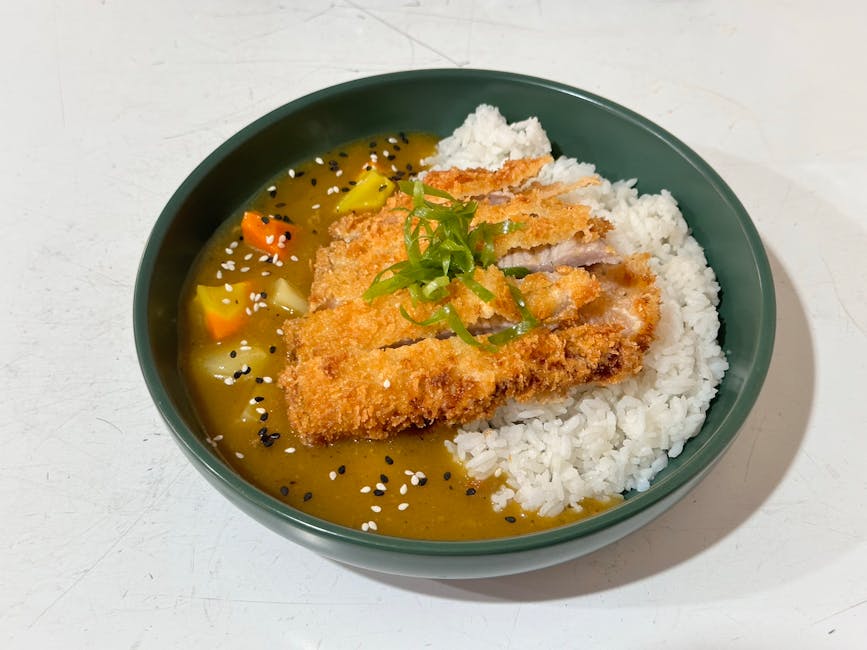
Katsu kare — a breaded, deep-fried pork cutlet (tonkatsu) served over rice with curry sauce — is the maximalist version of Japanese curry and the form that's gone most viral internationally. The dish combines two imported foods (curry and the French/German schnitzel that inspired tonkatsu) into a combination so satisfying that it seems almost unfairly good. The cutlet is panko-crusted, fried until the coating is shatteringly crisp, sliced into strips, and arranged over a mound of rice next to a lake of thick curry sauce. The first bite delivers crunch (panko), fat (pork), sweetness (curry sauce), and starch (rice) simultaneously. It's a serotonin bomb on a plate.
At Go Go Curry in Tokyo — a chain with a distinctive gorilla logo and Major League Baseball-themed decor — the katsu curry is served on a stainless steel plate with a mountain of shredded raw cabbage that provides the only fresh, light element in an otherwise heroically heavy meal. The curry sauce is darker and thicker than the standard home version, cooked for hours until it's almost black, with a deeper, more complex sweetness that suggests heavy caramelization. A regular katsu curry costs ¥780 ($5.35). For ¥1,100 ($7.55), you can get the "Major Curry," which upgrades the pork cutlet to double thickness and adds a fried shrimp on top. It is precisely as excessive as it sounds, and you should absolutely order it once.
The Curry Shops: Where It Gets Serious
Beyond the home-cooking roux and the katsu curry chains, Japan has a thriving independent curry shop culture where chefs make their own roux from scratch, often incorporating Indian, Sri Lankan, or Southeast Asian influences back into the Japanese framework. In Shimokitazawa, a neighborhood in western Tokyo known for its counterculture, a new wave of curry shops serves what's sometimes called "spice curry" — Japanese curry made with whole spices, often with South Asian or Nepalese cooks consulting on the spice blends, resulting in dishes that bridge the gap between Japanese and Indian traditions. The curry at Negombo in Shimokitazawa uses 30 spices, incorporates coconut milk, and comes with three different types of pickles and a side of dhal. It's recognizably Japanese in its presentation (neat rice mound, curry arranged precisely alongside) but the flavor is something new — complex, layered, and hotter than Vermont Curry would ever dare.
In Osaka, the curry scene tilts toward the eccentric. Colombo, a tiny shop in the Minami district, serves a black curry made with squid ink, chocolate, and an undisclosed spice blend that the owner has been refining for 25 years. The curry is pitch-dark, slightly sweet, faintly bitter from the chocolate, and strangely addictive. Mastani in Shinsekai district makes a dry keema curry — ground meat cooked with spices until the liquid evaporates, served over rice with a raw egg yolk on top that you stir in at the table. The egg emulsifies with the warm curry into a rich, coating sauce that clings to each grain of rice. These shops are as different from Vermont Curry as Vermont Curry is from Indian curry, and the distance between them measures the scope of Japanese curry's evolution from naval ration to national obsession.
The Comfort That Transcends
Japanese curry's global expansion in the 2020s — CoCo Ichibanya now has locations in 14 countries, and katsu curry has become a staple of the British takeaway scene, completing a full circle from British ships back to British plates — suggests that its appeal isn't culturally specific. There's something universal about a thick, warming, mildly spiced sauce over white rice: it triggers comfort-food responses across cultures. It doesn't challenge you. It doesn't demand expertise. It doesn't punish you for eating quickly or reward you disproportionately for eating slowly. It just sits on the plate, brown and glossy and familiar, and does exactly what you need a Tuesday dinner to do. The fact that this particular Tuesday dinner traveled from India to Britain to the Japanese Navy to a factory in Osaka to your kitchen table, transforming completely at each stop, is a story about how food moves through the world — not in straight lines, but in long, looping detours that end up somewhere nobody planned.