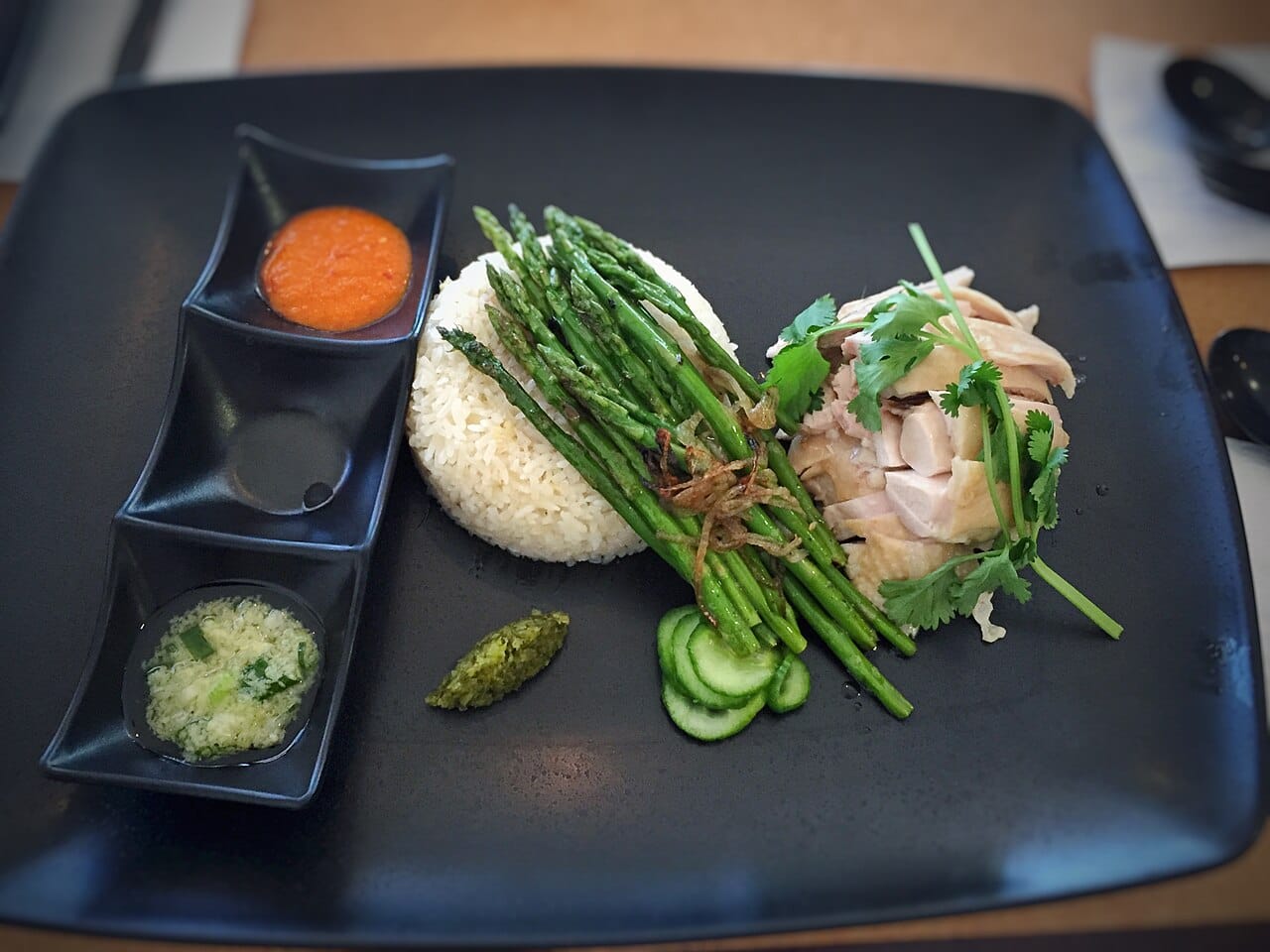
If you sit at the Tian Tian stall in Maxwell Food Centre in Singapore in May 2026 and order chicken rice, you receive a plate that is the codified, hawker-stall version of a dish that left Hainan with migrants in the 1920s. If you fly two hours north to Wenchang in Hainan and order Wenchang chicken — Hainanese chicken rice's claimed ancestor — you receive a substantially different dish: typically a yellow-skinned free-range chicken poached with ginger and scallion, served at room temperature with sour calamansi-and-soy dip, with rice that may or may not have been cooked in chicken stock, often plainer. Three generations of migration, adaptation and cross-pollination produced two related but distinct dishes. Understanding the divergence reveals something about how Asian cuisines actually evolve.
What the original Wenchang dish actually is
Wenchang chicken is one of Hainan's "four famous dishes" (sì dà míngcài), recognised since the Qing dynasty. The traditional preparation uses the Wenchang free-range chicken — a specific breed raised on coconut meal and banyan tree fruit, giving the meat a slight nutty character. The chicken is poached in seasoned water (the temperature controlled to prevent boiling), cooled in ice water to set the skin into a yellow gelatinous layer, and served at room temperature with three accompaniments: ginger-scallion oil, garlic-vinegar, and calamansi-soy.
Crucially, the rice in Hainan is often served plain or only lightly flavoured. The rice-cooked-in-chicken-stock convention that defines Singapore chicken rice is a Singapore innovation — added between roughly 1935 and 1950 by Hainanese cooks adapting to Southeast Asian preferences for more complete one-plate meals.
How the Singapore version became the global standard
Three waves of Hainanese migration to Singapore (1900-1920, 1935-1945, post-Communist 1949) brought the dish to British Malaya. Hainanese migrants were often employed as cooks in British colonial households, which gave them daily exposure to European one-plate dining and Chinese-Cantonese kitchen techniques. By the time the dish settled into Singapore's hawker culture in the 1960s, three modifications had become standard:
- Rice cooked in chicken stock with garlic and pandan leaf — the flavour anchor that distinguishes Singapore chicken rice from its origin.
- Chili sauce based on red chilies, garlic, lime juice and ginger — a much spicier and more emulsified condiment than the Hainan calamansi-soy dip. This is the single most distinctive element of the Singapore version.
- Selection of larger, white-feathered "kampong" chicken — meatier than the Wenchang breed, with a milder flavour that worked better with the increasingly assertive sauce.
Why Singapore won the global dish
Singapore chicken rice spread internationally in the 1980s-2000s through three vectors: Singapore Airlines in-flight food, Singaporean students and professionals abroad opening restaurants in London, Sydney, San Francisco, and the conversion of the dish into a national symbol after CNN's 2017 "world's 50 best foods" inclusion. The Hainan version stayed regional, partly because Hainan was politically and economically peripheral during the period when food brand-building happened.
What you're actually tasting at a top stall in 2026
The current generation of top-tier Singapore chicken rice stalls — Tian Tian (Maxwell), Hawker Chan (Chinatown Complex), Sin Kee (Mei Ling Street), Five Star (Anson Road) — operate at a level of consistency that the Hainan reference dish rarely achieves. Three technical elements distinguish a top-tier 2026 plate:
- Chicken at 65 °C internal temperature: poached and rested correctly, the meat is silky and the skin is gelatinous-soft rather than rubbery. Bad chicken rice is overcooked, dry, and the skin has the texture of plastic.
- Rice grains separate but glistening: cooked in chicken fat-emulsified stock, with the rice slightly under-hydrated so individual grains stay distinct. Rice that clumps is undertrained kitchen technique.
- Chili sauce balanced for heat + acidity + salt: chili sauce is where you can identify hawker training lineage. Tian Tian's sauce is markedly more acidic than Hawker Chan's; Sin Kee runs a hotter, garlic-forward version. Regulars know which they prefer.
The Hainan revival that's making chicken rice complicated
Since 2022, mainland Chinese diners — flush with disposable income and increasingly interested in regional Chinese cuisines — have driven a Wenchang chicken revival in Hainan tourism. Travel to Hainan in 2026 and order Wenchang chicken at a serious restaurant (Tan's Family in Wenchang city, or several Sanya hotels) and you encounter a Wenchang chicken that has been re-engineered to compete with the Singapore version: better stocks, more attention to skin texture, often with a Singapore-style chili sauce on the side as an alternative dipper. The original is itself now adapting to the famous diaspora descendant.
The "authentic" Hainanese chicken rice question has no clean answer in May 2026. The Singapore hawker version is the canonical reference. The Hainan original is its evolving counterpart. Both are now cousins; neither is the parent.