The Technique You're Already Using
If you've eaten Asian food this week — and statistically, you have — you've consumed fermented ingredients. Soy sauce: fermented. Fish sauce: fermented. Miso: fermented. Kimchi: fermented. Gochujang, doubanjiang, shrimp paste, black vinegar, sake, rice wine, tempeh, natto, pickled mustard greens, XO sauce — all fermented, all foundational, all so thoroughly integrated into their respective cuisines that removing them would be like removing vowels from a language. Fermentation isn't a technique in Asian cooking. It's the technique, the process that converts ordinary agricultural products into the concentrated, complex flavor bombs that define what Asian food tastes like. And most people who eat and enjoy these foods daily couldn't tell you what fermentation actually does or why it matters.
At its simplest, fermentation is controlled decomposition. Microorganisms — bacteria, molds, yeasts — break down organic matter into simpler compounds. When these organisms work on food under managed conditions (specific temperatures, salt levels, oxygen exposure), they produce desirable outcomes: lactic acid (tangy flavor, preservation), amino acids (umami, savory depth), alcohol (which can be further converted to vinegar), and hundreds of volatile aromatic compounds that give fermented foods their distinctive, complex smells and flavors. The magic is in the specificity. The same soybeans fermented with Aspergillus oryzae mold become miso. Fermented with Rhizopus oligosporus, they become tempeh. Fermented with a mixed culture of molds, yeasts, and bacteria in a brine, they become soy sauce. The raw material is identical. The microorganism is the chef.
The Soy Sauce Universe
Soy sauce might be the most consumed fermented product on earth, and its production is a masterclass in controlled microbial transformation. Traditional soy sauce (as opposed to the chemically hydrolyzed imitations sold in supermarkets) starts with soybeans and roasted wheat, inoculated with Aspergillus oryzae or Aspergillus sojae mold to make koji. The koji is mixed with a salt brine to create moromi (mash), which ferments in large vats for six months to three years. During this period, the koji's enzymes break down the soy and wheat proteins into amino acids (umami) and sugars (sweetness), while lactic acid bacteria produce sourness and yeasts generate alcohol and complex aromatics.
The resulting liquid — pressed from the moromi and pasteurized — contains over 300 identified flavor compounds. Three hundred. This is why naturally brewed soy sauce tastes complex and layered while chemically hydrolyzed soy sauce (made by treating soybeans with hydrochloric acid, a process that takes days instead of months) tastes flat and one-dimensionally salty. The fermentation does work that chemistry shortcuts can't replicate. At Kikkoman's factory in Noda, Japan — the world's largest soy sauce producer — the fermentation halls hold thousands of tanks of moromi at various stages, and the smell is a warm, savory, slightly sweet wave that tells your brain "this is going to taste good" before you've tasted anything.
The Korean Onggi System
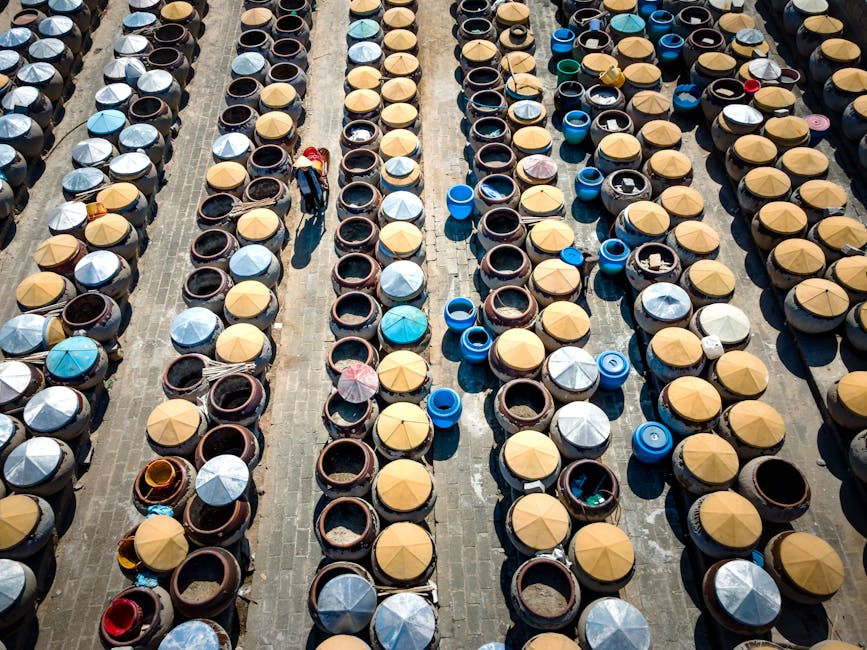
Korea's fermentation tradition is distinguished by its vessel: the onggi, an unglazed ceramic pot with a breathable micro-porous structure that allows gas exchange while maintaining anaerobic conditions inside. The onggi is the vessel for making kimchi, doenjang (fermented soybean paste), gochujang (fermented chili paste), ganjang (soy sauce), and jeotgal (fermented seafood). Every traditional Korean household maintained a jangdokdae — a terrace of onggi pots on the rooftop or in the yard — and the management of these pots (checking fermentation progress, adjusting lid position for ventilation, protecting them from extreme weather) was a domestic skill as important as cooking itself.
The onggi's porosity is not incidental — it creates a fermentation environment that's microbiologically distinct from glass, plastic, or metal containers. The microscopic pores allow carbon dioxide produced during fermentation to escape (preventing pressure buildup) while admitting trace amounts of oxygen that influence the microbial community inside. Research at Korea University found that kimchi fermented in onggi develops a different microbial profile — specifically, a higher proportion of Leuconostoc mesenteroides, the bacterium responsible for kimchi's initial fizzy, bright fermentation — than kimchi fermented in plastic or glass. Whether this translates to a taste difference is debated by food scientists and unanimously affirmed by Korean grandmothers, who insist that onggi kimchi simply tastes better. I believe the grandmothers.
Southeast Asian Fish Fermentation
The fermented fish products of Southeast Asia form a category so diverse it could fill a book. Beyond liquid fish sauce (covered elsewhere on this site), the region produces pastes, whole preserved fish, and fermented fish condiments that occupy a spectrum from mildly funky to aggressively pungent. Cambodian prahok — a paste of crushed, salted, fermented freshwater fish — is the backbone of Khmer cooking, stirred into soups, stir-fries, and dipping sauces. Its smell is challenging even by fermented food standards, but its contribution to flavor is irreplaceable: a deep, complex, almost meaty savoriness that provides the bass notes over which Khmer cuisine's bright, herbal flavors play. At a market in Phnom Penh, the prahok vendors sit surrounded by earthenware jars of paste in various stages of fermentation, from weeks-old (pale, relatively mild) to years-old (dark, intense, and smellable from 10 meters).
Thai pla ra (fermented freshwater fish) and the related pla daek of Laos serve similar roles in Isaan and Lao cooking. The fish — usually snakehead or mudfish from rice paddies — is packed with salt and rice bran in sealed containers and fermented for at least a year. The resulting paste is used in som tam (green papaya salad), in larb (minced meat salad), and in countless soups and stir-fries throughout Isaan and Laos. Its flavor is deeper and more complex than liquid fish sauce, with earthy, grain-like notes from the rice bran that fish sauce lacks. In Bangkok, using pla ra marks a dish as Isaan rather than Central Thai, and its inclusion is a matter of regional pride.
Japanese Koji: The Master Mold
Aspergillus oryzae — koji mold — is arguably the single most important microorganism in Asian cuisine. It's the organism that makes miso, soy sauce, sake, rice vinegar, mirin, amazake (sweet fermented rice drink), and shio koji (salt koji, a versatile seasoning and marinade). Japan designated it the national mold (kokukin) in 2006, a distinction that sounds humorous but reflects the genuine cultural significance of an organism that has been cultivated and refined by Japanese craftspeople for over a thousand years.
Koji's power lies in its enzymatic productivity. When grown on steamed rice or soybeans, it produces amylases (which convert starches to sugars), proteases (which convert proteins to amino acids and umami compounds), and lipases (which break down fats into fatty acids and glycerol). These enzymes do the heavy lifting of fermentation, pre-digesting the substrate so that subsequent organisms (yeasts, lactic acid bacteria) can work on the released sugars and amino acids. In sake brewing, koji converts rice starch to sugar, which yeast then converts to alcohol. In miso, koji converts soy protein to amino acids, which accumulate over months into the paste's characteristic umami intensity. The mold doesn't produce flavor directly — it creates the conditions for flavor to develop. It's the foreman, not the laborer.
Shio Koji at Home
The most accessible way to experience koji's power is shio koji — a simple mixture of koji rice, salt, and water that ferments at room temperature for 7-10 days. The result is a thick, porridge-like paste that functions as a universal marinade and seasoning. Rub it on chicken thighs for 4-6 hours before grilling and the enzymes tenderize the meat while the sugars and amino acids produce a caramelized, deeply savory crust. Use it to marinate vegetables (cucumbers, radishes) for a quick pickle that's more complex than salt alone. Stir it into soups and stews as a finishing seasoning. Shio koji is available pre-made at Japanese grocery stores (Hanamaruki brand is excellent) or you can make it from dried koji rice (available online and at Japanese markets). The investment — $8 for dried koji, a week of occasional stirring — produces a condiment that will change how you think about seasoning food.
The Fermentation Revival
Western food culture has been experiencing a fermentation revival since the 2010s, driven by books like Sandor Katz's "The Art of Fermentation" and the broader interest in gut health, probiotics, and traditional food processing. This revival has been valuable in introducing fermentation techniques to a new audience, but it sometimes treats fermentation as a rediscovery rather than recognizing that the techniques never went anywhere in Asia. The Korean grandmother who's been making kimchi for 50 years didn't need a Brooklyn-based fermentation workshop to tell her about lactic acid bacteria. The Japanese toji (sake master brewer) who's been cultivating koji since he was an apprentice at 18 isn't waiting for a Western validation of his craft. The fermentation "trend" is a Western trend. In Asia, it's Tuesday.