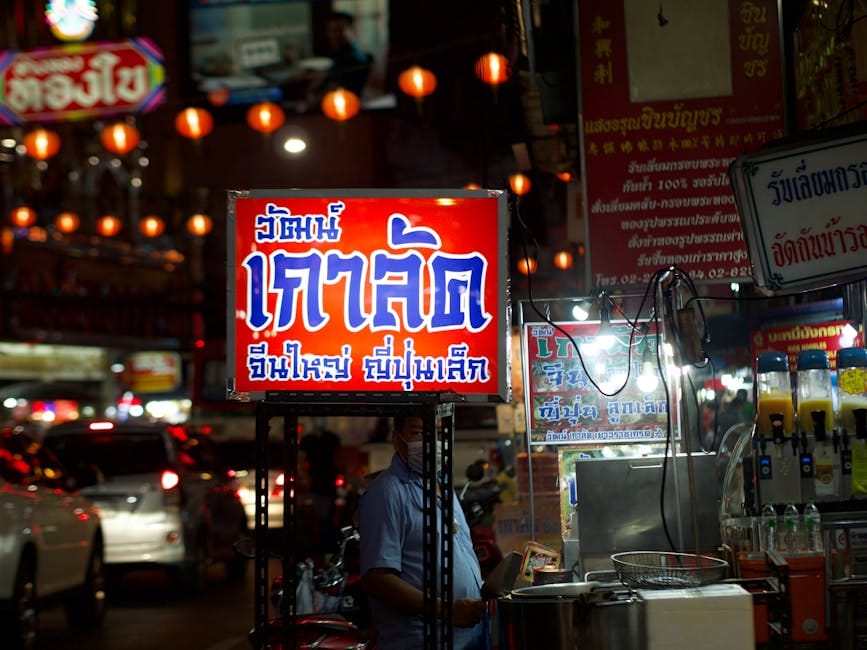
The City Wakes Up When Everyone Else Goes to Sleep
At 1 a.m. on Yaowarat Road, the smoke from a dozen charcoal grills hangs in the humid air like a translucent curtain, lit orange by the neon signs of Bangkok's Chinatown. A woman in a plastic apron is fanning flames under a wire rack of giant river prawns, each one the size of your hand, their shells cracking and turning from grey to brilliant coral. The line behind her cart stretches past three shopfronts. Nobody seems to mind the wait. This is Bangkok doing what Bangkok does best — feeding people at hours when most cities have long since shuttered their kitchens.
The popular tourist narrative places Bangkok street food squarely in the daylight hours, at places like Chatuchak Weekend Market or the sanitized food courts of Siam Paragon. That version of Bangkok street food is fine, even good. But it misses the city's real pulse. After midnight, a parallel food economy emerges: mobile carts roll into position along Ratchadaphisek, wok stations fire up behind Victory Monument, and the old Chinatown transforms into a seafood theater that rivals any restaurant in the country. If you haven't eaten in Bangkok after midnight, you haven't eaten in Bangkok.
Yaowarat Road: Chinatown's Open-Air Seafood Feast
The undisputed king of late-night Bangkok eating is Yaowarat Road and its branching sois. T&K Seafood, the restaurant with the green tables spilling onto the sidewalk, is the one you'll find in every guidebook. The tom yum kung here — intensely sour, loaded with head-on prawns, fragrant with galangal and lemongrass — runs about 350 baht ($10) for a portion that could drown two bowls of rice. It deserves its reputation. But the real magic of Yaowarat happens at the unnamed stalls wedged between the gold shops. One vendor near Soi 11 does nothing but grilled squid, butterflied and pressed flat on a charcoal grate, served with a seafood dipping sauce so spicy it makes your lips tingle for an hour. Thirty-five baht. Under a dollar.
Walk deeper into the sois and you'll find rolled ice cream vendors who were doing the technique decades before it went viral on social media, and ancient Chinese dessert shops serving tong sui — warm sweet soups with lotus seeds, red beans, and ginkgo nuts — from recipes that trace back to Teochew immigrants. The sensory overload is part of the point: sizzling woks create brief fireballs, ice is hand-crushed with a mallet, and the smell of roasting oyster omelets mingles with diesel exhaust and jasmine garlands from the nearby shrine. It's not pretty. It's magnificent.
Victory Monument: The Boat Noodle District
The area around Victory Monument BTS station transforms after 10 p.m. into a dense cluster of boat noodle shops. Boat noodles — kuay tiaw reua — are Bangkok's most underrated street food. Traditionally sold from boats on the canals of Ayutthaya and Bangkok, the bowls are deliberately tiny, about the size of a teacup. You're meant to eat five, ten, fifteen of them. Each bowl costs 12 to 15 baht (around 35 to 45 cents), and they arrive in rapid succession once you start ordering. The broth is dark, almost black, thickened with pig's blood (yes, really) and intensely flavored with cinnamon, star anise, and dried chilies. Thin rice noodles, a few slices of braised pork or beef, crispy pork rinds on top.
The best spot is Kuay Tiaw Reua Pa Lek, a no-frills shop where they stack your empty bowls to keep count. Regulars here put away 15 to 20 bowls without blinking. The trick is to add the provided condiments bowl by bowl, so each one tastes slightly different — more chili flakes here, a squeeze of lime there, a spoonful of sugar in the next one. It's interactive eating that turns a simple noodle soup into a personalized experience, and at roughly $5 for a full meal, it's the best value in a city already famous for cheap food.
Ratchadaphisek Road: The Night Market That Feeds Night-Shift Bangkok
After the famous Train Night Market Ratchada closed, the area around Ratchadaphisek Road developed a scattered but thriving collection of late-night food stalls and carts catering to taxi drivers, security guards, and club-goers stumbling out of the neighborhood's entertainment venues. The food here skews toward hearty Thai-Chinese comfort: khao man gai (Hainanese chicken rice) with impossibly silky poached chicken and rice cooked in chicken fat, pad see ew with wide rice noodles seared to smoky sweetness, and plates of crispy pork belly over rice drenched in sweet soy gravy.
One stall near the Huai Khwang intersection specializes in joke (Thai rice porridge) and serves it from 11 p.m. to 5 a.m. exclusively. The porridge is smooth, almost velvety, topped with a raw egg that slowly cooks in the hot rice, shreds of ginger, fried garlic, and your choice of pork meatballs, sliced liver, or century egg. At 50 baht ($1.50), it's the quintessential Bangkok late-night recovery meal, equally suited to ending a night of drinking or fueling a graveyard shift. The plastic stools and fluorescent lighting strip away any pretense. You're here for one reason.
Sukhumvit Soi 38 and Its Legacy
Soi 38 was once the most famous late-night food street in Bangkok, a narrow lane lined with stalls serving pad thai, mango sticky rice, and satay to a mixed crowd of expats, tourists, and office workers. Development eventually pushed most vendors out, but the food culture simply migrated. Today, the stretch between Soi 38 and Thong Lo still harbors excellent late-night options, just in a more dispersed configuration. Look for the pad thai vendor who sets up near the mouth of Soi 38 around 9 p.m. — the noodles are cooked over charcoal in a worn steel wok, tossed with dried shrimp, pressed tofu, bean sprouts, and wrapped in a thin egg crepe. Eighty baht. The smoky char on the noodles is what separates this pad thai from the gummy tourist versions.
A few blocks toward Thong Lo, a rotating cast of Isaan food carts serves som tam (green papaya salad) with enough bird's-eye chilies to rearrange your understanding of spicy food. The som tam poo plara version — with fermented crab and pickled fish sauce — is not for the faint of heart but is absolutely what you should order if you want to understand northeastern Thai flavor at its most uncompromising. Pair it with sticky rice and larb moo (minced pork salad) and you have a complete Isaan meal on a plastic table at two in the morning.
The Unwritten Rules of Late-Night Bangkok Eating
A few things will improve your after-midnight food experience dramatically. First, bring cash in small denominations — most vendors don't have change for 1,000 baht notes and mobile payment adoption among street vendors is spotty at best. Second, point and gesture confidently. Most late-night vendors speak minimal English, but the food is visible and pointing works perfectly. If you see someone else eating something that looks good, point at their plate, hold up one finger, and you'll have the same thing in minutes.
The golden rule of Bangkok night eating: If a stall has a long line of Thai customers after midnight, join it. If a stall has English menus and photos, walk past it.
Third, don't be afraid of the hygienic conditions. The turnover at busy stalls is so high that ingredients are constantly fresh. The stall that looks spotless and empty is statistically more likely to give you food poisoning than the chaotic one with thirty customers. Bangkok's street food culture has survived for generations because the economics of high-volume, low-margin cooking naturally select for freshness and speed. The prawns on that grill were alive two hours ago. The noodles in that wok were dry ten minutes ago.
The Meal That Keeps Bangkok Honest
There's a theory that you can judge a city's food culture by what's available at 3 a.m. By that measure, Bangkok ranks with only a handful of cities worldwide — Taipei, Mexico City, perhaps Istanbul. The late-night food scene isn't a gimmick or a tourist attraction. It's a functional part of the city's infrastructure, feeding the vast workforce that keeps Bangkok running through the night: the tuk-tuk drivers, the hotel staff, the construction workers, the nurses finishing their shifts at Bumrungrad Hospital. The food is priced for them, portioned for them, and seasoned for them. You're just a lucky guest at a table that was never set for you.
At 4 a.m., when the last of the Yaowarat grills are cooling and the joke vendors are hitting their stride, Bangkok's food culture reveals its most honest face: not the Michelin-starred restaurants or the rooftop bars with river views, but a bowl of rice porridge under a buzzing fluorescent light, eaten on a wobbly stool, with a stray cat watching from under the cart.