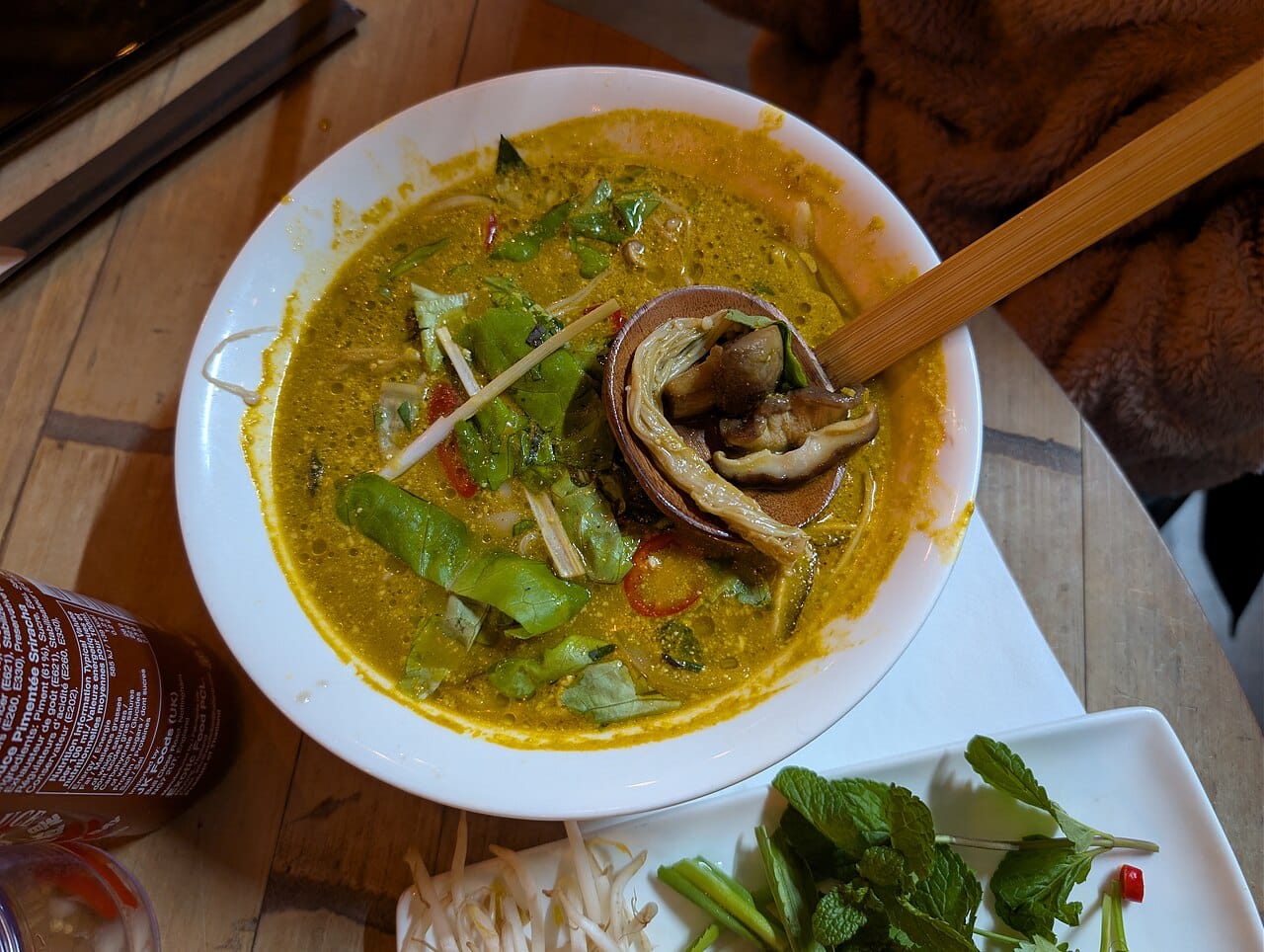
It is 06:40 on a Tuesday in Hanoi's Old Quarter, and the woman at the corner stall has already served forty-two bowls of pho. I count them by the wooden chopsticks she pushes across the steel counter, one pair per customer, before she turns back to the broth that has been simmering since 04:00. The men sitting on plastic stools eat without looking up. There is no music, no menu, no conversation beyond the occasional grunt of approval. This is breakfast in a city that takes breakfast seriously, and across Asia, the bowl that opens the morning carries more meaning than any croissant ever managed.
I have spent the better part of two years tracing what I have come to think of as the breakfast-soup belt: a continuous arc from Hanoi through Taipei, Tokyo, Seoul and Sapporo, where the day begins, properly and almost universally, in front of a steaming bowl. The dishes are different, but the logic is the same. They are slow to make and fast to eat. They are nutritionally complete. They are cheap. And they are, in each city, the deepest expression of a public food culture that has not been replicated anywhere else in the world.
Pho in Hanoi: the broth that defines a country
Pho bo, the Vietnamese beef noodle soup, is older than most of the buildings that serve it. The version eaten in Hanoi (pho Bac) is austere: a clear broth simmered for at least eight hours from beef bones, charred ginger, charred onion, star anise, cinnamon and cardamom. The noodles are flat, fresh, and slipped into the bowl at the last moment. Slices of rare beef cook in the heat of the broth as it is poured. The garnish is restrained, perhaps spring onion, perhaps coriander, perhaps a wedge of lime.
The southern variant (pho Nam, eaten in Ho Chi Minh City and most of the diaspora) is sweeter, more aromatic, and arrives with a forest of basil, bean sprouts, sawtooth herb and chilli. Both are correct. Both are pho. The argument between them is older than my grandmother and will outlive me.
What you learn from a Hanoi breakfast bowl
- The broth carries the meaning, not the toppings. A great pho stall is judged on its broth alone.
- You eat first, talk later. Hanoi pho stalls are quiet for a reason: the soup cools quickly, and a cold bowl is a wasted bowl.
- The lime, the chilli, the herb are choices, not requirements. The first bowl, properly, is unadorned.
- Twenty minutes is the polite duration. Anything longer is conspicuous.
Ramen in Tokyo and Sapporo: the engineering of warmth
Where pho is austere, ramen is elaborate. The Japanese have made the breakfast bowl into an engineering problem and solved it differently in every region. Tokyo's shoyu ramen pairs a soy-based tare with a chicken-and-pork dashi, served with thin straight noodles and slices of chashu pork. Sapporo's miso ramen, born in the post-war years to fight Hokkaido winters, pairs a fermented bean tare with a richer broth, curly noodles and corn or butter.
What unites them is intention. A good Japanese ramen-ya treats the morning bowl as a discrete category. The shop opens early, often at 05:30 in working-class districts of Tokyo such as Tsukiji, Kanda or Tachikawa, and the breakfast version is lighter, with less oil and a smaller portion of noodles. You eat in roughly twelve minutes, you say "gochiso-sama deshita" as you leave, and the shop turns the seat over before your scarf is back on.
The morning ramen rules I had to learn the hard way
- Slurp. The cooling effect is real, the acoustic effect is appreciated, and silent eating is mistaken for displeasure.
- Do not photograph the bowl in shops smaller than ten seats. The chef is watching the steam, not your phone.
- Finish the noodles before the broth cools below 70 degrees. Beyond that point, the texture deteriorates within ninety seconds.
- If you order kaedama (a noodle refill), commit to finishing it. Half-eaten kaedama is a rudeness that registers.
Beef noodle soup in Taipei: the post-war bowl
Niu rou mian, Taiwan's beef noodle soup, is younger than pho and ramen. Most food historians date its modern form to the late 1940s and early 1950s, when Sichuanese and Shandong cooks who arrived with the Kuomintang adapted their regional traditions to the ingredients available on the island. The result is a bowl that pairs braised beef shank, hand-pulled or thick wheat noodles, suan cai (pickled mustard greens) and a broth that ranges from clear (qing dun) to deeply red and spicy (hong shao).
The Taipei breakfast version is typically clear-broth, lighter than the lunchtime hong shao, served at stalls that open at 06:00 in neighbourhoods like Yongkang Street, Tonghua Night Market's morning side, and the alleys around Zhongxiao Fuxing. The bowl costs between 120 and 180 New Taiwan dollars, comes with a small dish of fermented vegetables, and is eaten with a slow, deliberate efficiency that contrasts with the rushed kinetics of Tokyo or the silent intensity of Hanoi.
The Taipei breakfast economy
Niu rou mian breakfast culture is a working-class economy in transformation. Many of the older masters are now in their seventies, with no apparent successors, and stalls are closing at a rate of perhaps fifteen per cent per year in central Taipei. New entrants tend to be more polished, more expensive, and more performative, with carefully designed interiors and Instagram-friendly bowls. The flavour is sometimes better, sometimes worse, but the rhythm is different.
Seoul's haejangguk: the bowl that mends
South Korea has its own breakfast soup culture, anchored not in noodles but in haejangguk, literally "soup to chase a hangover." The most common variants are seonjiguk, a beef-blood soup; ugeoji haejangguk, with dried cabbage and ox bones; and kongnamul gukbap, a bean-sprout and rice soup served in Jeonju style. Seoul's morning haejangguk restaurants open by 06:30 and reach peak occupancy between 07:30 and 08:30, when office workers stop on the way to nearby buildings.
The bowl is communal, the side dishes are abundant, and the social contract is straightforward: the soup is medicinal, the conversation is minimal, and the price (between 9,000 and 14,000 won) is fixed regardless of how much rice you reload.
What the breakfast bowl teaches a city
The Asian breakfast soup tradition is, more than anything, a public-space institution. It requires stalls, counters, plastic stools, shared tables. It assumes that strangers will eat side by side without speaking, that the morning is a quiet ritual rather than a domestic one, and that the bowl in front of you is the beginning of a relationship between you and a vendor that may last decades.
Western cities have largely lost this. The closest analogues, working-class diners and bagel counters, have shrunk under property pressure and changing rhythms of work. Asia has held on, partly through density, partly through cultural conservatism, partly through the simple economic fact that a 50,000-dong bowl of pho or a 600-yen morning ramen is still cheaper, faster and more nourishing than the alternatives.
How to eat a breakfast bowl, anywhere in Asia
- Arrive between 06:30 and 08:00. The broth is freshest, the noodles cooked to the most attentive standard.
- Sit alone. Talking partners diminish your attention to the bowl, which is the point.
- Tip with completion, not money. An empty bowl is the highest praise.
- Return. The third visit is when the vendor begins to remember you.
Back in Hanoi, the woman at the corner stall has reached bowl number sixty-three. The stool I am sitting on has been used by perhaps two hundred different people this morning. The broth in front of me is, I am told, identical to the broth her mother served in this same alley in 1987. None of this is sentimental. It is simply how a city wakes up, in a part of the world that has not yet decided that breakfast is a private matter.