The Robusta Rebellion
In the world of specialty coffee, robusta beans are the villain. They're bitter, they're harsh, they contain nearly twice the caffeine of arabica, and they're grown at lower altitudes in conditions that arabica snobs consider insufficiently challenging. Third-wave coffee shops that charge $6 for a single-origin Ethiopian pour-over wouldn't stock robusta if you paid them. Vietnam, the world's second-largest coffee producer (behind Brazil), grows approximately 95% robusta. And Vietnamese coffee culture has taken this theoretically inferior bean and built one of the most satisfying coffee traditions in the world around it, using a combination of dark roasting, slow extraction, and sweetened condensed milk that transforms robusta's weaknesses into strengths. The coffee world's dismissal of robusta says more about the coffee world's blind spots than it does about the bean.
Vietnamese robusta is typically roasted dark — much darker than the light and medium roasts favored by specialty coffee — sometimes with additions of butter, sugar, or even fish sauce during roasting (the additions caramelize, coating the beans with a thin layer of toasty sweetness). This dark roast eliminates the harsh, rubbery notes that make raw robusta unpalatable and replaces them with a deep, chocolatey bitterness that's closer to dark cocoa than burnt coffee. The high caffeine content, which is a flaw in a delicate arabica context, becomes a feature when the coffee is served cold over ice — the robust (pun intended) flavor doesn't dilute into watery nothing the way lighter roasts do. Vietnamese coffee is engineered for its conditions, and those conditions include tropical heat, ice, and sweet dairy.
The Phin: Five Minutes of Patience
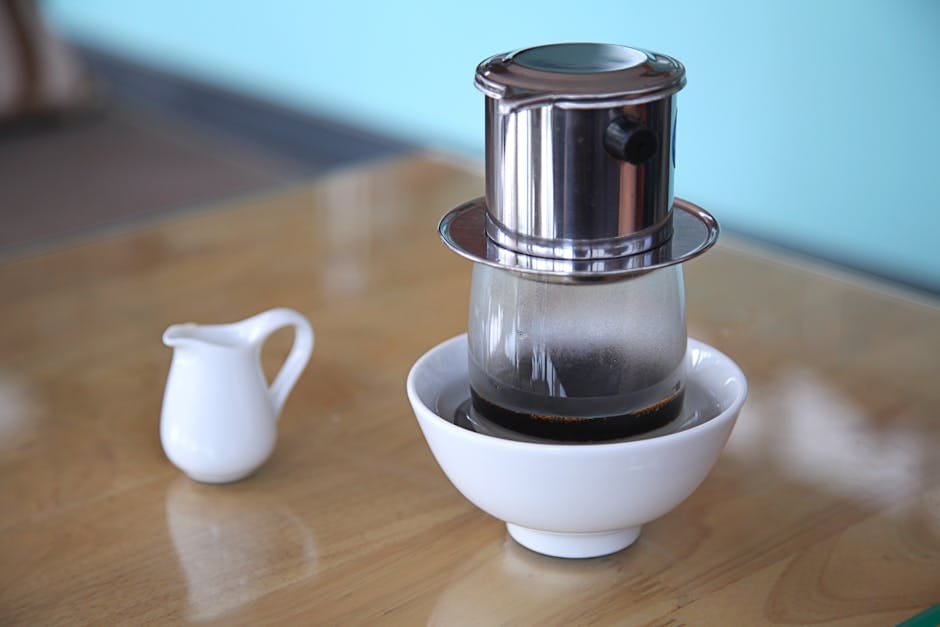
The phin — a small, single-serving metal filter that sits directly on top of your cup — is the defining tool of Vietnamese coffee. It's a beautifully simple device: a perforated plate rests on the cup, a brewing chamber sits on the plate, ground coffee goes in the chamber, a press screen tamps the grounds, and hot water is poured over the top. The coffee drips through the grounds and the perforated plate, one drop at a time, directly into the cup below. The entire process takes three to five minutes, and there's nothing to do while you wait except watch the dark liquid accumulate, inhale the aroma, and contemplate whether you have anywhere to be.
The phin produces a coffee that's somewhere between espresso and drip coffee in intensity — stronger and more concentrated than a standard American drip but less pressurized and slightly smoother than espresso. The slow gravity extraction pulls different compounds from the grounds than high-pressure methods do, producing a brew that's heavier on oils and body but lighter on the sharp, acidic notes that espresso extracts. It's a contemplative way to make coffee, and it suits the pace of Vietnamese cafe culture, where sitting for an hour over a single cup is not just acceptable but expected. At Cong Ca Phe in Hanoi's Old Quarter — a military-themed chain that serves coffee in tin cups amid Communist-era decor — the phin arrives with a small cup of ice tea on the side, and you're meant to sip the tea while waiting for the coffee. The tea is free. The patience is mandatory.
Ca Phe Sua Da: The National Drink
Ca phe sua da — iced coffee with condensed milk — is Vietnam's national beverage, consumed from breakfast through late evening by virtually everyone regardless of age, class, or occupation. The preparation is straightforward: two tablespoons of sweetened condensed milk go into the bottom of the glass, the phin drips concentrated coffee on top, you stir to combine, then pour the mixture over a tall glass of ice. The result is a drink that's sweet, intensely caffeinated, creamy, cold, and powerfully flavored — the condensed milk's caramel-sugar richness tames the robusta's bitterness while the bitterness prevents the sweetness from becoming cloying. It's a balance that mirrors the Thai iced tea principle: strong flavors in opposition create a whole that's more satisfying than either component alone.
The condensed milk, as in Thai iced tea, is a colonial artifact. French colonists brought coffee cultivation to Vietnam in the 1850s and brought canned condensed milk as a shelf-stable dairy product shortly after. Fresh milk was unavailable in tropical Vietnam, so condensed milk became the default addition to coffee and has remained so even as fresh dairy has become widely available. Today, using fresh milk in Vietnamese coffee is considered a different drink entirely — ca phe sua tuoi — and it's perceived as lighter and less satisfying than the condensed milk version. At ca phe stalls across Ho Chi Minh City, the condensed milk is non-negotiable, and the only question is how much. Most vendors default to a quantity that Western visitors find staggeringly sweet; asking for "it ngot" (less sweet) is advisable on your first order until your palate adjusts.
Ca Phe Trung: The Egg Coffee of Hanoi
In 1946, a bartender named Nguyen Van Giang at the Sofitel Legend Metropole Hanoi faced a problem: fresh milk was scarce during the First Indochina War. His solution was to whisk egg yolk with condensed milk and sugar until it formed a thick, foamy cream, then pour hot coffee underneath. The result — ca phe trung, egg coffee — is still served at Cafe Giang, the shop that Nguyen Van Giang's son operates in a narrow alley off Hang Gai Street in Hanoi's Old Quarter. The egg cream sits on top of the coffee like a meringue, dense and custard-like, and you're meant to spoon the cream and sip the coffee alternately, mixing them gradually as you go.
Egg coffee is one of those preparations that sounds categorically wrong and tastes categorically right. The egg yolk adds a richness and body that condensed milk alone can't achieve — it's like drinking a liquid tiramisu, with the bitter coffee cutting through the sweet, eggy foam. The texture is what sells it: the cream is airy but substantial, almost like a warm zabaglione, and it maintains its structure for several minutes before slowly dissolving into the coffee below. At Cafe Giang, the egg coffee costs 35,000 VND ($1.40) and the shop is perpetually crowded, with customers crammed onto small plastic stools across three floors of a narrow Hanoi tube house. The experience — the tight space, the sweet smell of beaten egg, the first sip of cream-and-coffee — is one of Hanoi's essential food moments, and it wouldn't exist if fresh milk had been available 80 years ago.
The New Wave: Vietnamese Specialty Coffee
Vietnam's coffee scene has undergone a transformation in the 2020s as a new generation of Vietnamese roasters and cafe owners has begun applying specialty coffee principles to local beans. The Workshop in Ho Chi Minh City was among the first to offer single-origin Vietnamese arabica (grown in the Central Highlands around Da Lat) brewed as pour-over and espresso, treating Vietnamese coffee with the same seriousness that third-wave shops apply to Ethiopian and Colombian beans. The result challenges every assumption the specialty world holds about Vietnamese coffee: the arabica from Da Lat is clean, fruity, and complex, nothing like the dark-roasted robusta that defines the traditional cafe.
But here's the nuance that the "Vietnamese specialty coffee is finally good" narrative misses: traditional Vietnamese coffee was never bad. It was different. The robusta-condensed-milk-phin combination is a sophisticated system optimized for specific conditions — tropical heat, high-caffeine preference, limited dairy infrastructure, social cafe culture that values contemplation over efficiency. Judging it by arabica specialty standards is like judging sashimi by steak standards: you're applying the wrong rubric. The best Vietnamese cafes today — places like The Workshop, Shin Coffee, and Cong Ca Phe — understand this and offer both: specialty arabica pour-overs for the new wave, and traditional ca phe sua da for everyone else. The two can coexist, and the coffee is better for it.
The Plastic Stool and the Street
The defining image of Vietnamese coffee culture isn't a coffee shop interior. It's a sidewalk. Specifically, it's a Saigon sidewalk at 7 a.m., where a dozen plastic stools the height of a child's chair are arranged around a low cart, and office workers in pressed shirts sit with their knees at their chests, drinking ca phe sua da from glasses the size of a fist, watching the motorbike traffic stream past in a continuous, honking river. The stool is uncomfortable. The coffee is perfect. The scene is repeated on every block, in every neighborhood, in every Vietnamese city, from Hanoi to Can Tho, and it represents something that no coffee chain or specialty roaster can replicate: coffee as a public ritual, performed at street level, without pretension or hurry, in the place where life actually happens.