A robot rolls toward your table in a Shenzhen hotpot restaurant, carrying a tray of thinly sliced lamb and a QR code for the bill. In Tokyo, a ramen shop requires no human interaction at all — you order from a vending machine, sit in a solo booth separated from the kitchen by a bamboo screen, and your bowl appears through a slot. In Singapore, an AI system analyzes your previous orders and suggests tonight's dishes based on the weather, your dietary restrictions, and trending items. In Seoul, a conveyor belt delivers your bibimbap while a screen embedded in the table shows you a 30-second video of the farmer who grew the rice.
Asia's restaurant technology isn't experimental or aspirational. It's operational, widespread, and accelerating in ways that are transforming the dining experience for hundreds of millions of people. Whether this transformation is entirely positive is a more complicated question.
Japan: The Original Tech Dining Pioneer
Japan has been automating restaurants since before "automation" was a food-industry buzzword. The ticket vending machine (券売機, kenbaiki) has been standard in ramen shops and budget restaurants since the 1960s. You insert money, press a button corresponding to your dish, receive a ticket, hand it to the cook. No ordering confusion, no language barriers, no human interaction required. It's efficient, democratic (everyone gets the same service regardless of social status), and perfectly suited to Japan's cultural comfort with technology and its labor shortage.
Sushiro and Kura Sushi — Japan's largest conveyor belt sushi chains — have pushed automation further. Current Sushiro locations feature tablet ordering, automated delivery via express lanes (your specific order arrives on a dedicated upper belt, announced by your table number), plate counting by sensor (the bill is calculated by the stack of plates you've accumulated), and a gacha machine reward system where every five plates earns you a capsule toy. A family of four can eat at Sushiro without speaking to a single employee. Some families do.
The extreme example is Ichiran Ramen, which has turned the absence of human contact into a brand identity. The "flavor concentration booths" (味集中カウンター) are individual stalls with wooden partitions on three sides. You customize your ramen on a paper form (noodle firmness, broth richness, garlic level, spice level, extra toppings) and slide it under the bamboo screen. The bowl appears minutes later. You eat in solitude. Ichiran calls this "a system that allows each customer to focus fully on ramen." Critics call it dining for people who don't want to dine. Both descriptions are accurate.
China: Scale and Speed
China's restaurant technology operates at a scale that makes other countries' innovations look like pilot programs. Haidilao, the hotpot chain with over 1,400 locations, deployed robot servers at its Beijing flagship in 2018 and has expanded the program to dozens of locations. The robots navigate dining rooms using LIDAR and cameras, delivering ingredients to tables and returning empty plates to the kitchen. They're cute — designed to look friendly rather than industrial — and children love them. They also free human servers to focus on Haidilao's legendary customer service (nail painting, shoe shining, phone screen protectors while you wait).
WeChat and Alipay have eliminated cash from most urban Chinese restaurants. The typical dining experience in a mid-range Shanghai restaurant in 2026: scan a QR code at the table, browse the menu on your phone (with photos, ingredient lists, and allergen warnings), order and pay without flagging a server. Your food arrives delivered by a combination of human servers and automated systems. The tip line doesn't exist because tipping isn't customary. The entire transaction can occur without a word spoken.
AI Menu Personalization
Several Chinese restaurant chains have begun implementing AI-driven menu recommendations. Yum China (which operates KFC and Pizza Hut in China) uses purchase history and demographic data to customize digital menu displays — showing different promoted items to different customers. Luckin Coffee's app uses machine learning to predict what you'll order based on time of day, weather, and previous purchases, pre-loading your likely order for one-tap purchasing. The accuracy is reportedly above 60%, which means the AI gets your coffee order right more often than some human baristas.
South Korea: Convenience Meets Culture
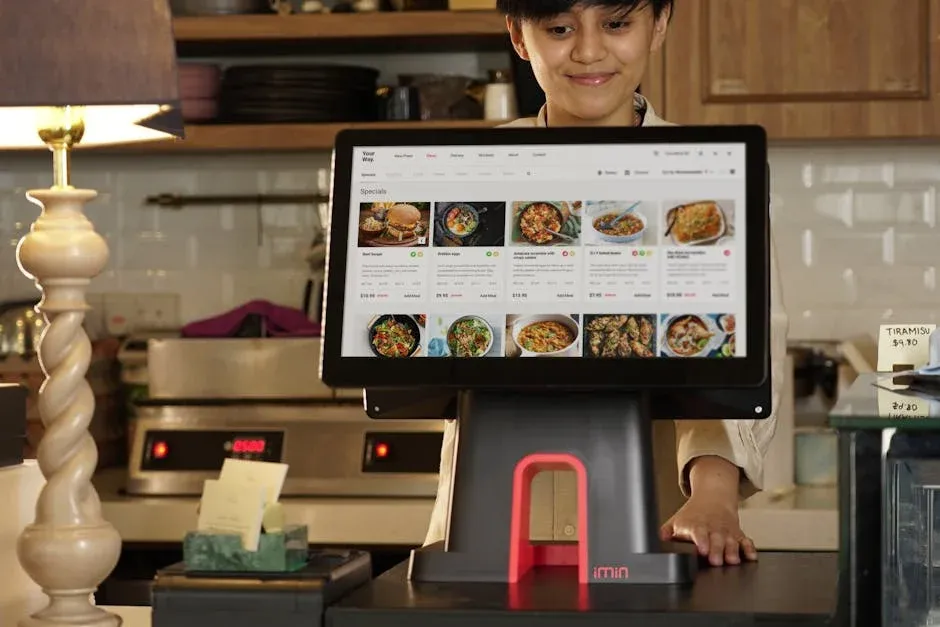
South Korea's restaurant technology reflects the country's position as one of the world's most digitally connected societies. Tablet ordering is standard in mid-range Korean restaurants — the device sits on every table, showing the full menu with photos. You order by tapping, and the kitchen receives the order instantly. No waiting for a server, no miscommunication, no awkward flagging.
The kiosk ordering system in Korean fast food and fast casual restaurants has become so dominant that some older Koreans have complained about digital exclusion — they struggle with the touchscreen interfaces and feel unwelcome in restaurants that have eliminated human order-taking entirely. The government has responded with "digital literacy" programs, but the underlying tension between technological efficiency and human accessibility remains unresolved.
Korean delivery apps — Baemin (배달의민족), Coupang Eats, Yogiyo — have transformed not just delivery but the restaurant industry itself. An estimated 40% of restaurant orders in Seoul now come through delivery apps. This has spawned a new category of "delivery-only" restaurants (similar to ghost kitchens but more formalized) and changed menu design: dishes must travel well, photograph well for the app, and compete on a screen rather than through ambiance or location.
A Seoul restaurant owner told me: "My dining room seats 30 people. My delivery app reaches 3 million. Which should I optimize for?" The answer, increasingly, is the app.
Singapore: The Smart Food Court
Singapore's hawker centers — the UNESCO-recognized food courts that are central to national identity — are undergoing a technology transformation that's equal parts promising and contentious. The government-backed Hawker Centre 3.0 initiative has introduced centralized dishwashing systems, automated tray return stations, and digital payment integration to new and renovated hawker centers.
Some hawkers have embraced technology enthusiastically. A chicken rice stall at Chinatown Complex uses a robotic arm to chop chicken — a task that traditionally requires years of knife skill. The robot produces consistent portions, reduces labor costs, and allows the stall to serve more customers. The chicken tastes the same. But something is lost when the dramatic, rhythmic chopping — a performance that was part of the hawker experience — is replaced by a machine's silent precision.
The Human Cost
Technology's benefits to Asian restaurants are real: reduced labor costs in markets facing worker shortages, increased speed and consistency, better data for inventory management and waste reduction, and accessibility improvements (multilingual digital menus, photo-based ordering for tourists). But the costs are also real.
The most significant cost is the erosion of the human interactions that make dining a social experience rather than a fueling exercise. The ramen shop where the owner greets regulars by name, remembers their order, and adjusts the broth based on the weather — that experience requires a human. The hawker who chats with customers while stir-frying noodles, who gives extra portions to students who look hungry, who knows the neighborhood — that relationship can't be automated.
There's also the question of who benefits. Large chains can afford robot servers and AI menu systems. Independent restaurants — the family-run noodle shops, the single-cook curry stalls, the grandmother selling dumplings from a street cart — often can't. Technology risks accelerating the consolidation of Asian dining into chain-dominated landscapes where efficiency replaces personality and data replaces instinct.
Where This Goes
The trajectory is clear: more automation, more AI, more data-driven dining. The question isn't whether technology will continue transforming Asian restaurants — it will — but whether the transformation will preserve what makes Asian food culture special or optimize it away. The robot that delivers your hotpot ingredients doesn't diminish the hotpot itself. The vending machine that replaces a friendly greeting might diminish the experience of eating ramen alone in a booth with wooden walls. The AI that predicts your coffee order saves you 30 seconds but removes the small daily improvisation of choosing something different.
The restaurants that will matter most in the coming years are probably the ones that use technology to enhance rather than replace the human elements — the ones where the tablet ordering system frees the server to actually talk to you, where the delivery app extends the kitchen's reach without gutting the dining room, where the robot handles the repetitive tasks so the chef can focus on the creative ones. Technology is a tool. In Asia's best restaurants, the cook has always been more important than the tools. That should probably stay true, even when the tools get very, very good.