The Salmon Trap
Salmon is the most popular sushi topping outside Japan and one of the least traditional inside it. Norwegian salmon was virtually unknown in Japanese sushi until the 1980s, when the Norwegian fishing industry — facing a glut of farmed Atlantic salmon and a collapsing European market — launched a deliberate campaign to convince Japan to eat raw salmon. The campaign, called "Project Japan," took over a decade and involved extensive lobbying, free samples to Japanese supermarkets, and strategic partnerships with trading companies. Before this effort, Japanese sushi chefs largely avoided salmon because wild Pacific salmon carried parasites that made it unsafe to eat raw without freezing, and the farmed Norwegian product was considered too fatty and too orange to be "real" sushi. The campaign succeeded spectacularly — salmon (sake) is now the top-selling sushi topping in Japan's conveyor belt sushi chains — but it succeeded by changing Japanese consumer behavior, not by reflecting Japanese sushi tradition.
None of this means salmon sushi is bad. A piece of well-made salmon nigiri, with buttery, rich fish over properly seasoned rice, is genuinely delicious. But if salmon is the only fish you order at a sushi restaurant, you're experiencing roughly 5% of what sushi offers. The tradition of edomae sushi — the Tokyo-style nigiri sushi that is the foundation of every omakase — encompasses dozens of fish and seafood preparations, many of which involve curing, marinating, aging, or torching the fish to enhance its flavor. The best sushi is not about raw freshness alone. It's about the interaction between the topping (neta), the preparation, and the rice (shari), and salmon's straightforward richness, while pleasant, doesn't challenge or surprise in the way that the ten pieces below do.
Kohada (Gizzard Shad)
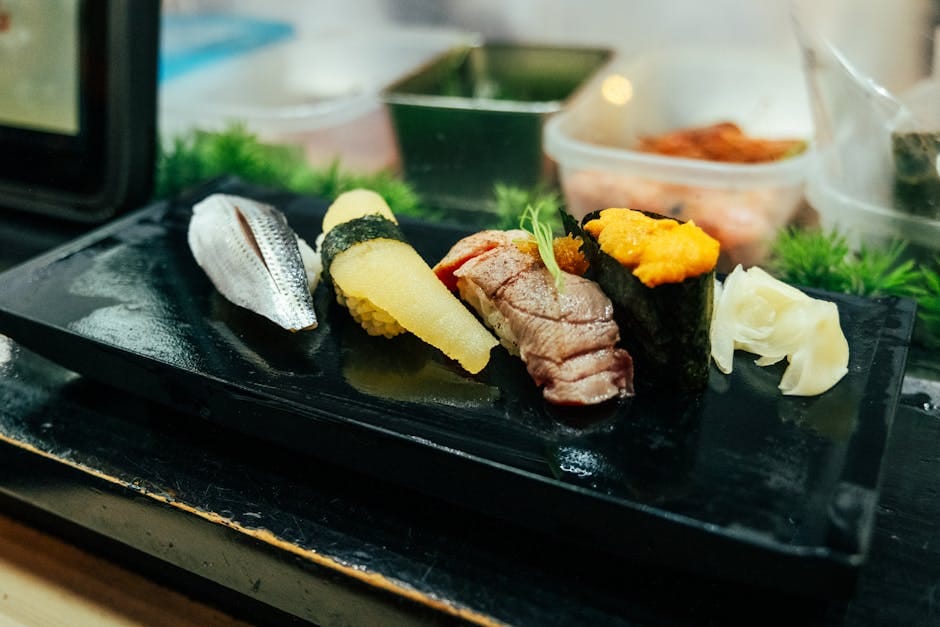
Kohada is the single most telling piece of sushi on an omakase. A small, silvery fish from the herring family, kohada is cured in salt and rice vinegar before being served — the cure tightens the flesh, adds a tangy brightness, and transforms the fish from ordinary to luminous. The preparation requires precision: too much salt and the fish is harsh; too little vinegar and it tastes flat; too long a cure and the texture becomes mushy. A great kohada — served with its silver skin glistening, the flesh firm but yielding, the vinegar tang balanced against the fish's natural sweetness — reveals a chef's skill more clearly than any piece of tuna or salmon. At Sukiyabashi Jiro in Ginza, the kohada is considered the benchmark piece, and Jiro Ono has said that he judges visiting chefs by their kohada. If you see it on a menu and it's good, you're in a serious sushi restaurant.
Engawa (Flounder Fin)
Engawa is the thin strip of muscle that runs along the dorsal and anal fins of hirame (fluke/flounder). It's a tiny piece of the fish — each flounder yields only four narrow strips of engawa — which makes it relatively rare and always worth ordering when available. The texture is what sets engawa apart: it's simultaneously firm and gelatinous, with a chew that resists your teeth before dissolving into a rich, almost fatty wave of flavor. Wild hirame engawa has more texture and a cleaner finish than the karei (sole) engawa served at conveyor-belt places, which tends to be softer and oilier. The best engawa is briefly torched (aburi) with a blowtorch, which renders the surface fat and adds a smoky note that amplifies the gelatin's richness.
Shime Saba (Cured Mackerel)
Mackerel is too strong, too fishy, too assertive for most Western sushi consumers, which is exactly why it's one of the most prized toppings in traditional edomae sushi. Shime saba is mackerel that's been cured in salt and rice vinegar — the cure firms the flesh, mellows the fishiness, and adds a bright acidity that plays against the mackerel's natural oiliness. The cross-hatch pattern of silver skin on top is left intact, and a thin line of grated ginger or finely sliced shiso leaf is placed between the fish and the rice to bridge the flavors. Great shime saba tastes simultaneously of the sea and the vinegar jar — briny, tangy, rich, and clean. At Sushi Saito in Minato, Tokyo, the shime saba is cured for a precisely calibrated period that changes with the season and the fat content of the fish, and the result is a piece of sushi so well-balanced it makes you wonder why anyone orders salmon.
Uni (Sea Urchin)
Uni divides people more starkly than almost any other food. The golden-orange reproductive organs (gonads, technically) of sea urchins have a texture like cold custard and a flavor that ranges from sweet-oceanic (Hokkaido bafun uni) to rich-briny (Hokkaido murasaki uni) to aggressively marine (some California and Chilean varieties). Great uni tastes like the ocean crystallized into cream — it melts on your tongue and leaves a lingering sweetness that's closer to crème brûlée than seafood. Bad uni tastes like iodine and regret. The quality gap is enormous, and it correlates directly with freshness: uni begins deteriorating within hours of being removed from the shell, and by day two it develops the bitter, metallic off-flavors that turn people off permanently.
If you've had uni and hated it, there's a strong chance you had old uni. Try it again at a sushi counter where the chef opens the sea urchin in front of you — the difference is revelatory. At Tsukiji, vendors sell uni in wooden trays graded by color, firmness, and origin, and the premium Hokkaido bafun uni (small, bright orange, intensely sweet) can cost ¥5,000+ ($34+) for a single tray. On top of sushi rice, a tongue of good uni is one of the most intensely pleasurable bites in Japanese cuisine.
Anago (Saltwater Eel)
Anago — saltwater conger eel — is the gentle, elegant counterpart to unagi (freshwater eel). Where unagi is grilled with a thick, sweet tare sauce and served as a substantial main dish, anago for sushi is simmered (ni-anago) until the flesh is so tender it threatens to dissolve on contact with the rice, then brushed with a light, reduced tsume sauce that adds a subtle sweetness. The texture is extraordinary: a piece of well-prepared anago barely needs to be chewed — it collapses in your mouth with the gentlest pressure, releasing a wave of delicate, slightly sweet flavor. It's traditionally one of the final pieces in an omakase, served as a transition from the savory fish courses to the end of the meal.
Aji (Horse Mackerel)
Aji is the everyman's sushi fish — affordable, available year-round, and when prepared correctly, as satisfying as anything ten times the price. Raw aji has a clean, mildly fishy flavor with a firm, almost crunchy texture that's different from the silky softness of tuna or the butteriness of salmon. It's served with grated ginger and sliced scallion on top, and a tiny dab of wasabi between the fish and rice. At Sushi Dai in Tsukiji Outer Market, the aji nigiri is impeccable — the fish is so fresh it's almost translucent, and the ginger adds a heat that complements the fish's own flavor rather than masking it. Aji is the piece that teaches you what sushi fundamentally is: not about luxury ingredients, but about the perfect marriage of fish, rice, and seasoning.
Hotate (Scallop)
Raw scallop nigiri — a thick slice of Hokkaido hotate perched on rice — is sweet, clean, and texturally unique. The scallop's flesh is dense but yielding, with a slight resistance that's satisfying to bite through, and the flavor is predominantly sweet with a clean mineral finish. It's one of the most accessible "unusual" sushi pieces for people transitioning beyond salmon and tuna. The best hotate comes from the cold waters off Hokkaido, where the scallops grow slowly and develop more concentrated flavor. Some chefs lightly torch the surface (aburi hotate), which caramelizes the sugars in the scallop and adds a smoky note that's transformative.
Akagai (Ark Shell)
Akagai is for the sushi adventurer. This crimson-colored bivalve has an assertive, almost metallic flavor and a firm, crunchy texture that's completely unlike any other sushi topping. It's served butterflied over rice, its vivid red flesh a striking visual contrast to the white rice beneath. The taste is briny, slightly bitter, and lingers in a way that milder toppings don't. Akagai is an acquired taste, and acquiring it is worth the effort — once you appreciate its intensity, blander sushi toppings start to feel like they're holding back.
Ikura (Salmon Roe)
Ikura — cured salmon eggs, each one a glistening orange-red sphere roughly the size of a pea — is served gunkan-style: a mound of eggs cupped in a strip of nori wrapped around the rice. The pleasure of ikura is the pop. Each egg bursts on your tongue, releasing a salty, slightly sweet liquid that tastes intensely of the ocean. The best ikura is cured in-house by the sushi chef using soy sauce and sake, and the difference between house-cured and commercially packaged ikura is the difference between fresh-squeezed and bottled orange juice. At Sushisho in Nishi-Shinjuku, the ikura is cured in a dashi-soy mixture that adds a smoky depth to the eggs, and the portion is generous enough that each bite delivers five or six simultaneous pops.
Tamago (Egg)
Tamago — the sweet, layered omelet that traditionally closes an omakase — is often dismissed as the "beginner" sushi or the piece for people who don't like fish. This is wrong. Tamago is the quiet test of a sushi kitchen. Making proper tamago requires cooking thin layers of a dashi-sweetened egg mixture in a rectangular pan, rolling each layer over the previous one to build a dense, layered block that's uniform in color, texture, and sweetness. Some chefs add shrimp paste (ebi-shi) to the egg mixture for savory depth. Others go for a pure, sweet, almost cake-like tamago that functions as a dessert. At Yoshino Sushi in Nihonbashi, Tokyo — one of the oldest sushi restaurants in the city — the tamago is a warm, custard-textured block served at the very end of the meal, and it tastes like the most refined French pastry made from eggs and dashi. Eating it as the final bite of an omakase is like a period at the end of a perfectly constructed sentence.