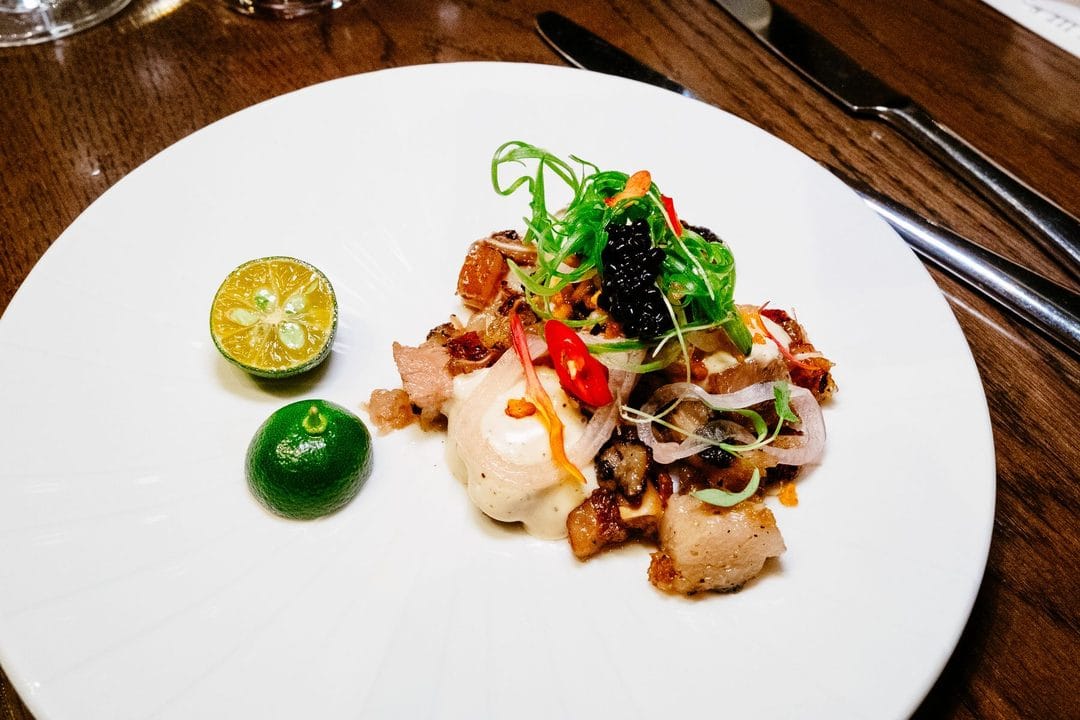
Order sisig in Angeles City after 10pm and it arrives on a cast-iron sizzling plate loud enough to turn heads two tables over — pork jowl and ear, chopped down to something between a mince and a dice, glistening with pig fat that's still crackling audibly against the hot metal, a raw egg cracked on top so the heat of the plate cooks it right there in front of you. You mix it yourself. That's part of the ritual: fork through the egg, drag it through the meat, watch the yolk turn everything glossy and slightly thicker in texture within about ten seconds. Calamansi gets squeezed over the top last, always last, because the citrus needs to hit hot fat rather than get folded in before the plate arrives.
A dish born from what the officers didn't want
Sisig's origin story is inseparable from Clark Air Base, the former US military installation that sat just outside Angeles City for nearly a century. American officers took the prime cuts of pork — the loin, the belly — and left the pig's head, ears and cheeks behind as scraps. Local cooks, notably a woman named Aling Lucing who's widely credited with popularising the modern dish in the 1970s, boiled those cast-off parts, grilled them over charcoal, chopped them fine, and seasoned the result with vinegar, calamansi, chilies and onion. What started as a way to stretch inedible-by-Western-standards cuts into something worth eating became, within two decades, the signature dish of an entire province.
Pampanga province, where Angeles City sits, has a culinary reputation in the Philippines that borders on regional pride bordering on rivalry — Filipinos from Pampanga will tell you, unprompted and at some length, that their province is the country's actual culinary capital, Manila's larger population notwithstanding. Sisig is Exhibit A in that argument, and it's not an unreasonable one. The dish took a set of ingredients nobody else wanted and turned them into something restaurants in Manila, Cebu and now Los Angeles and London charge a premium for.
What actually goes into it, and what shouldn't
Traditional sisig is built from pig's face — cheek and jowl meat specifically — along with ears, boiled first to tenderise, then grilled over charcoal to render fat and add smoke, then chopped fine on a board with a heavy knife until the texture turns almost hash-like. Chicken liver gets folded through some versions for richness and a slight mineral edge that cuts the fattiness; not every cook uses it, and purists in Pampanga tend to insist it belongs. Onion, red and green chilies, and a souring agent — vinegar most commonly, though calamansi and even mayonnaise show up in modern Manila versions — round it out before it hits the sizzling plate.
Here's where I'll take a side: the mayonnaise versions that have become common in Manila food-court sisig are fine, genuinely, but they're a different dish wearing the same name. Mayo mutes the sharp vinegar-and-citrus hit that makes traditional Kapampangan sisig work in the first place — that bright, almost aggressive sourness is the entire point, the thing that cuts through all that rendered pork fat and stops the dish from turning heavy after four bites. If you're trying sisig for the first time, order it the Pampanga way before you order the creamy Manila-mall version, because going the other direction means you'll spend your first bite of the "real" thing wondering why it tastes so sharp instead of understanding immediately why it's beloved.
Bangus sisig — milkfish instead of pork — exists for pescatarians and it's a genuinely solid dish in its own right, smoky and citrus-forward in the same register as the original. Tofu sisig, less commonly, does similar work for vegetarians visiting a cuisine that doesn't make many concessions in that direction. Neither replaces the original for most Filipinos, and nobody's really claiming they should — they're a different entry point into the same flavour logic, not a substitute.
Why it's always eaten with beer, specifically
Sisig occupies a category Filipinos call "pulutan" — food built specifically to be eaten alongside drinking, usually beer, usually San Miguel Pale Pilsen or Red Horse if the session's expected to run long. The dish's saltiness, fat content and citrus acidity are practically engineered for pairing with a cold beer on a hot night, which describes most nights in Pampanga for roughly eight months of the year. Order sisig without beer at a proper Angeles City carinderia and the server won't say anything, but you'll notice you're one of very few tables doing it that way.
The sizzling-plate presentation matters beyond spectacle, too — it keeps the fat rendering and the dish audibly hot through an entire beer-drinking session that might run ninety minutes, so the last bite still has some of the same textural contrast as the first. A dish served cold or lukewarm loses that; sisig without the sizzle is genuinely a lesser experience, not just a less dramatic one.
Where to actually eat it
Aling Lucing's original restaurant still operates in Angeles City under the family name, and while the current iteration has moved locations more than once over the decades, it remains the closest thing sisig has to a pilgrimage site. Beyond that specific spot, the real test of a good sisig restaurant in Pampanga is whether the smell of charcoal reaches the street before you walk in — grills cooked over gas lack the depth that charcoal brings to the pork fat, and cooks in the province will tell you this without hesitation if you ask.
Manila has good sisig too — Mesa, Sarsa and a handful of Kapampangan-run spots do the dish justice — but treating a Manila plate as the definitive version is a bit like judging Neapolitan pizza from a slice eaten three hundred miles from Naples. It can be genuinely good. It's still not quite the same thing, and anyone from Pampanga sitting across the table will happily explain exactly why over the course of the meal.
Sisig outside the Philippines
The dish has travelled further than most Filipino food in the last decade, showing up on menus in London, Los Angeles, Toronto and Dubai wherever Filipino diaspora communities have reached critical mass. Jollibee's global expansion gets most of the attention when people talk about Filipino food going international, but sisig has done its own quieter version of the same thing — smaller, chef-driven restaurants rather than a fast-food chain, often run by second-generation Filipino cooks reworking the dish with ingredients available locally.
Some of that adaptation works better than others. Pork belly substitutes reasonably well for the harder-to-source cheek and jowl cuts in cities where a whole pig's head isn't something a supplier keeps in stock, and the texture holds up close enough that most diners wouldn't notice the swap unqualified. What's harder to replicate abroad is the charcoal grilling step — many Western kitchens run electric or induction lines with no open flame at all, and sisig cooked entirely on a flat-top loses some of the smokiness that charcoal contributes in Pampanga. The dish still works. It's simply working with one hand tied behind its back, and cooks who've eaten the original in Angeles City are usually the first to admit it.
What hasn't changed in translation is the sizzling plate itself, which has become almost a non-negotiable part of how the dish gets served anywhere in the world — it's now recognisable as sisig's signature the way a wok's char is recognisable in stir-fry, immediately identifying the dish before a single ingredient is named.