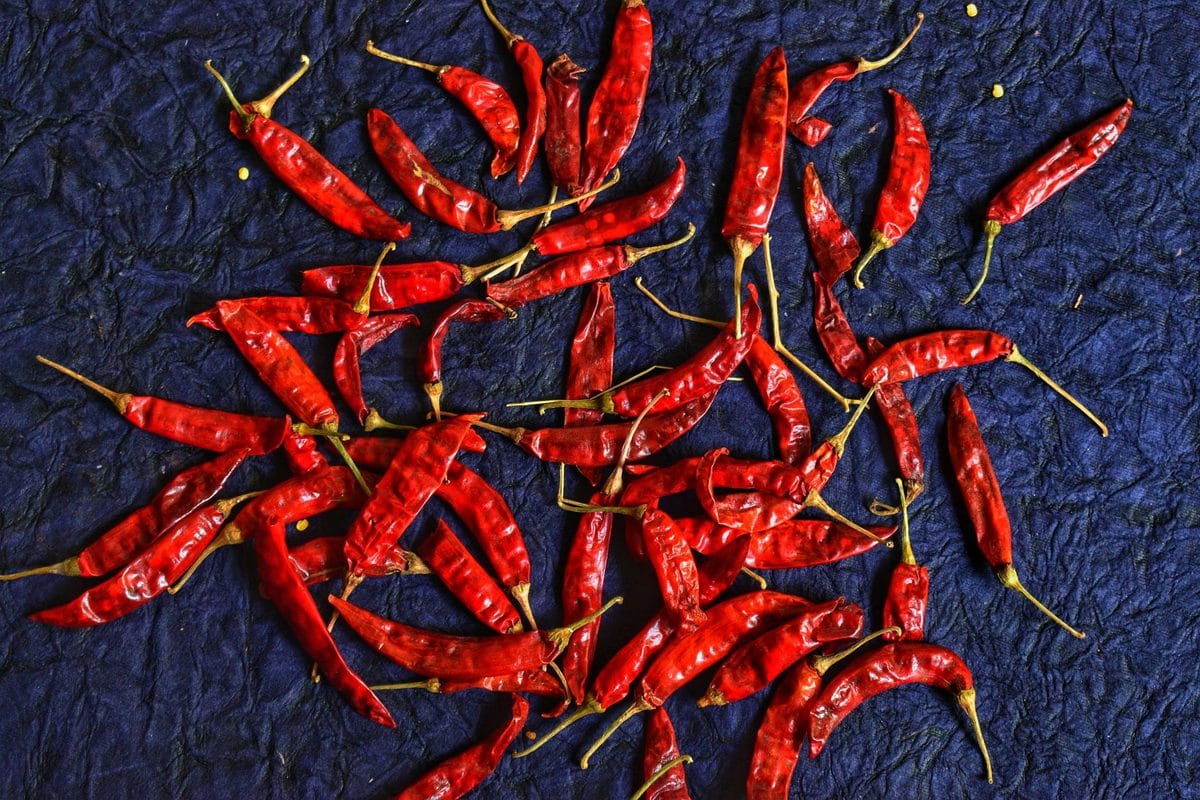
Every October, the corrugated roofs of farmhouses across Bhutan turn red. Chilies go up by the string, hundreds of them per house, drying in air thin enough to crack lips until they shrink into leathery pods dense enough to last a family through a winter that closes half the country's mountain roads. Walk through a village in the Bumthang valley at that time of year and you'll see chili doing something it rarely does anywhere else in Asia: acting as the main event on the plate rather than the seasoning around its edges.
Ema datshi — a bubbling stew of whole green or red chilies smothered in melted farmer's cheese — is Bhutan's closest thing to a national dish, eaten at nearly every meal in nearly every household from Thimphu to the eastern district of Trashigang. What makes it unusual, even by the standards of its chili-loving neighbors, is that neither headline ingredient started out as obviously Bhutanese. The chili arrived from elsewhere centuries ago, carried along trade routes that eventually threaded most of the world's peppers out of the Americas. The cheese is newer, and its story is stranger: it traces back to a Swiss dairy farmer who came to the Himalayas to help build roads and ended up staying to milk cows instead. Put those two imports on the same plate and you get a dish most Bhutanese would insist has always been there, even though the pairing is barely two generations old.
Chili as the Vegetable, Not the Garnish
In most Asian kitchens, chili is measured by the pinch or the tablespoon — a flavoring agent layered under rice, noodles, or broth. Bhutanese cooks measure it the way other kitchens measure potatoes: by the double handful, whole pods and all, simmered until they soften into something closer to a vegetable than a seasoning. A proper ema datshi is built from whole chilies split lengthwise, not diced or ground, and the dish is judged by how generously the chili crowds the pot rather than how subtly it's dosed.
Bhutan runs on chili.
That single fact shapes an enormous amount of daily life in the country. Farmers grow both green and dried red varieties at different altitudes, since the crop behaves differently in Thimphu's cooler valleys than it does in the lower, warmer districts near the Indian border. Dried red chili gets ground into a coarse powder used across dozens of other dishes, while fresh green chili is reserved largely for datshi preparations, where its grassier, less smoky bite plays better against the richness of melted cheese. When Bhutan's own harvest falls short, especially after a poor monsoon, traders bring in truckloads of dried chili from across the border in India to cover the gap, since a shortage of chili is treated less as an inconvenience than as a genuine supply crisis. Visitors who assume Bhutanese food will taste like a milder cousin of Indian or Thai cuisine are usually corrected within the first meal.
The Swiss Farmer Who Came to Bhutan and Stayed
The cheese half of the equation has a documented, and genuinely odd, origin. In the late 1960s, as Bhutan first began accepting international development assistance, the Swiss aid organization Helvetas sent agricultural specialists into the country to help with infrastructure and farming projects. Among them was Fritz Maurer, a Swiss dairy farmer who ended up in the Bumthang valley, a high, cool region in central Bhutan that reminded him enough of the Alps to try something nobody there had attempted before: raising Brown Swiss cattle for milk at altitude, then turning that milk into cheese using techniques he'd grown up with back home.
Maurer never left. He married locally, settled permanently in Bumthang, and built what became known simply as the Swiss Farm — an operation that, over the following decades, expanded well beyond cheese into apple orchards, fruit juice, and eventually Bhutan's first brewery, producing a beer called Red Panda that's still sold across the country today. But the cheese is what mattered most to how Bhutan eats. Local milk, mostly from yak or cattle raised on high pasture, had never really been turned into a stable, storable product before Maurer's operation showed a workable method for doing it at scale.
Two Imports, One Plate
What Maurer produced wasn't the aged, hard wheels of cheese associated with the Alps — Bhutan had no ripening cellars, no tradition of eating solid cheese on its own, and no refrigerated distribution network to move a slow-cured product across a country with almost no flat land. Instead, the operation settled on a fresh, unripened cheese, soft and mild, meant to be used almost immediately rather than aged. In Dzongkha, the word for this cheese is simply datshi, and it melts on contact with heat rather than holding its shape.
That single property is what made the marriage with chili work. A fresh, meltable cheese doesn't behave like a table cheese; it behaves like a cooking medium, closer to how a French kitchen treats butter than how it treats Comté. Bhutanese cooks folded it directly into simmering chilies along with onion, garlic, and a little tomato, and the cheese dissolved into a thick, tangy sauce that coated the chili instead of sitting beside it. The pairing is younger than most people who eat it every day realize: food historians in Bhutan generally agree that versions of chili-and-curd dishes existed in some form before Maurer's dairy scaled up nationally, using whatever local cheese or fermented dairy a household had on hand. What the Swiss Farm did was standardize and multiply the cheese supply until a dish that had been a regional or occasional preparation became something nearly every household could make on a random Tuesday.
Kewa Datshi, Shamu Datshi, and the Rest of the Family
Ema datshi is the flagship, but it's really the anchor of a whole family of dishes built on the same cheese-as-sauce logic. Kewa datshi swaps in sliced potato for a milder, starchier version that mutes the chili's punch without abandoning the dish's identity. Shamu datshi does the same with mushrooms, foraged in the wetter months from Bhutan's forests, and takes on an earthier depth that datshi purists in the east of the country often rate above the original. There's also ezay, a raw, uncooked relish of chopped chili, cheese, and tomato served on the side rather than as a main course — less a dish in its own right than the condiment version of the same idea, spooned onto rice to adjust the heat of whatever else is on the plate.
If you're trying ema datshi for the first time, start with kewa datshi instead. The potato absorbs enough of the chili's intensity that you get the flavor logic of the dish — the tang of the cheese, the grassy heat of the pepper — without the full, unfiltered volume of chili that catches most first-time visitors off guard. Plenty of travelers order the classic version out of curiosity, get through three bites, and spend the rest of the meal drinking suja, Bhutan's butter tea, in self-defense.
Why the Dish Still Resists Export
Bhutan's tourism model runs on a Sustainable Development Fee charged to foreign visitors, a policy designed to keep arrival numbers low and per-visitor spending high rather than chase the volume tourism common elsewhere in Asia. That approach has kept Bhutanese food largely uncommercialized outside the country's own borders, and ema datshi hasn't followed the export path that pho, pad thai, or even neighboring Nepal's momos have taken through diaspora restaurants abroad. Part of the reason is practical: fresh datshi cheese doesn't travel or store well, and the handful of restaurants outside Bhutan that attempt the dish usually substitute a firmer, aged cheese that changes the texture entirely, turning a sauce into something closer to a topping.
At Thimphu's Centenary Farmers Market on a Sunday morning, the two sides of this story sit a few stalls apart — sacks of dried red chili from vendors who've hauled them in from the lower valleys, and blocks of fresh datshi kept cool under damp cloth, sold by weight to home cooks who'll have it melted into that evening's dinner before the cheese has a chance to firm up.