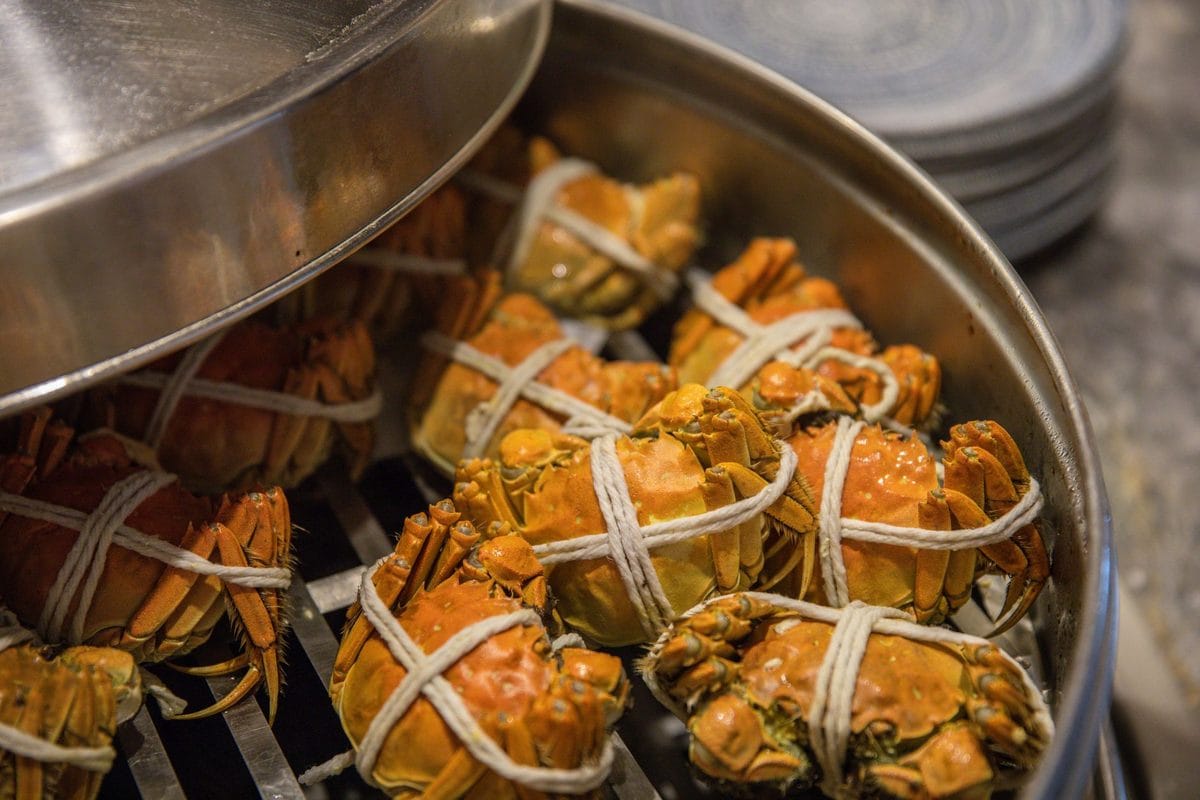
On September 28, officials gathered in Bacheng Town, Kunshan, to open the 2026 harvest at Yangcheng Lake and to unveil this year's crab tag. The tag was the headline. Every crab wears its own, every shipping box gets a sticker, and the plastic piece carries the geographical-indication mark, a unique serial number, an "AI anti-counterfeit" dot code and an irregular structure that the Suzhou government describes as extremely difficult to replicate and impossible to reuse. A phone scan is supposed to trace a crab back through its breeding water and its crab-fry source to the date it reached the market. That is a lot of paperwork for an animal about 8 to 10 centimeters (3 to 4 inches) across, and it exists for a simple reason: the name Yangcheng Lake is worth more than what is inside the shell, so people forge it.
The same announcement carried a number worth reading closely. Suzhou's agriculture bureau put this year's output at about 10,100 tons, roughly 1,600 tons from enclosures netted off inside the lake and roughly 8,500 tons from high-standard ponds along its shore. Do the division and about 84 percent of the crab sold under the lake's name was raised in ponds beside the water rather than in it. That is not a scandal, since officials count pond crabs as Yangcheng Lake crabs, but it is not the picture the words "lake crab" put in your head either. The official line is stable production with better quality (the 2025 estimate was 10,350 tons, the 2023 forecast 11,000), and bulk supply after mid-October.
Two Calendars, One Crab
The ceremony date is a starting gun, not a ripening date. Suzhou announces it each September (September 26 in 2025, September 28 this year), and nothing tagged as genuine Yangcheng Lake crab is meant to sell before it. The older clock is lunar, and the trade still quotes it in a saying: jiu yue tuan qi, shi yue jian, "in the ninth month the round belly, in the tenth the pointed one."
The round belly is the female, whose broad flap covers the golden roe. The pointed one is the male, whose narrow flap covers the white cream, sticky and richer than roe. This year the ninth lunar month begins around October 10 (the Double Ninth Festival falls on October 18) and the tenth starts in the second week of November, which puts the best females from mid-October into early November and the best males from mid-November into early December. The pattern follows the animal. Mitten crabs live in fresh water but spawn in brackish estuaries, so each autumn the adults fatten hard before migrating downstream, and farmers catch them at the moment they are loaded for the trip. Harvest earlier and the shell is mostly water; wait too long and the crab has spent what it stored.
| Female | Male | |
|---|---|---|
| Belly flap | Broad and rounded | Narrow and pointed |
| Prized for | Golden roe (xie huang) | White cream (xie gao) |
| Traditional month | Ninth lunar month | Tenth lunar month |
| 2026 peak, per one Shanghai guide | Mid-October to early November | Mid-November to early December |
Sizes are quoted in liang, one liang being 50 grams, so a four-liang crab weighs 200 grams and is the standard restaurant portion. Males run bigger, so "four-liang female, five-liang male" at one price is ordinary grading, and a male gives more claw and body meat. If you eat hairy crab once this year, make it a female in the last ten days of October. If you eat it twice, add a male in the third week of November, when the cream is at its best and the dining rooms are quieter.
What a Tag Can and Cannot Prove
A tag is a claim about the crab, not a property of it.
Counterfeiting is the trade's oldest problem, and it has its own vocabulary. "Bathing crabs" (xizao xie) are crabs from cheaper waters that spend a few days in Yangcheng Lake so a seller can claim its name, while the standard cited in the press for a genuine crab is one raised in the lake for at least six months. The ring tags date to 2006 and are redesigned most years, which tells you how long the arms race has run. So scan the QR code and check that it resolves to a traceability record rather than a shop page, then look at the crab, because paperwork can be copied and a heavy, lively crab is harder to fake. Traditional buyers check four signs: a dark green-black back, a clean white belly, stiff golden hairs on the claws and gold-tipped legs. A live crab should feel heavy for its size, pull its legs in when tugged and retract its eyes when touched, and a crab that is not moving should not go in the steamer.
For scale, one 2026 Shanghai travel guide lists a mid-range restaurant crab at roughly ¥80 to ¥150 (yuan), a tagged Yangcheng Lake crab at a premium venue at ¥150 to ¥350, and ordinary market crab at ¥80 to ¥140 per kilogram, which works out to roughly ¥16 to ¥28 for a 200-gram crab. Treat those as bands, since prices swing with demand: the South China Morning Post reported hairy crab prices were down on the eve of the 2025 National Day holiday. The same guide puts the premium of Yangcheng Lake over other lakes at 30 to 100 percent. At the top of the market the difference is real, with a firmer shell and sweeter meat, but a well-timed crab from a neighboring lake generally beats a Yangcheng crab caught in the wrong fortnight. The better rule is season before provenance.
Ginger, Vinegar and Warm Wine
Crab counts as a "cooling" food in traditional Chinese thinking, and every classic accompaniment is a warming counterweight. The dip is Zhenjiang black vinegar with a spoonful of sugar and a heap of shredded ginger. The drink is a small pot of warm yellow wine, Shaoxing being the usual choice, and the meal closes with ginger tea sweetened with brown sugar. Cold beer is the classic mistake, and persimmons afterward are an old taboo (persimmons ripen in the same weeks, which is probably how the rule started). The crab party in the Qing novel Dream of the Red Chamber runs on exactly this logic: hot wine, crab dipped in ginger and vinegar, poems improvised about chrysanthemums, and balls of green bean soaked with chrysanthemum leaves to wash the hands afterward.
At home, keep the string on, because an untied crab thrashes and sheds legs. Lay the crabs belly up so the roe does not run out, add ginger and a perilla leaf, and steam over a rolling boil for about 10 minutes for a 200-gram crab and 12 to 15 for a bigger one. Nothing fancier is needed. Li Yu, the 17th-century writer who treated crab as a way of life, held that steaming was the most authentic method because it brings out the natural flavor. Four parts stay on the plate:
- The stomach, a flat, sandy pyramid behind the mouth under the top shell
- The gills, two rows of soft gray feathery strips
- The heart, a small white hexagon in the center that tradition calls the coldest part
- The intestine, a dark thread that runs into the belly flap, and it is easiest to pull out before you start eating, not halfway through the meal.
Leave the raw route alone. Drunken crab is a genuine regional dish, but the US Fish and Wildlife Service notes that mitten crabs can host the oriental lung fluke, which passes to people in raw or undercooked meat.
The tools are a chapter of their own. Ming-era craftsmen are credited with the first dedicated crab implements, and by the late Qing the eight-piece set (hammer, anvil, pliers, shovel, spoon, fork, scraper and needle) was a fixture in a Suzhou bride's dowry, with the most lavish sets reportedly reaching 64 pieces. Restaurants today mostly hand over scissors, a pick, a spoon and gloves.
A Five-Thousand-Year Appetite
A 2025 review in Frontiers in Marine Science points to crab shells dug up at Songze culture sites in Qingpu, Shanghai, and Liangzhu culture sites in Yuhang, Zhejiang, as evidence that people in the Yangtze delta have eaten crab for more than five millennia. The Book of Jin records the official Bi Zhuo declaring that a wine goblet in the right hand and a crab claw in the left, floating on a barge of wine, was all a life needed, and Li Bai borrowed the image centuries later. The same review counts 891 crab poems in the Complete Collection of Song Poetry against 48 in the Tang equivalent, and credits Lu You alone with 51. When a Song emperor asked the official Qian Kun where he wished to be posted, the reply on record was "any place with crab."
Li Yu took it furthest. The writer was nicknamed the "crab fairy," kept a maid whose only job was cooking crab, and had at least 20 fresh crabs a day in season, according to The World of Chinese. Out of season he lived on crabs pickled in yellow wine, then drank the wine so nothing of the essence was wasted. His rule was that crab, like melon seeds and water chestnuts, should be peeled by your own hands to be enjoyed fully. It is the right rule. A kitchen will pick a crab for you if you ask, but a picked crab is a different, lesser dish.
The Crab You Cannot Take Home
Outside Asia the animal is a pest. Live mitten crabs were listed as injurious wildlife under the US Lacey Act in 1989, which bars their import, and they have turned up in the Great Lakes, Chesapeake Bay, the Hudson River, San Francisco Bay and the Columbia River. Their burrowing erodes levees, they can disable pumps and water-intake screens at industrial plants, and they carry that lung fluke. The Fish and Wildlife Service says the delicacy's lucrative market drives black-market smuggling from Asia, with tens of thousands of live crabs intercepted every year and shipments declared as T-shirts, jeans, auto-part samples, shopping bags or photo albums. The crab has also invaded parts of Europe. Eat it cooked, eat it where it is sold legally, and leave the live ones at the lake.
The Double Ninth Festival, a holiday of chrysanthemums and high places, falls on October 18, and by the old proverb the ninth month it sits inside belongs to the round-bellied females.