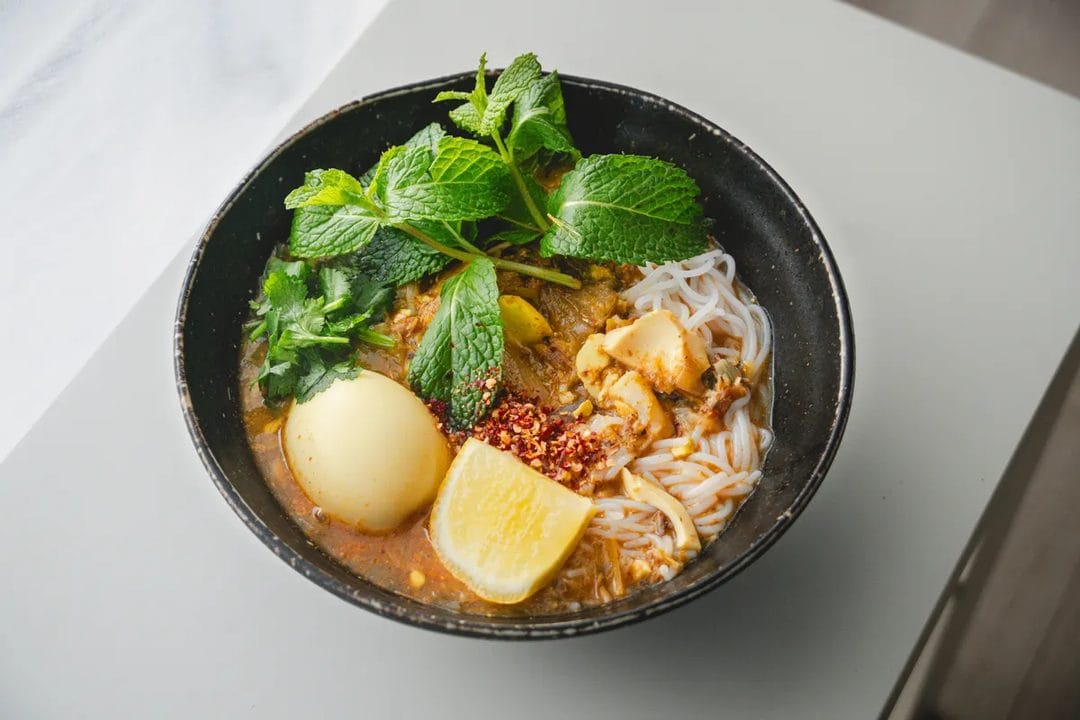
The Queue Starts Before the Stall Opens
By 7:40am, the line at Air Itam Laksa already curls past the neighbouring char kway teow cart, and the woman running the wok hasn't even lit her second burner. Locals here don't ask which bowl is better — they were assigned a side of Penang's oldest culinary argument at birth, usually by whichever grandmother did the school run. Assam laksa or curry mee: pick one, and be ready to defend it for the rest of your life on this island.
Most visitors arrive expecting a single "Penang laksa" and leave confused about why the hawker at Joo Hooi Cafe just gave them two completely different bowls with the same three-syllable name attached. That confusion is the whole point. Penang's food culture runs on this kind of unresolved rivalry — dry versus wet char kway teow, popiah with or without the sweet sauce, and, above everything else, the sour camp against the rich camp at the laksa stall.
The Sour Camp: What Actually Goes Into Assam Laksa
Real assam laksa starts with mackerel — usually ikan kembung — boiled down and flaked back into a broth built on tamarind (asam jawa), galangal, and a chopped stem of torch ginger flower, bunga kantan, that gets folded in raw at the very end so its perfume survives. Thick rice noodles go under a tangle of shredded cucumber, red onion, pineapple, mint leaves, and a slice of red chili, and the whole bowl gets crowned with a spoon of hae ko, a thick fermented prawn paste that Air Itam's stall thins to exactly the right pour — not so much that it turns the broth muddy, not so little that you can't taste it under the sourness. The fish itself matters more than most visitors assume: mackerel gives the broth a slight oiliness that a leaner fish like ikan parang can't replicate, which is why stalls that switch fish to save money tend to lose regulars within a season. You'll notice the smell first, a mix of tamarind sourness and something faintly briny underneath, before the bowl even reaches the table. And the torch ginger flower isn't a garnish — leave it out and the whole bowl tastes one-dimensional, all sour with none of the floral lift that makes assam laksa recognisable within one spoonful.
Where the sourness actually comes from
Tamarind pulp, not lime, and definitely not vinegar. A rushed cook uses concentrate; a good one soaks the pulp fresh that morning and strains it by hand, which is the difference between a broth that tastes sharp and one that tastes deep. At Air Itam Laksa a bowl runs RM 6.50, and the stall goes through roughly 200 servings before it sells out most mornings — arrive after 10am on a weekend and you're choosing from whatever's left in the pot, if there's a pot left at all.
The Rich Camp: Curry Mee's Coconut Argument
Cross the island to Lebuh Keng Kwee and the case for the other side gets made in coconut milk, dried chili paste, and a broth thick enough to coat the noodle without pooling underneath it. Curry mee — what most of Malaysia would just call curry laksa — pairs yellow noodles with rice vermicelli, then loads the bowl with cockles, fried tofu puffs, cuttlefish, and a dark curl of pig's blood cake for anyone who orders it that way. The broth carries dried shrimp and belacan underneath the coconut richness, so it never tastes purely sweet the way a Thai curry might.
Sister Curry Mee, which has moved stalls more than once but keeps its regulars through word of mouth rather than signage, sells a version thickened almost to the point of gravy — locals order it "kau", meaning extra rich, and the difference between a kau bowl and a regular one is close to RM 1.50 and roughly a third more coconut milk. A bowl with the works, cockles and blood cake included, lands around RM 8 to RM 9 depending on the stall and the day's cockle prices, which move with the tide more than people admit.
Joo Hooi Cafe: The One Place That Refuses to Pick
Here's the thing about Joo Hooi, on the corner of Lebuh Keng Kwee and Jalan Penang: it runs both stalls under one roof, assam laksa on one side of the coffee shop and curry mee on the other, and regulars order a half-bowl of each rather than commit. Watching two strangers argue over whose bowl the waiter should bring first, while the coffee shop's ceiling fans do nothing against the midday heat, tells you more about Penang than any museum on the island.
Order the assam laksa here without asking for extra hae ko — the base already carries enough. For curry mee, tell them "kurang santan" if you don't want the full richness; nobody will judge you, though the auntie running the wok might raise an eyebrow. Go early. Both counters sell through their morning batch by early afternoon, and whatever gets remade after that is never quite the same broth.
Why the Argument Never Actually Ends
Nobody in Penang actually expects this fight to get settled.
Ask a Penangite to settle it and you'll get a shrug followed by a family history lesson — this grandmother's stall served assam because it was Teochew, that uncle's kopitiam only ever did curry because the original cook came from a Hokkien curry-mee household three streets over. The dishes trace old migration patterns as much as taste preference, which is exactly why nobody expects the argument to resolve. Teochew immigrants who settled around Air Itam and the inland tin-mining routes brought a sour, tamarind-forward palate with them from Chaoshan; Hokkien and Hainanese cooks who clustered closer to the port leaned into coconut and dried chili instead, closer to the curry traditions moving through the Straits from further south. Three generations later, the stalls still sit roughly where those communities settled, and a Penangite's laksa loyalty says almost as much about their family's old neighbourhood as it does about their tongue. It's not really about which broth wins.
The honest answer, if you push a local hard enough, usually depends on the weather that particular morning — humid and heavy, most people reach for the sourness of assam to cut through it; overcast and slightly cooler, curry mee's richness suddenly makes more sense. That's not indecision. That's just how the island actually eats.
One Catch Worth Knowing Before You Order
Not every stall flying the assam laksa banner makes its own hae ko anymore — some buy it pre-mixed from a supplier in Butterworth, and the difference shows up as a broth that tastes flat instead of layered. If the prawn paste on top looks glossy and jet-black rather than matte and reddish-brown, that's usually the tell. Air Itam Laksa still makes its own; ask before you queue somewhere new, because forty minutes in Penang heat for a bowl that skipped the one step that matters is not a trade worth making.
The Noodle Question Nobody Mentions
Assam laksa runs on thick, round rice noodles called laksa noodles — different from the flat kway teow and different again from the yellow mee used in curry mee, which typically pairs with thin rice vermicelli (bee hoon) tossed in alongside it for texture. Get the noodle wrong and the whole bowl falls apart: laksa noodles need to be springy enough to hold up in a thin, sour broth without turning mushy within the first five minutes, while curry mee's yellow noodles need enough surface texture to trap the thicker coconut gravy rather than let it slide straight to the bottom of the bowl. Most stalls buy from the same two or three noodle suppliers around Jelutong, so the real variable isn't the noodle itself — it's how long it sits in the broth before it reaches your table, which is one more reason the queue at Air Itam moves as fast as it does.
Bringing Both Bowls Home
You won't recreate either broth properly without ikan kembung and fresh torch ginger flower, both of which travel badly, so don't try to pack the ingredients home in a cooler bag. What you can carry is the ordering vocabulary — kau for extra-rich curry mee, and a request for extra bunga kantan on the assam side if the stall's default portion feels thin. Use both next time you're back on Lebuh Keng Kwee, and order the half-and-half at Joo Hooi like everyone with any sense already does.