A Dictator's Recipe
Here's a fact that reframes everything you thought you knew about pad thai: it's not ancient. It wasn't passed down through generations of Thai grandmothers. It doesn't have centuries of culinary tradition behind it. Pad thai was essentially invented — or at least standardized, promoted, and politically weaponized — in the late 1930s and early 1940s by Plaek Phibunsongkhram, Thailand's military dictator, as part of a nationalistic campaign to modernize the country and distinguish Thai identity from Chinese cultural influence. The dish you eat at Thai restaurants worldwide is, at its origin, a piece of government propaganda that happens to taste fantastic.
The context: in the 1930s, Thailand (then recently renamed from Siam as part of the same nationalist project) was grappling with a large ethnic Chinese population and a food culture heavily influenced by Chinese noodle traditions. Phibunsongkhram's government saw food as a tool of national identity. His regime promoted "Thai noodles" — rice noodles stir-fried with Thai ingredients rather than Chinese ones — through government-distributed recipes, cooking competitions, and subsidized noodle carts placed on Bangkok streets. The specific dish that emerged — wide or thin rice noodles stir-fried with tamarind paste, fish sauce, palm sugar, dried shrimp, preserved radish, tofu, egg, bean sprouts, and Chinese chives, served with lime, roasted peanuts, and chili flakes — was codified during this period. The name pad thai literally means "Thai stir-fry," and the name itself was the point: this was Thai food, not Chinese, and eating it was a patriotic act.
The Ingredients Tell a Political Story
Look at pad thai's ingredient list through a political lens and the nationalist engineering becomes visible. Rice noodles (Thai-produced, unlike the wheat noodles associated with Chinese cooking). Fish sauce (Thailand's ancient condiment, distinct from Chinese soy sauce). Tamarind (native to the region, not imported). Palm sugar (locally produced). Dried shrimp and preserved radish (Thai pantry staples). The dish was deliberately constructed from ingredients that the Thai economy produced domestically, reducing dependence on Chinese imports and emphasizing ingredients that were Thai rather than Chinese in cultural association. Even the peanuts — which arrived in Southeast Asia via Portuguese and Spanish trade — were locally grown by the time of pad thai's codification.
The genius of the recipe is that the political engineering produced something genuinely delicious. The balance of sweet (palm sugar), sour (tamarind), salty (fish sauce), and umami (dried shrimp, fish sauce again) creates a flavor profile that's self-correcting: each element moderates the others, and the overall effect is harmonious rather than aggressive. The textures — chewy noodles, crunchy bean sprouts, crispy peanuts, soft egg, firm tofu — provide constant variety within each bite. And the lime squeezed over the top at the table adds a brightening acid that lifts the entire dish out of heaviness. Phibunsongkhram may have been a dictator with questionable motives, but his government's noodle recipe was objectively brilliant.
What Good Pad Thai Actually Requires
The gap between good pad thai and bad pad thai is wider than almost any other dish's quality spectrum. Bad pad thai — the version served at 90% of Thai restaurants outside Thailand and a depressing percentage inside it — is a pile of gummy noodles drenched in ketchup-sweet sauce, with no textural contrast and a one-dimensional sweetness that makes you reach for your water glass after every bite. Good pad thai has dry noodles (not wet or saucy), a balance of sweet, sour, and salty where no single flavor dominates, visible wok hei from high-heat cooking, and the characteristic smoky-charred edges on the noodles and egg that come from a screaming-hot wok and fast hands.
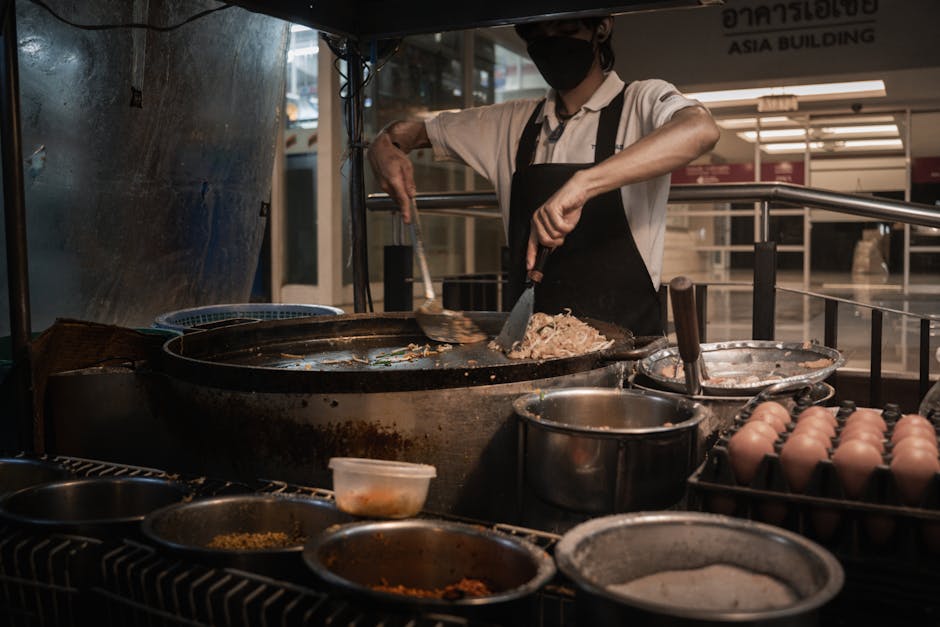
At Thip Samai on Maha Chai Road in Bangkok — the most famous pad thai shop in the city, operating since 1966 — the pad thai is cooked individually in a well-seasoned wok over a roaring charcoal fire. Each order takes about 90 seconds. The noodles are thin, slightly charred at the edges, and wrapped in a thin egg omelet that adds richness without heaviness. The sauce is balanced toward tart (more tamarind than sugar), and the dried shrimp are generous enough to contribute a real seafood depth rather than a token presence. A plate costs 80 baht ($2.30) and the line at peak hours stretches 20 or 30 people deep. This is pad thai as it should be, and if your experience of the dish has been limited to the ketchup version, Thip Samai will recalibrate your understanding entirely.
The Wok Temperature Problem
The single biggest reason pad thai fails outside of Thailand is heat. A proper pad thai requires a wok temperature that most restaurant burners can barely achieve, let alone the home stoves that recipe writers optimistically assume their readers are working with. At Thip Samai's charcoal station, the wok temperature exceeds 400°C (750°F). At that temperature, the noodles sear on contact, the egg sets in seconds, and the tamarind-fish sauce mixture hits the hot metal and partially caramelizes before it even reaches the noodles. This is why Thai pad thai has charred bits and a smoky complexity that Western versions lack — the chemical reactions that produce those flavors simply don't happen at 250°C (480°F), which is the maximum most commercial burners achieve. It's also why the best pad thai in Thailand comes from street vendors with dedicated charcoal or jet-burner setups rather than from full-service restaurants with standard kitchen ranges.
The Regional Variations Nobody Mentions
Pad thai in Bangkok is the version the world knows, but Thailand's noodle landscape includes several regional stir-fried noodle dishes that predate the nationalist pad thai and arguably offer more complexity. Pad thai in the south uses fresh turmeric in the sauce, giving the noodles a yellow tint and an earthy, slightly bitter undertone that balances the sweetness differently. In the northeast (Isaan), a related dish called pad mee korat — from the city of Nakhon Ratchasima — uses a different noodle (thicker, more irregular) and a darker, more savory sauce with less sugar, producing something that reads as a rustic, less polished cousin of Bangkok pad thai.
The most interesting variation is pad thai wrapped in egg — pad thai hor khai — which envelops the entire stir-fried noodle portion in a thin egg net, creating a golden package that you cut into with a spoon to reveal the noodles inside. The egg wrapper adds a layer of richness and provides a visual drama that the standard presentation lacks. At Jay Fai in Bangkok — a legendary street stall run by a 70-something woman in ski goggles who cooks over charcoal jets so powerful they literally shoot flames — the crab pad thai hor khai features fresh crab meat, costs 1,000 baht ($29, making it one of the most expensive street food items in the world), and holds a Michelin star. The cognitive dissonance of eating Michelin-starred food at a plastic table on a Bangkok sidewalk while a woman in goggles operates what amounts to a culinary blowtorch is, in its own way, a perfect expression of Thai food culture: the quality is taken seriously while everything around it stubbornly refuses to be.
The Dish That Won
Phibunsongkhram's nationalist project failed on most fronts — his cultural mandates were largely abandoned after his regime ended — but pad thai survived and thrived independently of the politics that created it. By the time Thailand began actively promoting its cuisine internationally in the 2000s (the "Global Thai" program placed Thai restaurants in dozens of countries with government support), pad thai had already established itself as the default entry point to Thai food worldwide. It's now the most ordered dish at Thai restaurants in the US, UK, and Australia, and the most recognizable Thai dish globally by a wide margin.
The irony is thick: a dish created to distinguish Thai identity from Chinese influence is now the dish that represents "Thai food" to people who couldn't name a second Thai dish if asked. Pad thai has become so associated with Thai cuisine that it risks flattening a food culture of extraordinary depth and regional diversity into a single stir-fried noodle dish. Green curry, som tam, khao soi, gaeng hanglay, nam tok, miang kham — the list of Thai dishes that are more complex, more regionally rooted, and more representative of Thai culinary sophistication than pad thai is long. But none of them have pad thai's accessibility, its balanced-for-everyone flavor profile, or its origin story. A dictator's recipe, perfected by street vendors, exported by government policy, and now the most famous Thai food on earth. Stranger things have happened, but not many.