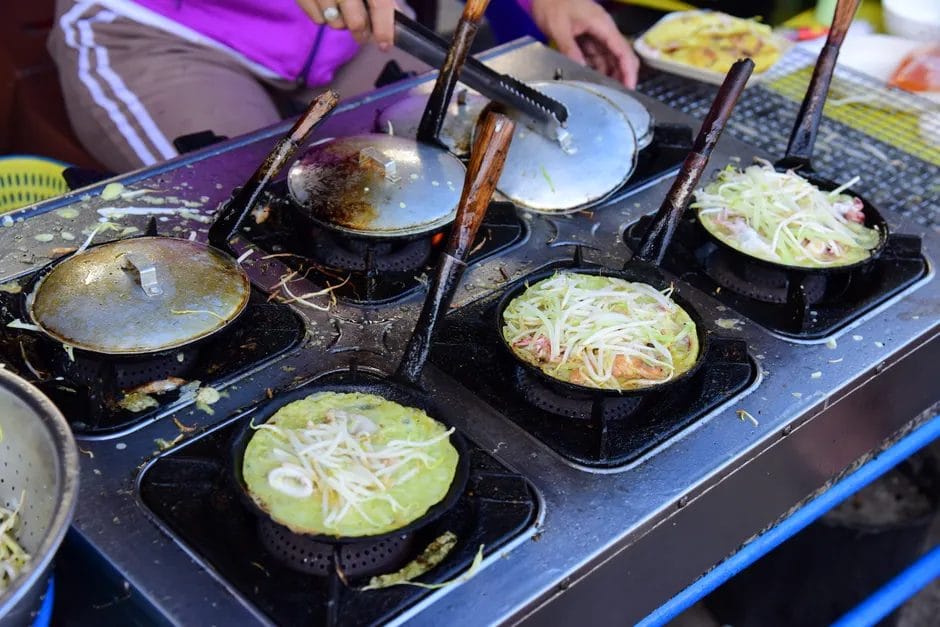
Walk into a restaurant in Dotonbori and order okonomiyaki, and the batter — cabbage, egg, grated yamaimo, pork belly, tenkasu crumbs — arrives already mixed in a bowl, ready for you to pour onto the teppan yourself. Walk into a restaurant in Hiroshima's Okonomimura building and order the same dish, and you will get something else entirely: a thin crepe laid flat, a mountain of shredded cabbage piled on top of it, a fistful of yakisoba noodles tucked underneath, and a fried egg sealing the whole stack together. Ask either kitchen if the other city's version deserves the same name, and you will get a very firm opinion. This is not a minor regional accent on a shared recipe. It is closer to two different dishes that happen to share a name, a sauce brand, and a griddle.
A Dish Born From Rationing, Not Refinement
Okonomiyaki's roots trace back to a wartime and postwar Japan with almost no flour to spare. In the 1930s and 40s, a cheap Tokyo street snack called issen yoshoku — literally "one-sen Western food" — used a thin wheat batter fried on a griddle and topped with whatever scraps were available, sold for a single sen coin to children on their way home. When flour rationing eased in the 1950s, regional cooks in Osaka and Hiroshima took that basic idea in opposite directions, and neither one ever really looked back. Osaka had a centuries-old habit of building meals around wheat-flour street food — takoyaki, negiyaki, yakisoba — a culture locals call konamon, or "flour things," and treated okonomiyaki as one more variation to mix, fry, and eat fast. Hiroshima, rebuilding from near-total destruction after 1945, needed a dish that could stretch a small amount of batter into something that actually filled a stomach, and stacking layers did exactly that.
Osaka: Mix Everything, Then Cook
In Osaka-style okonomiyaki, cabbage, flour, dashi, grated nagaimo (a starchy mountain yam that adds lightness), egg, and usually pork belly or seafood all go into one bowl and get folded together before they ever touch the griddle. The batter is poured as a single disc, roughly 2 to 3 centimetres thick, and left to cook for about four to five minutes a side until the edges crisp and the centre stays custardy. Diners in traditional Osaka shops are handed a spatula, called a kote, and expected to flip and finish the disc themselves at a built-in table griddle — the restaurant sells you the ingredients and the heat, and you do the cooking. Toppings go on last: Otafuku okonomiyaki sauce, Kewpie mayonnaise squeezed in a tight crosshatch, bonito flakes that curl and "dance" from the residual heat, and a scattering of aonori seaweed powder.
Ask an Osaka regular why the mixing method matters and they will tell you it is about texture, not tradition for its own sake — a properly mixed batter cooks evenly all the way through, while a layered stack risks a soggy middle under a dry top. That is a real trade-off, and it is the strongest technical argument Osaka has in this rivalry. A plate at a mid-range Dotonbori shop such as Mizuno or Chibo typically runs ¥1,200 to ¥1,800, and the classic pork-and-egg version, called buta-tama, is the baseline against which locals judge every other topping combination.
Hiroshima: Build It in Layers, and Never Call It a Mix
Hiroshima-yaki starts the same way Osaka's does, with a thin wheat crepe on the teppan, but everything after that diverges. The cook piles on a generous mound of cabbage — often 200 grams or more per serving, several times what goes into an Osaka disc — then adds bean sprouts, pork belly slices, and a portion of fried yakisoba or udon noodles, before cracking an egg on a separate patch of the griddle and lifting the entire stack on top of it, egg-side down, so it seals the layers together when flipped. Nothing gets folded into a batter. A cook in Hiroshima who mixed the cabbage into the crepe batter the Osaka way would be committing what many locals consider a basic technical error, not a stylistic choice.
Here is the detail that actually decides most arguments locally.
Ask for "okonomiyaki" in Hiroshima and most residents will correct you: the dish is Hiroshima-yaki, and the word okonomiyaki without qualification belongs to Osaka in most Hiroshima households' minds, even though official tourism material uses both terms interchangeably. Okonomimura, a three-storey building in central Hiroshima packed with roughly 25 independent okonomiyaki stalls stacked one on top of another, has functioned since 1992 as the city's informal shrine to the layered method, and each stall guards small variations in noodle type, sauce ratio, and egg placement as house secrets worth defending. A standard plate there costs ¥900 to ¥1,300, cheaper on average than Osaka's version, largely because noodles and cabbage are less expensive per serving than the seafood add-ins common in Dotonbori shops.
The Sauce Both Sides Actually Agree On
For all the mixing-versus-layering hostility, both cities lean on the same company for their finishing sauce, and that shared dependency is one of the odder footnotes in this rivalry. Otafuku Sauce was founded in Hiroshima in 1922 and still headquarters there, producing the thick, slightly sweet, Worcestershire-based sauce that both Osaka and Hiroshima okonomiyaki depend on almost universally — a rare point of unforced agreement in a debate that otherwise treats every choice as a small act of civic loyalty.
- Osaka-style: batter and fillings mixed before cooking, roughly 2–3 cm thick, self-cooked at table griddles in many traditional shops
- Hiroshima-style: layered on the griddle in a strict order, always includes yakisoba or udon, and the cabbage volume alone can double what an Osaka disc holds
- Both rely on Otafuku sauce as the default topping, and most shops in either city would consider serving the dish without it — to quote one Hiroshima cook bluntly — "not okonomiyaki at all"
Which One Should You Actually Order First
If this is your first okonomiyaki and you only have one meal to spend on it, order the Hiroshima version — the layered structure makes the components easier to identify by taste, so a first-timer can actually tell the noodles from the cabbage from the pork instead of meeting one uniform custardy disc. Osaka's mixed style rewards people who already know what they are eating and want the flavours melded rather than separated; it is the better order on a second or third visit, not a first one. This is not a hedge — for someone who has never had either, Hiroshima-yaki is the more legible introduction, full stop.
The regional loyalty runs deep enough that it shapes how each city treats the other's chains. Botejyu, an Osaka-style chain that started in Dotonbori in 1946 and now has locations as far as Hawaii and Indonesia, rarely opens outlets in Hiroshima proper, and when Hiroshima-yaki chains such as Nagata-ya have tried expanding toward Osaka, they have generally marketed the dish explicitly as "Hiroshima-style" rather than letting it compete under the unqualified okonomiyaki name. Neither city seems eager to let the other's version pass as the default.
That said, the rivalry is softer among younger chefs than the tourist framing suggests. A handful of newer restaurants in Tokyo and Fukuoka have started offering both styles on the same menu, occasionally even proposing hybrid versions with a partially mixed base and a partial noodle layer, treating the Osaka-Hiroshima split as a spectrum of technique rather than a binary loyalty test. Purists in both home cities tend to dismiss these hybrids as neither one thing nor the other, which is probably exactly why they keep appearing on menus aimed at visitors rather than locals.
What the Rivalry Is Really About
Strip away the sauce brand and the shared name, and what is actually being argued over is a much older question in Japanese regional identity: whether a dish belongs to the people who invented its ingredients or to the people who perfected its method. Osaka can point to centuries of konamon street-food culture as its claim; Hiroshima can point to a postwar necessity that turned scarcity into a structure worth keeping even after scarcity ended. Neither claim cancels the other out, and neither city shows any sign of conceding the argument for the sake of a tidy shared definition.
Order both, on different trips, and decide for yourself which spatula you would rather hold.