Same Country, Different Planets
The Thai food most people know — green curry, pad thai, tom yum, mango sticky rice — is Central Thai cuisine, the cooking of Bangkok and the surrounding plains. It's the export version, the diplomatic representative, and while it's genuinely excellent, it obscures a culinary diversity within Thailand that's as dramatic as the difference between Sicilian and Milanese cooking in Italy, or Cantonese and Sichuan in China. Northern Thai food (ahan phak nuea) and Southern Thai food (ahan phak tai) sit at opposite ends of nearly every culinary spectrum: heat level, fat content, dominant herbs, protein sources, fermentation intensity, and even the type of rice served alongside. Understanding this divide transforms Thailand from a country with one cuisine to a country with at least four, and the northern-southern contrast is where the differences are sharpest.
The geography explains a lot. Northern Thailand — centered on Chiang Mai and stretching to the borders of Myanmar, Laos, and China — is mountainous, relatively cool (by Thai standards), and historically connected to the Lanna kingdom, which was culturally distinct from the Siamese south. Southern Thailand — the long peninsula that reaches toward Malaysia, with population centers in Surat Thani, Phuket, and Songkhla — is tropical, coastal, heavily influenced by Malay and Indian Ocean trade routes, and home to a significant Muslim population. These different geographies produced different ingredients, which produced different cooking techniques, which produced cuisines that share a nationality but little else.
The Northern Table
Northern Thai food is the quieter sibling. The heat level is moderate compared to Central and Southern Thai cooking — chilies are present but not dominant, and the emphasis is on herbaceous, earthy flavors rather than aggressive spice. Sticky rice (khao niao) is the staple starch, eaten by hand in small balls rolled between the fingers and used to scoop up dips and relishes. This is significant: Central and Southern Thailand eat jasmine rice (khao suay), and the choice of rice fundamentally changes how food is eaten and, therefore, how it's seasoned. Food designed for sticky rice tends to be drier and more intensely seasoned per bite, because you're eating small amounts of relish with large amounts of rice. Food designed for jasmine rice tends to be saucier, because the rice absorbs liquid.
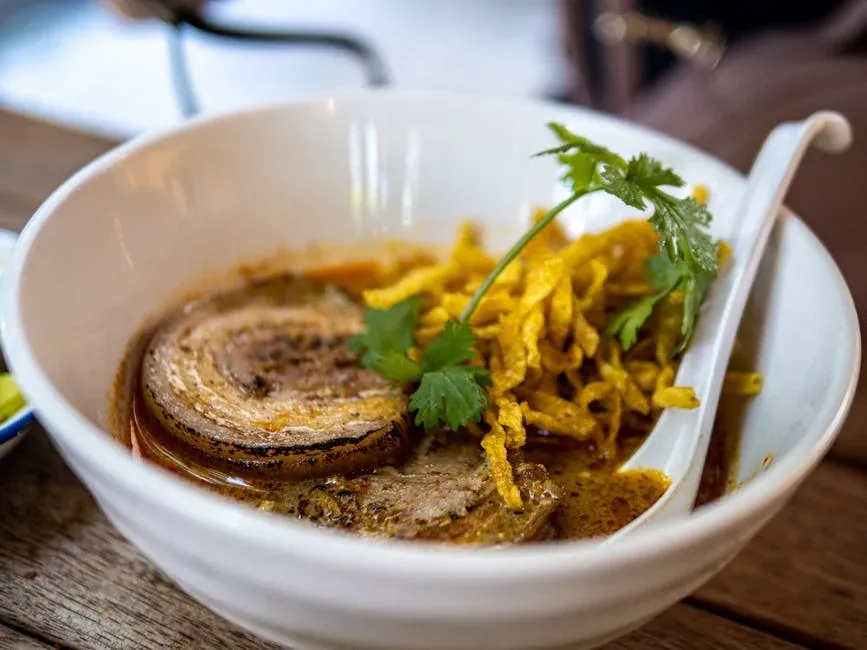
The defining dish of northern Thai cuisine is khao soi — a coconut curry noodle soup with roots in Burmese and Yunnanese (Chinese) cooking. Egg noodles sit in a rich, yellow curry broth made with a paste of dried chilies, turmeric, coriander, and shallots, simmered with coconut cream. On top: a nest of crispy deep-fried noodles that provide textural contrast to the soft ones below, pickled mustard greens, raw shallots, and a squeeze of lime. The dish is served with chicken leg (the most traditional protein) or beef, and the curry is mild by Thai standards — warming rather than burning, with the coconut cream providing a rich baseline that the pickled greens and lime cut through. At Khao Soi Khun Yai on Charoenrat Road in Chiang Mai, the version served has been refined over three generations and uses a curry paste made fresh each morning. A bowl costs 50 baht ($1.45), and it's the most satisfying bowl of curry noodles in Thailand.
The Northern Relishes
Northern Thai cuisine revolves around nam phrik — chili relishes — to a degree that other Thai regions don't match. A typical northern Thai meal centers on a selection of nam phrik served with fresh and blanched vegetables, sticky rice, and grilled or fried proteins. Nam phrik ong (a tomato-and-pork mince relish, mildly spicy and slightly sweet) is the most accessible. Nam phrik num (young green chili relish, roasted over charcoal until smoky, then pounded with garlic and shallots) is more assertive, with a bright heat that lingers. Nam phrik kha (a relish made from galangal) adds an earthy, gingery depth that's unique to northern cooking.
The vegetables served alongside — crisp cabbage wedges, blanched long beans, steamed squash, bitter eggplant, fresh cucumber — are not garnishes. They're structural elements, each one paired with specific relishes and eaten in specific combinations. The bitter eggplant, for example, is traditionally eaten with nam phrik ong, where its bitterness contrasts with the relish's sweetness. The cucumbers go with nam phrik num, where their coolness moderates the chili heat. This relish-and-vegetable system is closer to Middle Eastern mezze than to the one-plate-one-protein model of Western dining, and it produces meals of extraordinary variety from relatively simple components.
The Southern Table
If Northern Thai food whispers, Southern Thai food screams. The heat level in Southern Thai cooking is the highest in Thailand — significantly higher than Central Thai, which is already higher than most cuisines worldwide. The curries use fresh turmeric (giving them a yellow hue instead of green or red), are thinner and more soup-like than Central Thai curries, and contain less coconut milk, resulting in a sharper, more intense spice profile. The dominant protein is seafood — fish, shrimp, squid, and crab — reflecting the peninsula's coastal geography. And the flavor profile tilts heavily toward sour and spicy, using tamarind, lime, and sour fruits (like sator beans and riang, a sour leaf) as primary seasonings.
Kaeng tai pla — arguably the most intense dish in Thai cuisine — is a Southern curry made from fermented fish entrails (tai pla) simmered with bamboo shoots, long beans, and eggplant in a broth so aggressively spicy that it can induce sweating in people who consider themselves spice-tolerant. The fermented fish provides a funky, deeply umami base that's amplified by shrimp paste and dried shrimp. The overall effect is a curry that hits every pain receptor in your mouth while simultaneously delivering complex, layered flavor. It is not for everyone. It is not even for most people. But if you eat spicy food regularly and want to find your ceiling, kaeng tai pla is the test. At Raya restaurant in Phuket Old Town, the kaeng tai pla is made by a cook who's been making it for 40 years, and the intensity is calibrated to be just barely on the edible side of overwhelming.
Sator Beans and Stink
Southern Thai cooking uses sator beans (petai or stink beans) — flat, bright green beans with a shape like oversized lima beans and a smell that can clear a room — as a signature ingredient. The smell is sulfurous, like garlic crossed with natural gas, and it persists in your body for 24 hours after eating (yes, in all the ways you're imagining). The flavor, however, is remarkable: slightly bitter, slightly nutty, with a crunchy texture that holds up to stir-frying. Pad sator goong (stir-fried stink beans with shrimp and shrimp paste) is the quintessential Southern Thai sator dish — the shrimp paste's funk amplifies the beans' funk, the shrimp's sweetness cuts through the bitterness, and the overall dish is one of those foods that you either find utterly addictive or completely repulsive, with no middle ground.
The Turmeric Difference
Fresh turmeric root is to Southern Thai cooking what lemongrass is to Central Thai: a foundational aromatic that appears in virtually every curry paste and many stir-fries. Southern Thai curry pastes — pounded in a mortar with dried chilies, shallots, garlic, and shrimp paste — get their distinctive yellow-orange color from turmeric rather than the green chilies (Central) or dried red chilies (Northern) that define other regions. The turmeric adds an earthy, slightly bitter undertone that gives Southern curries a flavor depth distinct from the sweeter, more coconut-forward Central versions.
The Rice Divide
The north eats sticky rice. The south eats jasmine rice. This sounds like a trivial difference, but it shapes entire meal structures. A Northern Thai meal is communal and hands-on: bowls of relishes and curries in the center, each person pulling off pieces of sticky rice, rolling them into balls, and dipping. A Southern Thai meal is plated individually or served with rice that absorbs the curry gravy. The difference in tactile engagement — eating with your hands versus eating with a spoon and fork — changes the pace, the portion control, and the social dynamic of the meal. The Northern style is slower, more conversational, more focused on the variety of accompaniments. The Southern style is more focused on the curry itself, which needs to stand alone because it's the main event rather than one of several relishes.
Both systems work perfectly for their respective cuisines, and both are poorly represented on international Thai restaurant menus, which typically default to Central Thai preparations with jasmine rice regardless of what's being served. If you're ever in Chiang Mai and a restaurant serves your khao soi with jasmine rice instead of offering sticky rice as an alternative, you're in a restaurant that doesn't take Northern food seriously. Likewise, if a Southern Thai curry arrives with sticky rice, someone in the kitchen has confused their regions. The rice isn't interchangeable. It's part of the dish.