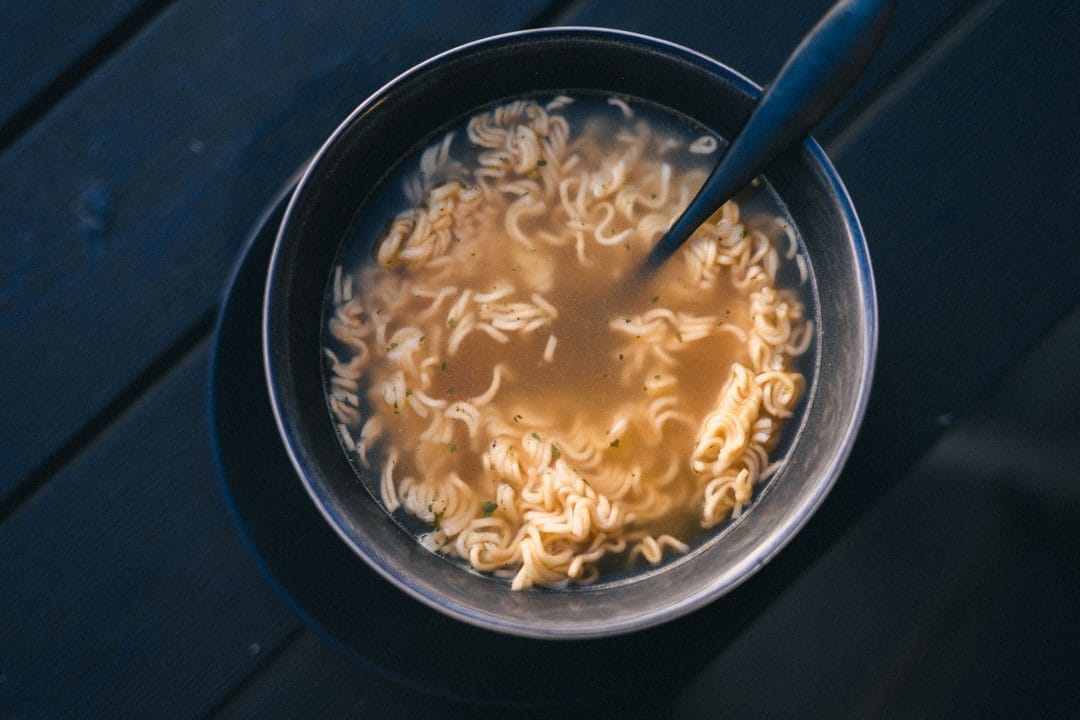
Order a bowl of noodles in Hakata at two in the morning and the broth arrives nearly opaque — a milky, collagen-heavy tonkotsu that's been rolling at a hard boil for twelve to eighteen hours, emulsifying pork bones until the fat and marrow disappear into the liquid itself. Order the same category of dish — noodles, broth, a protein, a garnish — five hours south in Hanoi, and you get something almost the opposite: a clear, restrained beef broth built on charred ginger and star anise, ladled over flat rice noodles that have no gluten and therefore no real chew to speak of. Both are, technically, "noodle soup." Neither chef would recognise the other's bowl as belonging to the same tradition.
Wheat versus rice versus buckwheat: the noodle decides everything else
Ramen starts with wheat flour and kansui, an alkaline mineral water that gives the noodle its yellow tint, springy bite and resistance to going soft in hot broth for the twenty minutes it takes to actually eat a bowl. Phở uses rice flour exclusively, milled into a batter, steamed into sheets and cut into flat strands that soak up broth rather than resisting it, which is why a good phở broth has to be more aggressively seasoned — fish sauce, charred onion, cinnamon bark — to survive contact with a noodle built to absorb rather than repel. Naengmyeon, Korea's cold buckwheat noodle, splits the difference: buckwheat has almost no gluten on its own, so Korean noodle-makers cut it with sweet potato or kudzu starch to get any chew at all, producing a noodle so tightly bound it's often cut with scissors at the table rather than twirled or slurped in one motion.
The starch choice isn't an aesthetic preference — it's a direct response to climate and to whatever grew locally before refrigerated shipping existed. Wheat suited the cooler, drier north of the noodle-eating world, which is why ramen, udon and Chinese lamian all trace back to wheat-growing regions rather than the rice paddies further south. Rice noodles spread across the wetter south instead, running from Vietnam through Thailand's kuaitiao and into southern China's own rice-noodle traditions, wherever rice paddies made rice flour cheaper and more reliable than imported wheat. Buckwheat thrived in Korea's colder highland provinces, where wheat struggled to grow and rice was a luxury grain reserved for special occasions well into the twentieth century. None of these choices were about flavour first — they were about what a noodle-maker could actually get their hands on, and the flavour differences treated today as deliberate culinary decisions were originally just geography.
Broth is where the real argument happens
Ramen broth divides into four base categories that Tokyo ramen shops treat almost like religious denominations: shio (salt), shoyu (soy sauce), miso and tonkotsu, each requiring a different simmer time, a different fat ratio and, in serious shops, a completely different noodle thickness to match. A Sapporo miso ramen uses a thicker, curlier noodle specifically because the miso broth is heavier and would drown a thin Hakata-style noodle; a Hakata tonkotsu shop, by contrast, serves thin straight noodles precooked so lightly that regulars order "kaedama" — a noodle refill — to drop into the leftover broth once the first batch is gone. Try that same kaedama order at a shio counter and most cooks will just look at you; the practice only makes sense with a broth rich enough to survive a second noodle drop.
Phở's north-south divide, and Malaysia's mee free-for-all
Phở, by comparison, only really comes in two regional camps.
Phở Bắc, the northern Hanoi style, keeps the broth clear and the garnish minimal — scallion, a few herbs, maybe a squeeze of lime, and nothing more, on the theory that a well-made broth doesn't need to be dressed up. Phở Nam, the southern Saigon style that spread internationally through the diaspora, piles on bean sprouts, Thai basil, sawtooth herb, hoisin and sriracha at the table, turning the same bowl into something closer to a build-your-own dish. Ask a Hanoi traditionalist about Saigon-style phở and you'll get an unqualified opinion delivered without hesitation: the northern version is the real one, and the southern additions exist to cover for a broth that wasn't simmered long enough. That's not a universally shared view — plenty of cooks in Ho Chi Minh City would say the northern style is simply underseasoned — but it's the opinion you'll hear most often north of the Red River, and it's worth knowing before you offer sriracha to someone's grandmother's phở.
"Mee" in Malaysia and Singapore isn't one dish at all — it's a noodle format dropped into a dozen unrelated preparations: mee goreng, fried and wok-charred with a tamarind-sour kick; wonton mee, thin egg noodles tossed in dark soy and lard with the soup kept separate, never mixed in; curry mee, which shares almost nothing with either beyond the noodle itself; and half a dozen others a good hawker centre will rotate through the week. A Penang hawker stall might sell three of these from the same cart, and regular customers order by dish name, never by "noodles," because in a market this fragmented the word alone tells a cook nothing useful.
Naengmyeon: the noodle built for summer, served with ice in the broth
Mul naengmyeon takes the buckwheat-and-starch noodle described earlier and drops it into a broth served literally over ice, traditionally made from dongchimi — a watery, mildly fermented radish kimchi — mixed with a clear beef or pheasant stock, chilled for hours before serving. Bibim naengmyeon skips the broth entirely and tosses the same noodles in a fiery gochujang-based sauce instead, which means two dishes sharing a name can taste like they belong in different cuisines depending on which one lands on the table. Pyongyang is generally credited as the dish's origin point, and Seoul restaurants specialising in the "Pyongyang-style" version — thinner broth, less sweetness, a more austere presentation — treat that distinction as a genuine mark of authenticity rather than a marketing label, charging accordingly for it.
Order naengmyeon in January in Seoul and nobody will blink, even though every guidebook calls it a summer dish — the phrase "이열치열," fighting heat with heat, gets used to justify eating naengmyeon in winter almost as often as it gets used to justify the reverse, eating scalding-hot stews in August. The logic contradicts itself depending on which meal someone is defending at the time, which is either a flaw in the reasoning or the entire point of it.
What actually changes when you cross the border
None of these differences are cosmetic, and none of them are really about "noodles" as a category at all — they're about wheat belts versus rice paddies versus buckwheat highlands, about which broths needed hours and which needed minutes, about a north-south argument in Vietnam that's been running for decades and shows no sign of resolving. A Hakata tonkotsu shop and a Hanoi phở stall are separated by roughly 3,800 kilometres, but the real distance between their bowls is closer to a different agricultural history entirely, with the noodle itself as the fossil record. Try ordering ramen-style kaedama at a phở stall and the server will have no idea what you're asking for — not because Vietnamese cooking lacks the concept of a refill, but because a phở noodle disintegrates if left sitting in hot broth waiting for a second bowl, so the entire practice never had a reason to exist there.
Ask a noodle vendor in any of these four cities what makes their version the right one, and you'll get a specific, confident answer — never "it depends" — because to the person actually making the bowl, it never did.