The Stack, Not the Menu
You sit down at a Rumah Makan Padang and no one hands you a menu. Within seconds a server appears with a forearm stacked in a tight fan — rendang, a fish curry, boiled cassava leaves, a bowl of rice — and sets a dozen small plates down in front of you before you've said a single word. You haven't ordered anything, and yet the meal has already started without you. That's the point. This is Nasi Padang, and if you've eaten at a busy lunch counter in Jakarta, in the older shophouses of Kuala Lumpur, or at a hawker stall in Singapore, you've likely encountered this format without ever hearing it explained.
No one asks if you'd like to see a menu. There isn't one.
The system has a name — hidangan, roughly "the display" — and it works on a logic that feels backwards to anyone used to ordering first and eating second. The server, often called a juru hidang, stacks anywhere from ten to twenty small dishes on your table in one uninterrupted motion, balancing them up the forearm the way a card dealer fans a deck. You don't request individual items unless you want something specific, like extra sambal or a second helping of gulai nangka, the young jackfruit curry. Instead you eat from what's placed, and the plates you don't touch get cleared and reused for the next table. Watch the front window of any serious Padang restaurant and you'll usually see the same food on display behind glass — dozens of bowls arranged in tiers so passersby can see exactly what's cooking before they've even walked in.
West Sumatra and the Merantau Habit
The dish takes its name from Padang, the capital of West Sumatra province and the largest city of the Minangkabau people. Minangkabau society is unusual in Indonesia for being matrilineal — property and the family home pass through the mother's line, not the father's — and one consequence of that structure is merantau, a long-standing custom in which young Minangkabau, especially men, leave home to build a livelihood elsewhere before returning with something to show for it. Merantau is why Nasi Padang restaurants exist in nearly every Indonesian city of any size, and why you'll find them well beyond Indonesia's borders. Opening a Padang eatery has been one of the most common paths into that tradition for over a century, requiring little capital beyond a stove, a set of recipes carried from home, and the willingness to cook the same dishes daily until the format sells itself.
Rendang, Cooked Until the Sauce Disappears
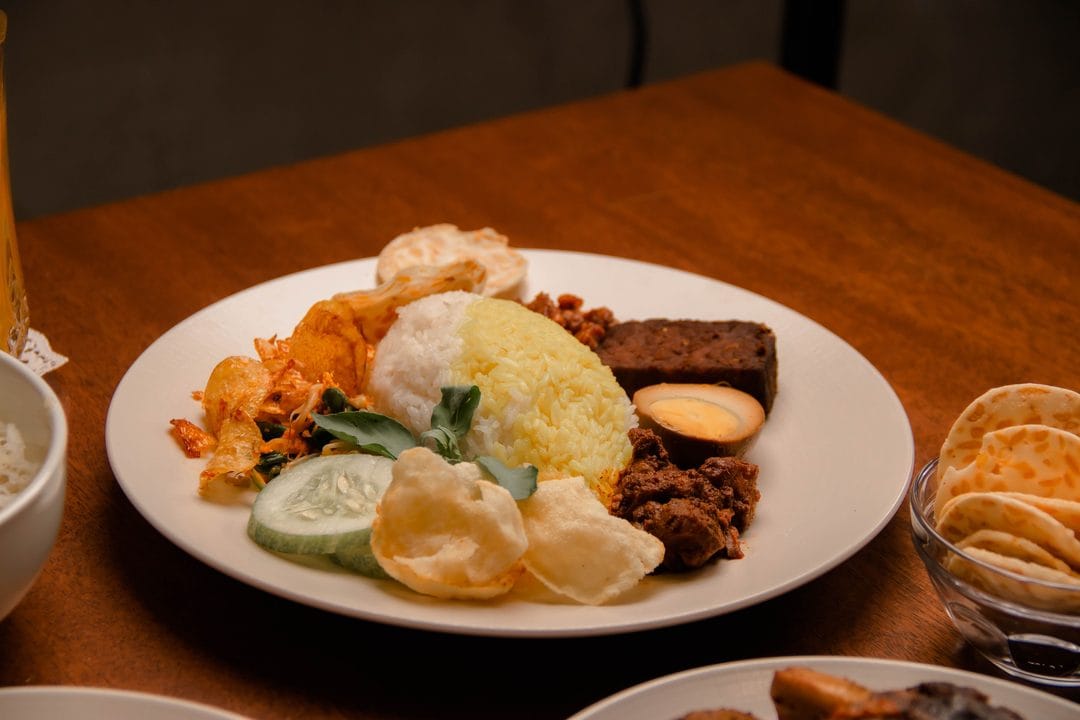
Every hidangan display centers on rendang, and if you order only one dish from the stack, make it that one — nothing else on the table demonstrates the technique as clearly. Rendang starts as a curry: chunks of beef simmered in coconut milk with a ground paste of galangal, turmeric, ginger, garlic, shallots and dried chilies. Over several hours of slow, uncovered cooking, the liquid reduces and darkens, passing through an intermediate stage called kalio — thick, red-brown, still saucy — before continuing down to rendang proper, where the coconut oil has separated out, the meat has taken on a near-black caramelized crust, and there's barely any liquid left to speak of. A good pot takes four to eight hours and gets stirred continuously near the end so nothing scorches to the bottom. In 2011, CNN's international readers' poll ranked rendang the single best dish in the world out of fifty finalists, ahead of Neapolitan pizza and Peking duck — a result that Indonesian newspapers still cite with some pride whenever the dish gets discussed abroad.
Beyond the Rendang
A few more regulars turn up on most tables, among others that shift depending on the city and the season:
- Ayam pop — chicken boiled first in coconut water and spices, then briefly fried, which leaves it pale and far less crisp than fried chicken elsewhere in Southeast Asia
- Gulai ikan is a turmeric-yellow fish curry, often made with mackerel or carp depending on what's local that week.
- Sambal ijo — a green chili sambal made from unripe chilies, milder in color than it looks but sharper in heat than most diners expect
- Dendeng balado — thin-sliced dried beef, fried crisp and tossed in a red chili sambal, one of the few dishes on the table you'd happily eat with your hands and nothing else
- Perkedel — a potato fritter bound with egg, usually the one plate at the table a child will actually finish without prompting
Paying for What You Actually Ate
The billing custom is where the format really departs from anywhere else you've eaten. In its traditional form, you're charged only for the dishes you touched, not for everything set down in front of you. Staff tally the bill by counting which small plates came back empty, or nearly empty, once you've finished — untouched dishes go back to the display case for the next customer. It runs on a degree of trust that would be unworkable almost anywhere else in food service, and it only holds up because everyone at the table already knows the rule before they sit down.
That said, the pure hidang system has been retreating for years in busier cities, and it's worth saying so plainly rather than pretending the old version is universal. Many Padang restaurants in Jakarta now operate closer to a standard counter service, where you point at what you want behind the glass and pay for exactly that, skipping the unsolicited stack altogether. Owners cite food waste and slower table turnover as the reason. The full hidang experience, plates arriving unasked and unbilled until the end, survives most reliably in West Sumatra itself and in a handful of older, family-run establishments elsewhere that have kept the practice as a point of identity rather than efficiency.
Sederhana and the Rise of the Chain Restaurant
Not every Padang restaurant stayed a single storefront. Sederhana, founded in Jakarta in 1972 by a Minangkabau migrant family, grew from one modest stall into one of the largest Padang restaurant groups in Indonesia, with branches now scattered across the country and into neighboring Malaysia and Singapore under Minangkabau-run franchises. The company's spread mirrors the merantau pattern at an industrial scale — recipes, staff and management knowledge moving out from West Sumatra through family and regional networks rather than corporate expansion in the conventional sense. Smaller operators followed the same playbook without ever forming a chain: a cousin sets up shop two provinces over, a nephew joins as a juru hidang to learn the trade, and within a few years there's a second location run by people who trained at the first.
You'll sometimes spot the connection to home in the architecture. Some larger Padang restaurants build their roofline with the upward-curving points of a rumah gadang, the traditional Minangkabau house, shaped to evoke buffalo horns — a small, deliberate signal to Minangkabau customers that this kitchen answers to the same standards as home.
A Restaurant That Doubles as a Waiting Room
For a newly arrived Minangkabau migrant in an unfamiliar city, the local Padang restaurant tends to function as something closer to a community office than a place to eat. Job leads circulate over the lunch counter. A newcomer without lodging sorted out yet can often find a first week's work washing dishes or waiting tables at a restaurant run by someone from the same regency back home, filling a role that, in other diaspora communities, might belong to a religious hall or a hometown association instead. Compare that to how a sit-down restaurant works almost everywhere else in Southeast Asia — you arrive, you're handed a menu, you order, a stranger serves you, you leave — and the difference isn't just in how the food is served. It's in what the building is actually for.
Next time a stack of unordered plates lands in front of you at a Padang counter, resist the instinct to ask for a menu. Eat what's there, leave what you don't want untouched, and let the empty plates do the talking when the bill comes.