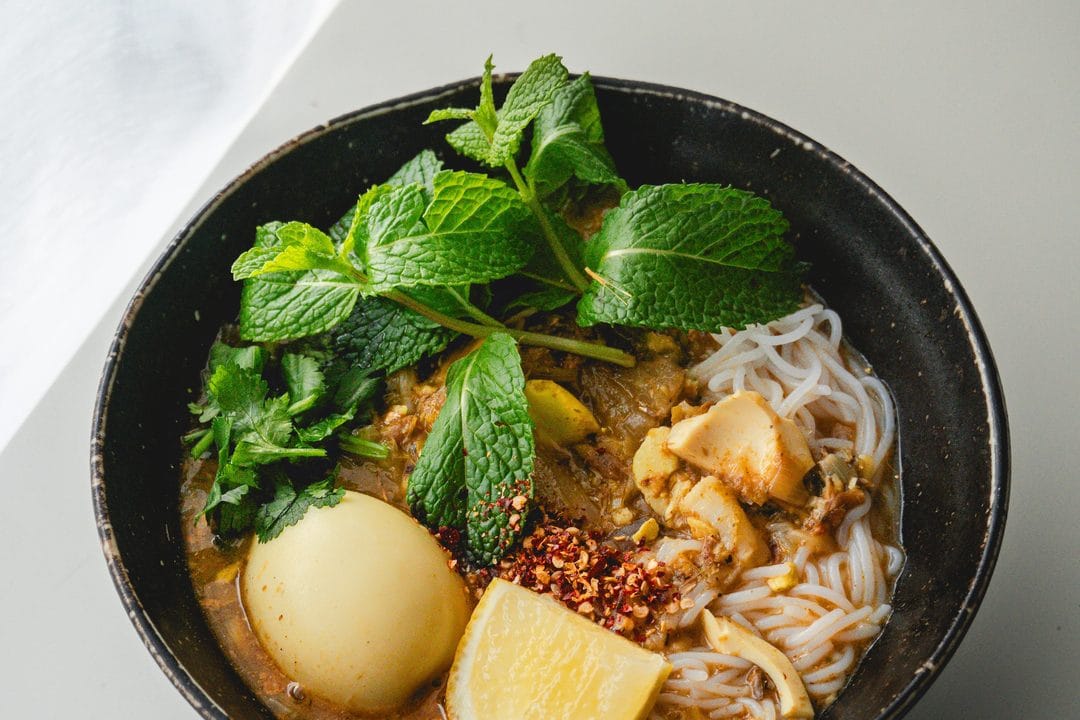
By 6:30 in the morning at Yangon's Theingyi market, the mohinga carts already have a line, and nobody in that line is dressed for breakfast theater — they're dressed for work, standing with one hand on a motorbike helmet and the other reaching for a bowl of rice noodles drowned in a thick, peppery catfish broth. Nobody explains the dish to anybody, because nobody needs it explained. You order by holding up fingers for how many bowls, you eat in under four minutes, and you move on, and the vendor has already ladled the next bowl before you've paid for yours. That briskness is the whole point: mohinga isn't a restaurant dish that happens to be popular, it's infrastructure, the thing that gets a large share of Myanmar to lunchtime without needing a proper breakfast conversation at all. Ask someone in Yangon what they had for breakfast and the honest answer, most days, is a five-minute bowl eaten standing up next to a stranger's idling motorbike.
What's Actually in the Pot
The broth starts with catfish — usually the walking catfish, nga khu, simmered whole until the meat falls off the bone and can be strained out, leaving behind a stock that's deeply savory without tasting overtly fishy. Lemongrass, ginger, and garlic go in early, and a good vendor toasts the garlic separately into an oil that gets drizzled on top rather than stirred through, so every spoonful hits a different concentration of it. Chickpea flour or toasted rice powder gets stirred in toward the end, which is the part first-time home cooks always get wrong: too much and the broth turns gluey, too little and it never thickens past a thin soup. A good mohinga vendor in Yangon can tell you the exact moment the broth "catches" — a change in the way it drags against the ladle — the way a barista learns to read foam without needing a thermometer. Some stalls add a spoonful of split pea powder alongside the rice powder for extra body, a trick most customers never notice unless the broth is missing it one morning.
The other essential, and the ingredient that trips up almost every outside account of this dish, is banana stem — not the fruit, the pith of the trunk, sliced paper-thin and simmered into the broth until it turns silky and faintly sweet. Skip it and you have a passable fish noodle soup. Include it and you have mohinga, because that starchy, slightly grassy note is doing as much work as the fish itself. Vendors in the Ayeyarwady Delta, where banana groves border almost every rice paddy, use noticeably more of it than city cooks do, and the broth reads sweeter for it — a difference you can taste within the first spoonful if you've had both versions back to back.
Reading a Bowl Like a Local
A bowl arrives with rice noodles already in the base, broth ladled over, and then the garnishes come separately — a wedge of lime, a scatter of coriander, dried chili flakes, and at least one crunchy element, usually akyaw, a split pea or gourd fritter broken into shards on top. A soft-boiled egg is common but optional, and ordering it costs a little extra: expect to pay 800 to 1,500 kyat for a basic bowl in Yangon, roughly $0.25 to $0.45 at current exchange rates, with the egg adding another 300 kyat or so. Fish sauce and extra chili sit on the table for self-service, and nobody will judge you for using both liberally, though the vendor absolutely will judge you if you drown the broth before tasting it plain first.
Here's the part that catches visitors off guard: you're expected to crush the akyaw into the broth rather than nibble it separately, so the fritter loses its crunch and instead turns the base slightly grainy and rich. Locals do this without thinking, dropping the fritter in with the same spoon they're already holding. First-timers keep the fritter on the side like a garnish, which — fine, no one will stop you, but you're eating a different dish at that point, texturally speaking, and you're missing why the fritter is there in the first place.
More Than Breakfast
Mohinga doesn't take a day off.
It shows up at funerals, where families serve enormous batches to mourners as a gesture that costs relatively little but feeds a crowd properly. It shows up at pwe festivals, ladled from pots the size of oil drums, with volunteers refilling bowls faster than anyone can count them. And during the unrest of 2021, when much of Yangon's normal commerce shut down, neighborhood volunteers kept mohinga carts running specifically because it was cheap, filling, and fast to distribute to people who had nowhere else to eat that day — a detail that tells you more about the dish's place in daily life than any restaurant review could.
Yangon, Mandalay, and the Delta Don't Agree
Ask a mohinga vendor from Mandalay about the Yangon version and you'll get an opinion, usually an unflattering one. Mandalay broth tends to run thinner and more peppery, built around a sharper garlic-oil finish, while Yangon versions lean thicker and rounder, closer to a chowder than a soup. Down in Delta towns like Pathein, cooks add more banana stem and sometimes a touch of tamarind, giving the broth a light sourness that neither of the other two regions bothers with. None of these is more authentic than the others — mohinga was never standardized, and that's arguably part of why it survived colonial disruption and decades of military rule without turning into a museum piece. Regional pride runs deep enough that a Mandalay native living in Yangon will still make the four-hour bus trip home partly for the broth, and won't pretend otherwise.
The dish does have a counter-current worth naming honestly: in central Yangon, a wave of air-conditioned "heritage" mohinga shops has opened for tourists and the newly moneyed middle class, charging three or four times the street price for a bowl that's frankly less interesting than what's still simmering in a dented aluminum pot two blocks away. Skip those unless you specifically want a seated, English-menu experience — the real thing is standing up, at a plastic stool, next to someone's idling motorbike, not under air conditioning with a laminated menu.
Where the Broth Still Tastes Like Something
For a first bowl in Yangon, the stalls ringing Theingyi market outperform almost anything with a shopfront, and the vendors rotating through the lanes near Sule Pagoda before 8 a.m. are worth chasing down even if you have to ask three people for directions to find the one that's actually good that morning. In Mandalay, the carts near Zegyo Market do a thinner, punchier broth that pairs well with an extra squeeze of lime — order it without the egg first, then decide if you want the richness added back in on your second bowl, because you will want a second bowl.
Eat it before nine, eat it standing or perched on a stool too short for adult knees, and don't ask for the recipe — most vendors learned it from a mother or grandmother and treat the exact ratio of chickpea flour to stock the way a family treats an old argument, which is to say, not up for discussion with a stranger holding a phone. That's not gatekeeping. That's just how the good stuff gets passed down here: slowly, unevenly, and only to people who show up often enough to be trusted with it.