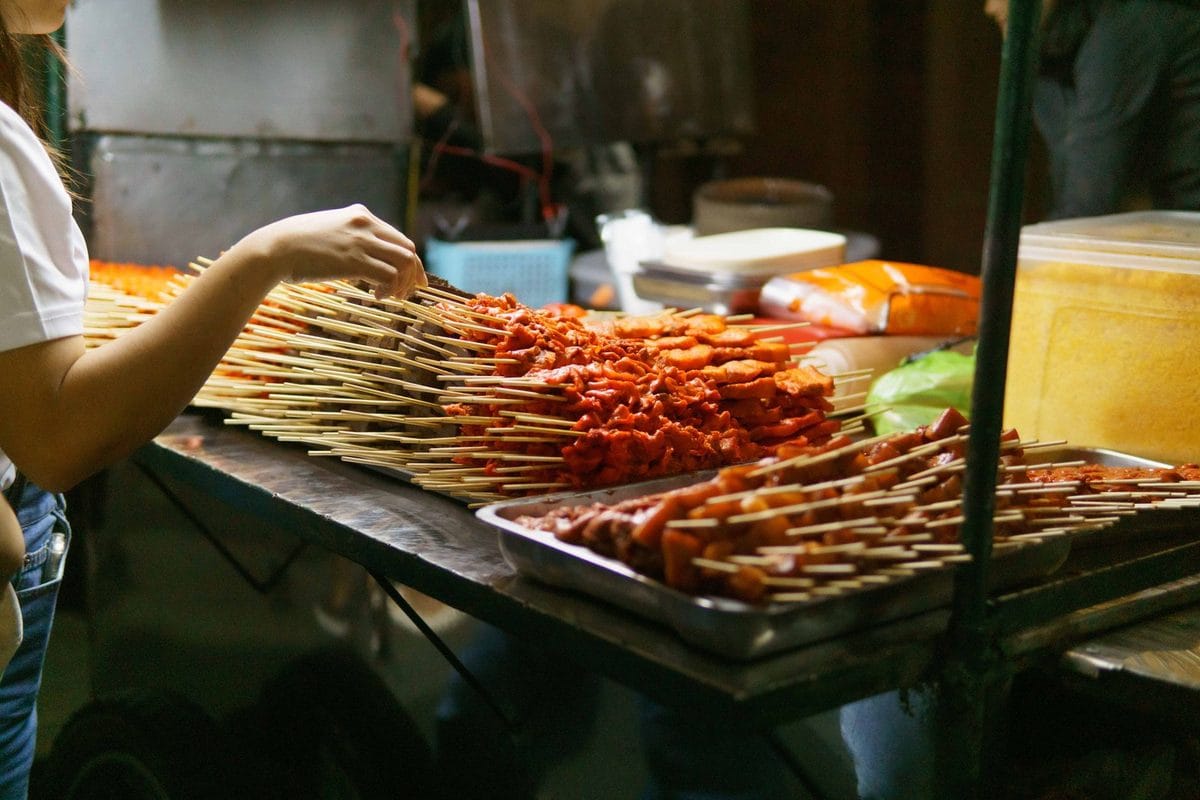
It's just past seven in the evening on a side street off Quiapo, and the smoke from a dozen charcoal grills has settled into a low haze under the tarpaulin awnings. Somewhere in that haze, a vendor named Manong Rudy is fanning a tray of skewers with a flattened cardboard box, and the smell — part char, part vinegar, part something you can't quite place until you've eaten it — pulls in office workers still in their lanyards, students in PE uniforms, and at least one taxi driver who's parked illegally for the sole purpose of getting three sticks of isaw before his shift ends. Nobody here is thinking about intestines. They're thinking about dinner.
That's the thing outsiders get backwards about Filipino street food: the "shock value" framing — chicken intestines, coagulated blood, deep-fried fish paste — completely misses what's actually happening on these carts. This is a full, functioning food economy that feeds a huge share of Metro Manila every single night, priced in five- and ten-peso increments, running almost entirely outside any restaurant license. Once you understand the mechanics of it, isaw and betamax stop looking like a dare and start looking like what they are: cheap protein, expertly grilled, sold by people who've done this six nights a week for twenty years.
What's Actually on the Stick
Isaw is grilled chicken or pig intestine, and the vendor's real skill is invisible to the customer: cleaning it. Raw intestine gets turned inside-out, scraped free of its lining with the back of a knife, then soaked in a vinegar-and-salt brine for anywhere from twenty minutes to an hour before it ever touches a skewer. Skip that step or rush it, and the smell gives you away instantly — a good isaw vendor's intestine smells like nothing at all before it hits the flame, and like caramelized fat and char once it's done. It's threaded onto bamboo skewers in a tight coil, basted with a mix of oil tinted orange with achuete (annatto seed) and grilled directly over lump charcoal, not gas — gas doesn't give you the same smoky crust, and any Manila vendor will tell you that without hesitation.
The dip is not optional and it is not an afterthought. Sawsawan — a small bowl of vinegar cut with soy sauce, chopped onion, and sliced siling labuyo (bird's eye chili) — sits on every cart, usually refilled from a repurposed soy sauce bottle with the label half peeled off. Dunk the skewer, don't drizzle. A stick runs ₱10 to ₱15, somewhere around $0.18 to $0.27 at current exchange rates, and most regulars order five or six at a time along with a small plastic cup of rice for another ₱10. Go for the cart with the brine bucket visibly changed within the hour — you can tell by the color, still pale rather than cloudy pink — and skip the one where the raw intestine has been sitting out under open air for who knows how long. That's the single biggest safety call you can make on a Manila street corner, and it matters more than which cart looks busier.
Betamax, Adidas, and the Parts Nobody Wastes
Named for its resemblance to the old Sony videotape cassette — a joke that's now older than most of the people eating it — betamax is coagulated pig or chicken blood, set into a firm block, sliced into rectangles, skewered, and grilled until the edges crisp. Texture-wise it lands somewhere between a very dense custard and a firm tofu, with an iron-heavy, faintly sweet flavor that the char balances out. Alongside it on most carts: adidas (grilled chicken feet, named for the three-stripe look of the tendons), walkman (chicken ears), and isaw's pork cousin, which some vendors keep separate from the chicken version because the cook time and thickness differ enough to matter.
None of this is waste product dressed up as novelty. In a country where a kilo of chicken breast at a Manila wet market runs roughly ₱220 to ₱260 (about $4), using the whole bird — blood, feet, intestine, and all — isn't a gimmick, it's basic economics that's been true since long before "nose to tail" became a phrase chefs put on tasting menus abroad. The vendors selling betamax tonight are doing what their grandmothers did with the same cuts, at the same corner, for a fraction of what a plate of grilled chicken thigh at a sit-down carinderia would cost.
The Fishball Sauce Wars
This is the one culinary argument every Filipino has strong feelings about.
A few carts down, a different setup: a wide wok of oil, visibly darker than the isaw grill's charcoal but that's beside the point here, holding dozens of small orange fishballs — ground fish paste, flour, and food coloring, deep-fried to order and skewered five or six to a stick. Next to the wok sit two plastic squeeze bottles, and this is where Manila street food gets genuinely opinionated: sweet sauce, a cornstarch-thickened brown syrup with a faint garlic note, versus spicy vinegar, thin and sharp with bird's eye chili floating in it. Most carts let you have both, layered on the same stick.
Take the spicy vinegar over the sweet sauce, every time. The sugar syrup just sits on top of the fry oil; the vinegar actually cuts through it, and that acidity is doing real work your palate will thank you for after the third or fourth skewer. Kikiam — a five-spice-seasoned ground pork and jicama roll wrapped in tofu skin, a legacy of Manila's Chinese-Filipino Binondo district — usually sits in the same fryer, along with squid balls that are mostly flour with the faintest whisper of squid flavor added for the name. A stick of five fishballs runs about ₱10, roughly $0.18, and a full round of one of each — fishball, kikiam, squid ball — with both sauces rarely clears ₱35, under a dollar.
The Informal Economy Running the Whole Operation
Here's what almost nobody outside Manila realizes: this entire nightly economy — the carts, the charcoal, the skewers, the sauces — mostly operates without a standard business permit. Many vendors qualify under Republic Act 9178, the Barangay Micro Business Enterprises Act, which exempts businesses with assets under ₱3 million from income tax and simplifies registration to the barangay level rather than the full city bureaucracy. A basic isaw-and-betamax cart setup — the metal grill frame, a sack of charcoal, a cooler, skewers, and starting stock — costs a vendor somewhere between ₱8,000 and ₱15,000 to get running, roughly $140 to $270, and most of that gets earned back within the first two or three weeks of steady sales. Add a helper for the evening rush, usually a relative paid in a cut of the night's take rather than a fixed wage, and the same cart can run from six in the evening until well past midnight without a single skewer going cold on the grill. On a decent night — payday Friday, a nearby basketball game letting out, a jeepney strike keeping people walking instead of riding — a single cart can move upward of 300 skewers, which puts gross nightly revenue somewhere around ₱3,000 to ₱4,500, or roughly $55 to $80, before the cost of charcoal, ice, and stock gets subtracted.
That doesn't mean the arrangement is comfortable or secure.
Manila City and several surrounding municipalities have run repeated "clearing operations" against ambulant vendors on major roads, confiscating carts and equipment under local anti-obstruction ordinances — a vendor who's built up ₱10,000 worth of gear can lose all of it in one afternoon raid, with no compensation and no straightforward path to get it back. The trade-off locals have made peace with is this: the same informality that keeps a stick of isaw at ₱10 instead of ₱50 is the informality that leaves vendors with almost no legal ground to stand on when the city decides a street needs clearing. It's a genuinely rough deal, and pretending it isn't would be dishonest to the people actually running these carts six nights a week, rain or heat index warning, to put their kids through school.
Where to Actually Go
Skip the sanitized "street food" stalls set up inside air-conditioned malls — they're fine in a pinch, but they're not the thing. The real version is on the street outside Quiapo Church after the vendors selling religious candles pack up for the night, along Recto Avenue near the university belt where the customer base is mostly students stretching a ₱200 daily allowance, and around Cubao Expo where the crowd runs older and the vendors have often held the same corner for over a decade. Go on a weeknight rather than a weekend — the carts are less crowded, the oil in the fishball wok has usually just been changed for the evening rush, and you'll get the vendor's full attention instead of waiting behind six other orders.
Eat standing, the way it's meant to be eaten, with a plastic cup of rice if the cart has one and a fistful of skewers in the other hand. Ask for the spicy vinegar first. And if the vendor recommends the betamax over the isaw that night — trust it, because that's usually a sign of which one came off the market fresher that afternoon, not just a sales pitch aimed at the tourist standing there with a phone camera out.