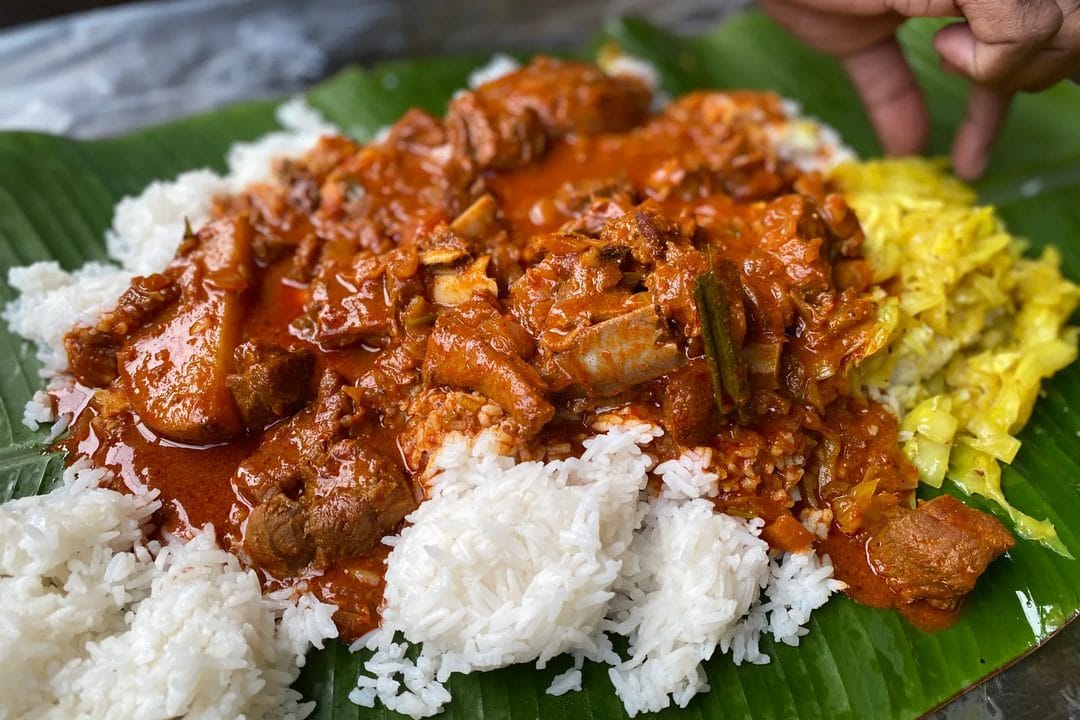
Every Sunday morning in Colombo, a small kitchen inside the Dutch Burgher Union's clubhouse ties off banana-leaf parcels the size of a fist and marks each one with a single letter — a "C" for chicken, sometimes nothing at all for the mixed version. The parcels go to VOC Café, the tiny restaurant the Union runs on its own colonial-era premises, and from there to a diaspora of regulars who grew up eating exactly this. What's inside is lamprais: rice cooked in meat stock, a three-meat curry, two fried meatballs, a pickled aubergine relish and a spoonful of dried-prawn paste, all baked together until the banana leaf itself becomes part of the flavor. It is, by most accounts, the single dish that best captures Sri Lanka's Dutch Burgher community — a group whose numbers have shrunk from tens of thousands to a fraction of that, and whose most visible legacy today is arguably not a language, a church or a surname, but a lunch.
A Snack From Java, Rewrapped in Ceylon
The word itself gives away the dish's foreign roots. "Lamprais" is an anglicized version of the Dutch lomprijst, loosely "a packet or lump of rice," and food historians trace the format back further still — to lemper, a Javanese snack of seasoned meat wrapped in glutinous rice and banana leaf that is still sold on Indonesian street corners today. The Dutch East India Company (VOC) controlled the coastal regions of Ceylon from 1658 until 1796, running the cinnamon and spice trade out of forts in Galle and Colombo, and the officials who staffed those forts moved constantly between postings in Batavia (present-day Jakarta) and Colombo. Somewhere in that traffic, the VOC's mixed-descent families — Dutch fathers, Sri Lankan and Portuguese-Burgher mothers — took the Javanese lemper and rebuilt it with what was on hand locally: black pepper, cinnamon, cloves, and cured bonito flakes from the Maldives. What came back out was no longer really Indonesian, and it was never Dutch either. Sri Lankan historian Deloraine Brohier, who wrote one of the only detailed studies of Dutch Burgher cooking, put it bluntly: people in the Netherlands have no idea what a lamprais is, and never have.
What's Actually Inside the Parcel
A proper lamprais is not one dish so much as five or six competing for the same banana leaf. The base is short-grain rice, fried first in ghee with onions and whole spices, then finished by simmering it in the same stock used for the meat — this is what gives the rice its deep, faintly brown color rather than plain white. Over that goes a mixed-meat curry that traditionally includes beef, pork and chicken together (modern versions, especially in Muslim and vegetarian households, swap in fish, egg, or nothing at all). Around the curry sit the supporting players:
- Seeni sambol — onions cooked down for hours until they caramelize into something closer to jam than relish, with a hit of dried bonito and a little heat
- Vambatu moju, a sweet-and-sour pickled aubergine dish cut with white vinegar
- Prawn blachan (also spelled belacan), a pungent fermented shrimp paste that food historians believe arrived via Malay or Indonesian trade routes, not Dutch ones
- Two small frikkadels, deep-fried meatballs that are, by most accounts, the only genuinely European element left standing in the whole assembly
Everything gets wrapped tight in a banana leaf — softened first over an open flame so it won't tear — and baked in an oven until the parcel steams itself shut. That baking step matters more than it sounds. It's what lets the seeni sambol's sweetness bleed into the curry and the curry's heat bleed into the rice, so that a lamprais eaten straight from its wrapping tastes like something that could never be served on separate plates.
A Community That Wrapped Its Identity in a Banana Leaf
To understand why a rice parcel became a whole community's calling card, it helps to know who the Dutch Burghers actually were. "Burgher" is simply Dutch for "citizen" — a term originally used to separate Dutch nationals from other Europeans on the island, later broadened to describe anyone of mixed European and Sri Lankan descent. When the British took over from the Dutch at the end of the eighteenth century, formally consolidating control of the whole island by 1815, the Burghers didn't disappear; they adapted. Fluent in English by upbringing rather than schooling, they slid comfortably into colonial-era law, medicine, the civil service and the railways, and by the late nineteenth and early twentieth centuries — a period Burghers themselves still refer to as a golden era — the community produced judges, artists and writers whose names remain fixtures of Sri Lankan culture. Colombo's premier arts theater is still named after the Burgher artist Lionel Wendt; novelist Carl Muller built an acclaimed trilogy out of Burgher family life, and Michael Ondaatje's memoir Running in the Family drew on the same world.
In 1908, the community formalized itself with the founding of the Dutch Burgher Union of Ceylon in Colombo, a clubhouse that became the center of Burgher social life — St. Nicholas Day parties every December 5th, dances, cricket, and, inevitably, enormous Sunday cooking sessions. Lamprais was never an everyday meal. Making it required a full night of work: meat boiled for hours the evening before, banana leaves washed and dried, rice cleaned and set aside, and then an entire morning of assembly, usually with three generations of women working the same kitchen together. It was a special-occasion dish precisely because it demanded that kind of collective labor — which is also exactly why it worked so well as a symbol of a tight, self-contained community.
When the Language Law Emptied the Clubhouse
That golden era didn't survive Sri Lankan independence for long. In 1956, eight years after the country gained independence from Britain, the government passed the Sinhala Only Act, replacing English with Sinhala as the sole official language and the medium of instruction in schools. For a community whose entire professional standing rested on English fluency, this wasn't a minor inconvenience — it was existential. Civil service jobs, university places and courtroom careers that had belonged to Burgher families for generations became suddenly inaccessible, and the response was a mass departure to Australia, the United Kingdom and Canada that ran for the next several decades.
The numbers tell the story on their own. Sri Lanka's 1981 census counted almost 40,000 Dutch and Portuguese Burghers, roughly 0.3 percent of the national population at the time; those still practicing the community's specific customs today are estimated at closer to 15,000, most concentrated in Colombo. A worldwide Burgher diaspora of roughly 100,000 now lives scattered across Australia, Canada, the UK and New Zealand — which means, for every Burgher who stayed, there are several who left. What used to be an enormous extended-family production, the kind Brohier remembered as a childhood ritual with cousins competing over who could eat the most parcels, is now something closer to a specialty order: reserved for the odd birthday or, more often, bought ready-made.
What's Left — and Who's Still Wrapping It
Here's the part that makes lamprais unusual among colonial-era dishes: it didn't fade out with the community that invented it. It got commercialized instead. Restaurants and bakeries across Colombo now sell versions of lamprais to a much broader Sri Lankan public that has no Dutch or Burgher ancestry at all, and that's exactly where the dish's authenticity debate lives.
Lorraine Bartholomeusz, a Dutch Burgher who has supplied lamprais to the Dutch Burgher Union's VOC Café for years, is unsparing about what's happened to the recipe in the process. She insists there's only one correct way to build a lamprais — the full three-meat curry, the moju, the blachan, the frikkadels, nothing swapped out for convenience — and that most commercial versions have drifted so far from that template, padded out with extra rice and the occasional bone-in chicken piece to bulk up the portion, that they'd be unrecognizable to the Burgher grandmothers who first made them. She's not wrong to worry: the dish's only serious written record is a 1929 cookbook, the Ceylon Daily News Cookery Book compiled by Hilda Deutrom, and as fewer Burgher families remain to pass the technique down directly, that thin paper trail is close to all that's left.
If you're chasing the closest thing to the original, order from a Burgher-run kitchen rather than a hotel buffet — VOC Café is the obvious starting point, and it's worth booking ahead since the parcels are made to order. Skip any version that leads with a deep-fried hard-boiled egg on top; it's a popular modern addition, but it wasn't part of what Brohier's generation grew up eating, and it tends to signal a kitchen optimizing for photographs rather than the original balance of flavors.
SriLankan Airlines' own in-flight magazine, Serendib, ran a feature on the dish's history in 2016 — a small but telling sign of how far a Sunday family ritual traveled from a colonial clubhouse kitchen to becoming shorthand for Sri Lankan cuisine itself. The community that built it is smaller now than it has been in over a century, and nobody is claiming the recipe circulating in Colombo's bakeries today is untouched by seventy years of substitutions and shortcuts. But the banana leaf still gets tied the same way, the rice still goes in first, and somewhere in Colombo this Sunday, someone will still be counting empty leaves to see who ate the most.