The Table Is a Battlefield
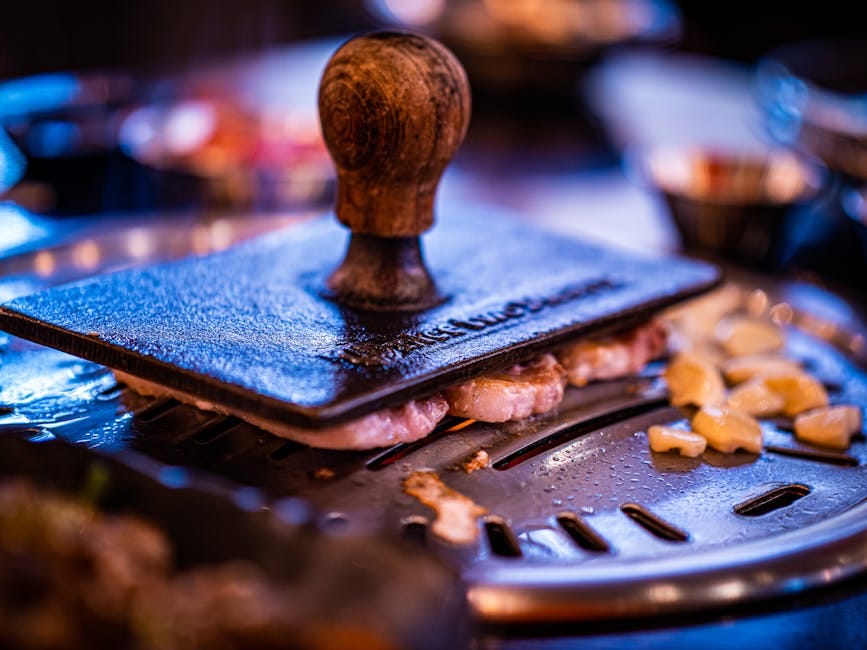
A Korean BBQ table at peak dinner hour looks like a logistics operation. A domed or flat grill occupies the center, surrounded by a constellation of small dishes — banchan — that can number anywhere from 8 to 20 depending on the restaurant. Tongs, scissors (yes, scissors), lettuce leaves, garlic slices, ssamjang (thick dipping paste), sesame oil with salt, sliced green chilies, and a stack of perilla leaves compete for space with your drink and your dignity. Someone is grilling meat. Someone else is wrapping meat in lettuce. A third person is arguing about whether the pork belly needs another 30 seconds. The exhaust hood above the table is working overtime, pulling smoke upward while pushing hot air down. It's chaotic, social, and fundamentally designed to prevent anyone from eating alone or in silence.
Korean BBQ — gogi-gui in Korean — is not complicated once you understand the system. But the system has enough moving parts that first-timers often freeze, overwhelmed by choices and unsure of the etiquette. The servers at most Korean BBQ restaurants in Seoul, LA, or Sydney will grill for you if you look confused, which is kind and helpful but also means you miss the interactive, slightly competitive, deeply satisfying experience of managing your own fire. Understanding the order of operations transforms Korean BBQ from a meal into a performance, and you're both the audience and the cast.
Choosing Your Cuts
Korean BBQ menus are organized by animal and cut, and the range can be dizzying. The essential categories are samgyeopsal (unmarinated pork belly), galbi (marinated beef short ribs), bulgogi (thin-sliced marinated beef), and moksal (pork neck/jowl). If you're eating at a place that specializes in pork — which is the majority of Korean BBQ restaurants, since pork is cheaper and arguably better suited to tabletop grilling than beef — start with samgyeopsal. Thick slices of unseasoned pork belly hit the grill and cook in their own fat, developing a caramelized crust on both sides while the interior stays juicy. The server or a tablemate will cut the cooked belly into bite-sized pieces with scissors right on the grill. This is normal. The scissors are there for a reason.
For beef, galbi is the crowd-pleaser: short ribs marinated in a sweet soy sauce mixture with pear, garlic, and sesame. The sugar in the marinade caramelizes fast, so galbi needs attention — a minute too long and you go from perfect char to burned sugar. At Maple Tree House in Samseong-dong, Seoul, the galbi uses 1++ grade Korean hanwoo beef (the highest marbling grade, equivalent to Japanese A5 wagyu) marinated for 48 hours. The meat is so well marbled that it practically bastes itself on the grill, and the marinade creates a lacquered, almost candy-like exterior. A serving of hanwoo galbi here runs ₩65,000 ($48), which is steep for Korea but represents extraordinary beef. For a more affordable option, Yeongcheon Yeongyang Center in Mapo-gu serves solid LA-cut galbi (cross-cut ribs, an Korean-American invention despite the name) for ₩18,000 ($13) per serving.
The Banchan Ecosystem
Banchan — the array of small side dishes that arrive before the meat — are not appetizers. They're structural elements of the meal, designed to be eaten alongside the grilled meat to provide contrast, freshness, and variety. The standard banchan lineup at a Korean BBQ restaurant includes kimchi (usually two types: baechu and kkakdugi), kongnamul (seasoned soybean sprouts), gamja jorim (soy-braised potatoes), sigeumchi namul (seasoned spinach), and pickled radish. Better restaurants add gyeran jjim (steamed egg custard), japchae (sweet potato noodles), and doenjang jjigae (fermented soybean paste stew) served in a stone bowl that stays bubbling hot throughout the meal.
The critical banchan rule: they're free and unlimited. If you run out of any banchan dish, ask for more. This is expected and normal in Korean dining — banchan are not portioned per table, they're a running supply that the kitchen keeps refilling. The exception is if a specific item is marked as a separate menu item (some premium restaurants charge for special banchan), but this is the minority. At standard Korean BBQ restaurants, banchan refills are as natural as water refills. Not asking for more when you've emptied a dish is the actual social faux pas — it signals to the kitchen that the banchan wasn't good enough to eat, which nobody wants.
The Ssam: Wrapping Technique
The culmination of Korean BBQ is the ssam — a leaf wrap containing grilled meat and condiments, eaten in one bite. The mechanics: take a lettuce leaf or perilla leaf (or both stacked together) in your palm. Place a piece of grilled meat on it. Add a thin slice of raw garlic, a sliver of green chili if you want heat, and a dab of ssamjang (a thick paste made from doenjang and gochujang, salty and slightly sweet). Some people add a spoonful of rice. Wrap the leaf around everything and eat it whole. Not in two bites. One bite. Stuffing the entire ssam into your mouth is the correct technique, and the temporary chipmunk-cheek appearance is both unavoidable and socially accepted.
The reason for the one-bite rule is functional, not just traditional. A ssam combines five or six different temperatures, textures, and flavors: hot meat, cold lettuce, sharp garlic, rich paste, the aromatic punch of perilla leaf. Eating it in one bite means all of these hit your palate simultaneously, creating a layered experience that eating each component separately can't replicate. It's the Korean BBQ equivalent of a carefully constructed sushi bite — the composition is the point, and deconstructing it defeats the purpose. Practice at home if you need to. Nobody wants to be the person who drops galbi into their lap at a business dinner.
The Grilling Order
There's an optimal sequence to grilling that most Koreans follow instinctively. Start with unmarinated meats (samgyeopsal, moksal) before moving to marinated ones (galbi, bulgogi). The reason: marinade sugar burns onto the grill surface and transfers a burnt-sweet flavor to everything cooked afterward. If you grill galbi first and then put samgyeopsal on the same grill, the pork will taste caramelized even if it shouldn't. Most restaurants will change the grill plate between rounds for exactly this reason — flag a server and they'll swap it out.
The Korean BBQ golden ratio for a table of four: Two servings of samgyeopsal, one moksal, one galbi, one bulgogi, one order of naengmyeon (cold buckwheat noodles) to finish. Adjust upward for appetite, never downward for pride.
Within the unmarinated category, start with the fattier cuts. Samgyeopsal's high fat content seasons the grill surface, creating a slick of rendered pork fat that improves everything cooked afterward. Moksal, being leaner, benefits from this fat layer. For marinated meats, grill galbi before bulgogi — galbi is thicker and can handle the direct heat, while bulgogi's thin slices cook in seconds and work better on a grill that's stabilized at a lower temperature after the initial high-heat sear of the earlier courses.
The Drinking Protocol
Korean BBQ without soju is technically possible but culturally incomplete. Soju — the clear, slightly sweet Korean spirit that ranges from 16% to 25% alcohol depending on brand — is the default pairing, and it comes with its own set of pouring rules. Never pour your own drink. Pour for others with your right hand, left hand supporting your right elbow or forearm. When someone pours for you, hold your glass with both hands. When drinking with someone older or more senior, turn your body slightly away and shield the glass with your hand. These aren't suggestions — in Korean social hierarchy, the drinking rules are observed at all levels of formality, from a casual dinner with friends to a corporate team-building evening.
The food-drink pairing logic is straightforward: soju's clean, slightly sharp flavor cuts through the richness of grilled pork fat, and its lower alcohol content (compared to vodka or whiskey) allows extended drinking over a long meal without the rapid intoxication that spirits would cause. Beer — either Korean lager like Cass or Hite, or increasingly, craft beer — is the alternative for those who don't drink soju, and the combination of soju and beer (somaek, mixed at the table in specific ratios that every Korean seems to know by heart) is the third option. The meal ends when the meat ends, the soju ends, or someone orders naengmyeon, which traditionally signals the meal's conclusion. Then you go to a second location for more drinks, because in Korean social culture, one stop is never enough.