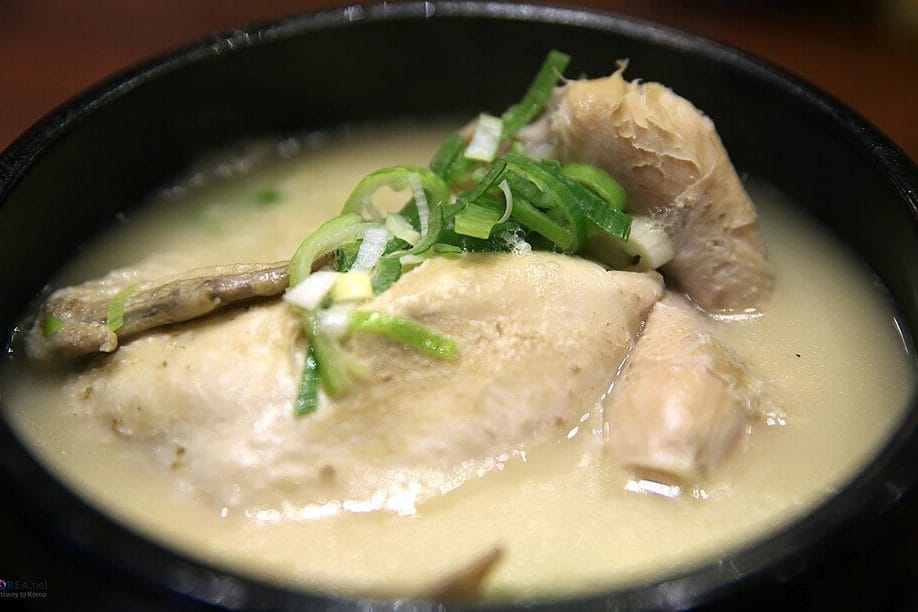
Seoul hit 34 degrees Celsius on July 25, the kind of wet, pressing heat that makes the subway platforms feel like saunas. It was also Jungbok, the second of Korea's three "dog days" of summer, and by noon the line outside Tosokchon Samgyetang near Gyeongbokgung Palace had wrapped around the block. Inside, servers were carrying out bowls of milky white broth, each one holding a whole small chicken stuffed with glutinous rice, ginseng, and jujube, still bubbling from the pot. Nobody was ordering iced coffee to cool down. They were ordering the hottest thing on the menu.
This is iyeol-chiyeol, "fighting fire with fire," and it's the logic underneath one of Korea's oldest surviving food customs. The idea is not metaphorical comfort food. It's a physiological argument: sweating out a scalding bowl of soup on the hottest day of the year is supposed to regulate the body's internal temperature better than anything cold ever could, replacing the energy that humidity and heat exhaustion drain away. Whether or not a modern doctor would sign off on the mechanism, the custom has outlasted plenty of things that had better science behind them.
Fighting Heat With Heat
The three bok days — Chobok, Jungbok, and Malbok, together called Sambok — aren't fixed calendar dates the way a Western holiday would be. They're pinned to the traditional 60-day sexagenary cycle, or ganji, which pairs ten "heavenly stems" with twelve "earthly branches" to name each day in a rotating sequence, a system Korea inherited from centuries of shared East Asian calendrical practice. Chobok falls on the first "gyeong" day after the summer solstice; Jungbok is the next gyeong day after that, exactly ten days later; Malbok is the first gyeong day after Ipchu, the solar term marking the start of autumn. In 2026, that math put Chobok on July 15 and Jungbok on July 25 — ten days apart, right on schedule.
Malbok is where the schedule gets interesting, and it's the reason this particular sambok season is worth writing about at all.
A Calendar That Skipped a Beat
Because Chobok and Jungbok are locked to a fixed ten-day gap but Malbok depends on Ipchu — a solar date that doesn't move in lockstep with the lunar-derived gyeong cycle — the interval between Jungbok and Malbok isn't always the same. Most years it's ten days, matching the rhythm of the first two bok days and giving Korea a tidy, evenly spaced month of designated eating occasions. This year it isn't. Ipchu 2026 falls on August 7, and the first gyeong day after that lands on August 14 — twenty days after Jungbok, not ten.
Ten days.
That's the size of the gap Korean food media has taken to calling "wolbok" (越伏), a bok day that leaps over a full cycle instead of landing where the almanac usually puts it. It doesn't happen every year, and it isn't advertised the way a public holiday would be — most Seoulites will notice it only because their favorite samgyetang restaurant suddenly has a long, awkward stretch between its two busiest weeks of July and its final push in mid-August. Restaurant owners feel it as a demand problem: three weeks of quiet after Jungbok, then a scramble to restock chicken and ginseng before Malbok hits.
What's Actually in the Bowl
Samgyetang, the dish built for exactly this kind of day, starts with yeonggye — a young chicken, usually under two months old and around 500 to 600 grams, small enough that the whole bird fits into a single earthenware pot. The cavity gets packed with soaked glutinous rice, a stick of fresh ginseng root, a dried jujube or two, whole garlic cloves, and often a chestnut, then the bird is trussed and simmered for well over an hour until the meat falls away from the bone and the rice inside has swollen into something closer to porridge than grain. The broth reduces to a milky, almost creamy consistency that owes more to collagen than to any added dairy or thickener, and regional or family variants push in different directions from that same base:
- Jeju-do kitchens frequently add abalone straight from the surrounding coast, simmering it alongside the chicken so the broth picks up a faint brine the mainland version never has
- Ogolgyetang swaps the standard chicken for ogolgye, a black-boned, black-skinned breed prized in Korean traditional medicine for its darker, denser meat
- Hanbang-samgyetang leans harder into the medicinal-broth side of the dish, adding extra dried herbs like astragalus root on top of the base ginseng, and it's the version most likely to show up at a restaurant that also sells herbal tonics on the side
- Some households skip the whole-bird presentation entirely and shred the meat into a thinner, faster soup for weeknight dinners rather than the full ceremonial bowl
If you're trying this for the first time, order it at a restaurant that specializes in nothing else — the dish rewards a kitchen that's run the same broth for decades. And skip the metal spoon everyone reaches for first: pull the meat apart with chopsticks before you touch the broth, or you'll lose the rice that's supposed to come with every bite.
The Other Bok-Day Dish, Almost Gone
For most of the twentieth century, samgyetang wasn't the only meat on Korea's bok-day table. Boshintang, a soup made with dog meat, occupied a similar seasonal niche for a shrinking but real portion of older Koreans, tied to the same iyeol-chiyeol logic and the same three dates on the calendar. That's effectively over now. In January 2024, the National Assembly passed a law banning the breeding, slaughter, and sale of dogs for meat by a 208–0 vote, and it took effect that August with a grace period running to February 2027. As of the government's most recent count, roughly 623 of the country's 1,537 registered dog farms — about 40 percent — have already shut down ahead of the deadline, with more than 5,600 farms and slaughterhouses eligible for state compensation during the wind-down. It's a genuine generational break in what "bok-day food" means in Korea, and it happened fast enough that plenty of people under 40 have never eaten the dish their grandparents associated with this exact week in July.
Where the Ginseng Comes From
Most of the ginseng that ends up in a Seoul samgyetang bowl traces back to Geumsan, a market town in Chungcheongnam-do that handles somewhere around 80 percent of the country's ginseng trade through roughly 200 wholesale and retail shops that have operated there since the mid-1980s. That concentration matters more this year than usual, because samgyetang itself has gotten noticeably more expensive. The Korea Consumer Agency put the average Seoul price at 18,154 won as of last year, up 29 percent from 14,077 won five years earlier, and trade press in early July reported it edging toward 20,000 won — close to 13 dollars — at some of the city's better-known specialty houses. Chicken and rent are part of that increase, but ginseng suppliers point to their own rising costs too, since a root the industry considers properly aged takes four years to grow before it's fit for a restaurant kitchen.
Korea Samgyetang, a restaurant that opened in 1960 and bills itself as the country's first dedicated samgyetang house, still advertises exactly that four-year Geumsan root alongside seven-week-old rooster and jujube sourced from Gyeongsan, and its menu runs from 14,000 won up to 32,000 won depending on how many extras go into the pot. That's not a cheap lunch by Korean standards, and it wasn't meant to be one even in 1960 — samgyetang has always sat closer to a restorative tonic than an everyday meal, priced accordingly.
A Line That Still Forms
Whatever the price on the menu, the queue outside Tosokchon on July 25 didn't look like it was shrinking. Office workers in short sleeves stood in the heat they were about to eat their way through, checking their phones, in no apparent hurry to get somewhere cooler. Malbok is still three weeks off. Whether that gap changes how crowded the restaurant gets in mid-August, or whether Seoul just finds another excuse to eat ginseng chicken soup in between, is the kind of thing you only find out by going back.