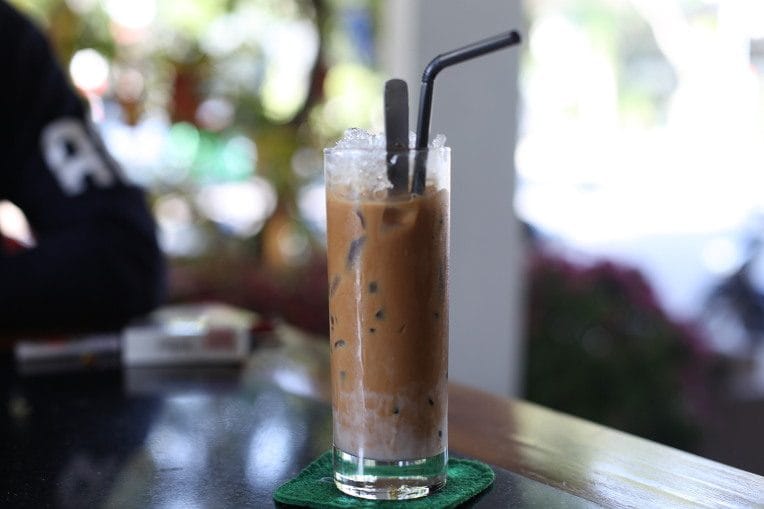
By ten in the morning in Ho Chi Minh City, the pavement is already too hot to stand on in bare feet, and the vendor at the corner of Nguyen Hue has already sold forty glasses of drip coffee stretched over ice. She doesn't measure the condensed milk — she just tips the can until the coffee turns the colour of wet sand, then walks away to serve the next customer. Two thousand kilometres north and east, in a Hong Kong cha chaan teng no bigger than a shipping container, a server is straining tea through a cloth sock for the sixth time that hour, because the fabric itself is what makes the tea taste right. Neither of these people has ever met the other, and neither would recognise the other's drink as a cousin of their own. But they're solving the identical problem: how do you get through a 34°C afternoon without dairy that spoils in an hour and without ice that used to cost more than the drink itself?
That's the real story behind the iced tea and coffee culture stretching from Hanoi to Taipei — not a single invention that spread, but four separate answers to the same climate, arrived at through different colonial trade routes, different dairy substitutes, and different ideas about what "milk" even means in a place where fresh milk barely existed a century ago.
Vietnam: Coffee Built on a Can of Condensed Milk
Cà phê sữa đá — literally "milk coffee ice" — exists because French colonists brought coffee cultivation to Vietnam's central highlands in the 1850s, and because fresh dairy simply didn't travel well in a tropical climate with no reliable refrigeration until well into the 20th century. Condensed milk did travel, and it kept. So Vietnamese households adopted it not as a treat but as the only dairy option that made sense, and the drink built around it became one of the most distinct coffee traditions anywhere in the world.
The method matters as much as the ingredients. A metal phin filter — a small perforated disc that sits directly on top of the glass — drips hot water through coarsely ground robusta beans for four or five minutes, landing on a puddle of condensed milk already sitting at the bottom. Only after that slow drip finishes does the vendor add ice and stir. Robusta, not arabica, is the bean of choice here, and that's not a budget compromise: robusta carries roughly double the caffeine of arabica and a heavier, almost bitter body that stands up to the sweetness of the milk instead of getting drowned by it. A glass at a street stall in District 1 runs about 25,000–35,000 VND (roughly £0.80–£1.10); at a sit-down café with air conditioning, expect closer to 55,000 VND. Trung Nguyên remains the dominant roaster for the beans themselves, though most stalls buy pre-ground. Order cà phê đen đá if you want it without milk — nobody will look at you strangely, but they will assume you take your coffee seriously.
Thailand: The Orange Drink That Isn't Actually About Tea Flavour
Cha yen, the bright orange iced tea sold from carts across Bangkok, confuses first-time visitors for a simple reason: it doesn't taste much like tea. The colour comes from a blend of black tea leaves mixed with ground tamarind seed, star anise, and sometimes red and yellow food colouring, a formula descended from the Ceylon tea imports that arrived through Thai-Chinese trading communities in the early-to-mid 20th century. The tea is brewed strong, poured over crushed ice, and finished with a float of evaporated milk or sweetened condensed milk on top rather than mixed through — so the first sip through a straw pulls dairy and tea together, and the last inch of the glass is nearly pure tannin.
ChaTraMue, recognisable by its orange cup with the number 878 logo, is the brand most visitors encounter first, largely because it has franchised aggressively through Bangkok's shopping malls and airports. A cup on the street from an unbranded cart costs 35–45 THB (about 75p–£1); at ChaTraMue itself, the same drink runs closer to 65–75 THB once you're paying for the branding and the seating. Locals overwhelmingly prefer the cart version — the flavour is punchier and the ice-to-tea ratio is more generous, since street vendors aren't optimising for a photogenic cup.
The Version Most Tourists Never Try
Cha yen has a lesser-known relative worth seeking out: cha manao, an iced tea made without milk at all, mixed instead with lime juice and sometimes a thin syrup. It's sharper, less sweet, and better suited to the kind of heat where a milky drink starts to feel heavy after the second sip. If you're standing in Bangkok in July wondering why the orange drink suddenly tastes cloying, order cha manao instead — it's the better choice for genuinely hot, humid days, and most stalls that sell cha yen will make it without hesitation.
Hong Kong: Tea Strained Through a Cloth Until It Tastes Like Silk
Hong Kong-style milk tea, known locally as "silk stocking" tea (絲襪奶茶), gets its name from the straining cloth used to filter the tea leaves — a cotton bag that, after repeated use and staining, does genuinely resemble old stocking fabric. The tea itself is a blend of several black tea grades, often including Ceylon and Indian varieties left over from British colonial-era trade, brewed strong and repeatedly strained back through the same cloth to smooth out tannins and aerate the liquid. Evaporated milk — traditionally the Black & White brand tin, recognisable by its red-and-white cow logo — goes in after straining, not before, because evaporated milk curdles less predictably in direct heat than fresh dairy and holds up better against a tea this concentrated.
A proper cha chaan teng (the small, fast, formica-tabled diners where this drink is a fixture) will serve a glass hot or iced for roughly HK$18–25 (£1.80–£2.50), and the difference between a decent cup and a great one usually comes down to how many times the tea was pulled through the cloth — three passes minimum, though the best shops go to five or six. Ask for it "yuenyeung" and you'll get something else entirely: a mix of this milk tea with coffee, a combination that sounds wrong until you've had it on a properly humid August afternoon and understood why it works.
Skip the milk tea at hotel breakfast buffets. It's almost always made from tea bags and UHT milk, and it tastes like a rumour of the real thing rather than the drink itself.
Taiwan: The Pearls Came Later Than You'd Think
Bubble tea's actual origin is contested in a way that Vietnamese or Hong Kong milk tea's history isn't. Both Chun Shui Tang in Taichung and Hanlin Tea Room in Tainan claim to have invented the drink independently in the early-to-mid 1980s, and neither side has ever fully conceded the point — Chun Shui Tang has gone as far as taking the dispute to court over the decades, without a definitive resolution. What's agreed on is the mechanism: tapioca starch pearls, already used in Taiwanese desserts, got dropped into iced milk tea almost as an experiment, and the chewy texture against the cold liquid turned out to be more addictive than anyone expected.
The tapioca itself needs constant attention that most people don't realise — pearls cooked more than four hours before serving turn hard and unpleasant, which is why serious tea shops cook fresh batches every couple of hours rather than holding a single pot all day. A classic pearl milk tea in Taipei runs NT$50–70 (about £1.20–£1.70) at a street-level shop; the newer brown sugar boba style, where the pearls are cooked directly in a dark sugar syrup and streaked up the inside of the glass before the milk goes in, typically costs NT$10–15 more and has become the dominant trend on Taiwanese social media since roughly 2018.
- Chun Shui Tang: credited by many historians as the earlier claim, dating to 1983
- Hanlin Tea Room: insists its version came first, and still sells a "original" pearl milk tea as a point of pride
- Both shops remain open today, and both still argue about it whenever a journalist asks
What Actually Connects These Four Drinks
None of this happened by coordination. Vietnam's condensed milk habit, Thailand's tamarind-and-food-colouring formula, Hong Kong's cloth-straining technique, and Taiwan's tapioca pearls all developed within a few hundred kilometres of each other but almost entirely without cross-influence, because each solved a slightly different version of the same three constraints: how to preserve dairy without refrigeration, how to make bulk-brewed tea taste balanced rather than bitter, and how to keep a drink cold in a climate that melts ice within twenty minutes of pouring it. Sugar and dairy substitution show up everywhere for the same reason fresh milk almost never does — it simply didn't survive the supply chains that existed before mid-century refrigeration reached the region.
What's changed by 2026 is the export direction. Thai iced tea mix is now sold pre-bottled in supermarkets from London to Los Angeles, brown sugar boba shops have opened in cities that had never heard the term "boba" a decade ago, and Vietnamese cà phê sữa đá has become a specific enough reference point that coffee shops in Berlin and Melbourne now list it by name rather than translating it into something blander. The drinks travelled. The reasons they were invented — heat, spoiled milk, and the total absence of a fridge — mostly didn't, which is exactly why each one still tastes like the specific city it came from.