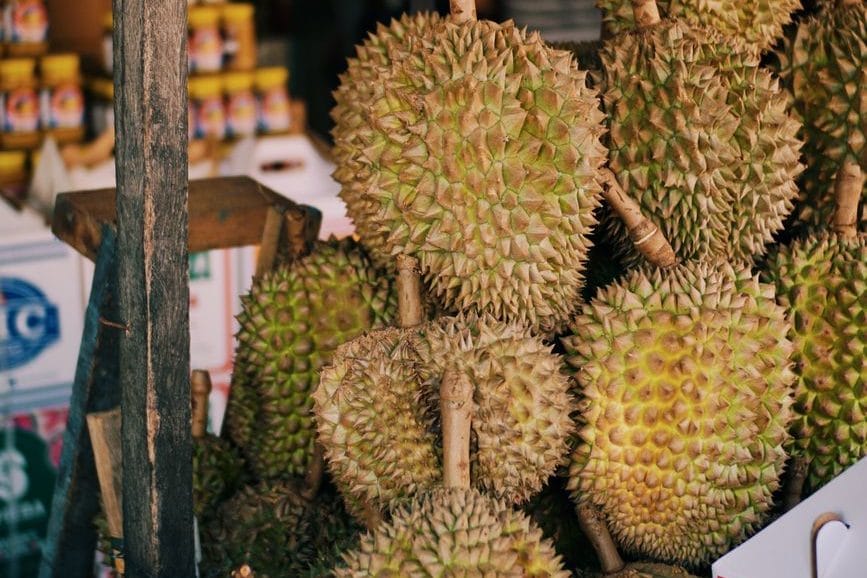
In Pahang, durian buyers don't check a calendar to know the season has started — they check whether the ground beneath the trees is wet enough for the fruit to drop clean on its own, because a durian pried loose before the rain arrives is a durian nobody in Kuala Lumpur will pay for. Across Southeast and South Asia, the fruit and dishes that define this stretch of the year don't follow a fixed date. They follow the monsoon, and the monsoon follows its own schedule.
That relationship is closest to the surface with durian. Malaysia's most prized variety, Musang King, reaches its peak harvest between June and August, timed almost exactly to the southwest monsoon that rolls in off the Strait of Malacca. Growers will tell you the rain does something to the flesh in the final weeks before drop — it turns denser, almost custardy, in a way that fruit forced to ripen in a dry stretch never quite matches. Buy Musang King in April, before the rain has properly set in, and you're paying peak prices for a fruit still weeks from its best self.
The Fruit Thailand Eats to Cancel Durian Out
Thai traditional medicine treats durian as a "hot" food — dense, rich, warming in a way that can sit uneasily in a tropical climate — and pairs it, almost ritually, with mangosteen, the so-called Queen of Fruits, whose peak harvest lands in the rainy month of May and whose cooling reputation is meant to balance the durian eaten alongside it. Whether or not the physiology holds up, the pairing has outlasted centuries of medical fashion for a simpler reason: mangosteen's tart, floral flesh genuinely cuts through durian's richness in a way water or fruit juice doesn't.
Mangosteen's scarcity is the catch. Its harvest window is short and its trees are slow to mature, which keeps supply tight even in a good year — buy it the week it appears at Bangkok's Or Tor Kor market or a provincial stall in Chanthaburi, because by the time durian season peaks in June, the mangosteen meant to accompany it may already be thinning out. Prices for good mangosteen can double within two or three weeks as supply tightens, a swing durian rarely sees to the same degree because durian trees, once established, tend to fruit more consistently across a longer window. Some vendors substitute rambutan or longan when mangosteen runs short, though neither carries the same cooling reputation in Thai tradition, and regular durian eaters tend to notice the difference. That's the quiet tension running under the whole pairing: the fruit built to balance durian doesn't actually share durian's full season, so the classic combination is really only reliable for a few overlapping weeks each year.
Mango's Longer, Gentler Season
Mango runs on a more forgiving calendar. In Thailand, the fruit is in season from late March through July, long enough that mango sticky rice — technically available year-round using imported or frozen fruit — only tastes like the dish it's supposed to be once the local harvest hits its stride. In India, mango season carries even more cultural weight: Alphonso from Maharashtra, Kesar from Gujarat, Chausa from the north and Banganapalli from the south each have loyalists who will argue, at length and without irony, that their regional variety is the only one worth the name.
What unites them across the country is what happens to the fruit once the heat becomes unbearable. Aam ka pana — a raw green mango drink cut with roasted cumin, mint and black salt — and mango lassi both exist because eating a ripe mango straight through the hottest weeks of the year isn't always what the body wants, and a blended, chilled version stretches the fruit's usefulness further into the season than the whole fruit alone ever could.
When the Rain Actually Arrives, the Kitchen Changes Entirely
Once the monsoon breaks, in India especially, the food shifts again — this time toward what the rain itself makes possible rather than what it ripens. Street vendors roast corn on the cob over coal fires, then rub it with lime, salt, red chili powder and chaat masala, a combination that works specifically because it's eaten hot in the middle of a downpour, not as a fair-weather snack. Kachori, samosas, vada pav and momos fill the same role: fried, warm, sold from carts under tarpaulin, built for a season when the alternative is cooking in a kitchen that may lose power for hours at a time.
Goa runs the deepest version of this shift. Between June and September, the fishing boats stay docked for the monsoon, and Goan households turn inland — to the forest floor, the paddy fields and the back garden — for ingredients that simply aren't available the rest of the year. Tisreo, small local clams hand-harvested from shallow mudflats, get tossed dry-style with grated coconut, onion, chili and turmeric, a dish that exists in Goan kitchens for exactly these four months and largely disappears once the boats go back out. Wild mushrooms foraged from the forest floor after the first heavy rains and bamboo shoots pickled in the same season fill out a table that, for the rest of the year, leans almost entirely on the Arabian Sea. It's not a substitute for the seafood-heavy cooking Goa is known for the rest of the year — it's a genuinely separate cuisine that most visitors never encounter because it only exists in the months tourists are least likely to come.
Why the Season Resists a Fixed Date
Ask a durian farmer in Pahang or a mango trader in Ratnagiri when the season starts and neither will give you a date — they'll describe conditions instead: enough consecutive days of rain, humidity holding above a certain threshold, the flowering pattern from months earlier finally paying off. A late monsoon pushes everything back by weeks, which is why guidebooks that print fixed date ranges for fruit season are best treated as a rough starting point rather than a schedule you can plan a trip around.
That unpredictability cuts both ways for the people who cook with these ingredients professionally. A restaurant in Bangkok that builds a fixed durian-and-mangosteen tasting menu months in advance is gambling that both fruits peak in the same narrow window they did last year, and increasingly, chefs describe adjusting menus week to week rather than locking in a seasonal plan the way they might have a decade ago. The rain hasn't become less reliable exactly — it's become less evenly distributed, which is a different problem with the same effect on anyone trying to plan a menu around it.
Preserving What the Season Won't Wait For
None of this abundance lasts. Thai households have spent generations turning peak-season durian, mango, banana, pumpkin and jujube into preserves — dried, sugared, pickled — specifically because the fresh version's window is too short to enjoy at leisure. A jar of preserved durian pulp bought in July is a hedge against the eight or nine months of the year when the fresh fruit simply isn't there at any price.
Skip the vacuum-sealed durian sold in supermarkets outside the region entirely — it's frozen at a stage nowhere near what growers consider ready, and no amount of thawing recovers the texture the monsoon rain was supposed to build in over its final weeks. If you want the version growers actually eat, you have to be there for the six or eight weeks a year when the ground is wet enough and the fruit is willing to fall on its own.