Every Seat Tells a Story
At a Chinese banquet table — always round, always set for 10 or 12, always with a lazy Susan in the center — the host sits in the chair facing the door. This isn't preference; it's protocol rooted in centuries of Chinese social hierarchy. The seat facing the door is the position of authority because it commands a view of who enters and exits the room, a holdover from an era when banquets were political events and the host needed to see potential threats. The guest of honor sits to the host's right. The second most important guest sits to the host's left. Everyone else is arranged in descending order of status radiating outward from these two positions, with the least important guests seated nearest the door — the position that carries an implicit readiness to handle any logistics or interruptions so that the honored guests aren't disturbed.
If this sounds elaborately hierarchical for a dinner, that's because Chinese banquet culture is inseparable from Chinese social structure. A banquet (yanxi) is not a meal — it's a social instrument. Banquets seal business deals, celebrate weddings, honor retirements, mark holidays, and solidify relationships. The food is important (and usually spectacular), but it serves the larger purpose of creating a shared experience that builds guanxi — the network of social relationships and mutual obligations that remains the operating system of Chinese business and social life. Getting the seating wrong, ordering the wrong dishes, or committing a toast-protocol error at a banquet can damage a business relationship as effectively as a bad contract. The stakes are real.
The Course Progression
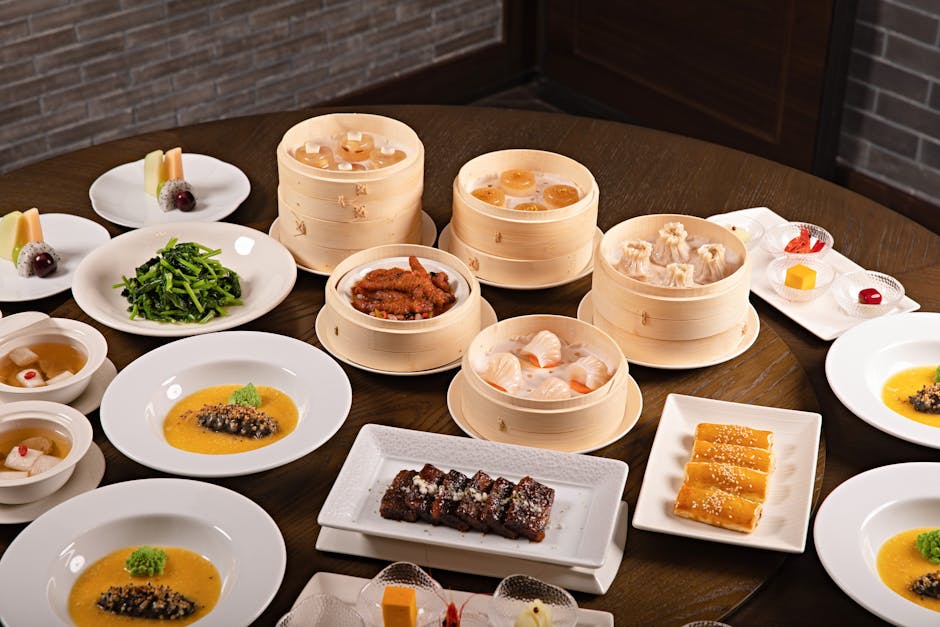
A formal Chinese banquet follows a fixed course structure with regional variations. The standard 10-12 course progression at a Cantonese banquet (the most common format for business and wedding banquets) runs roughly as follows: cold appetizer platter (a composed dish of jellyfish, char siu, roast duck, century egg, and pickled vegetables, arranged artfully on a large plate), soup (usually a double-boiled soup — clear broth slowly cooked for hours with medicinal herbs, chicken, and dried seafood), a seafood course (whole steamed fish, abalone, or lobster), a poultry course (Peking duck, roast pigeon, or crispy chicken), a meat course (braised pork belly or beef), a tofu or vegetable course, a fried rice or noodle course (signaling the approaching end of the meal), and a dessert (usually a sweet soup — tong sui — such as red bean or mango sago).
The ordering is not random. Cold dishes are light and clean, warming the palate. Soup restores after the cold course. Seafood comes early because it's typically the most expensive item and the host wants to signal generosity before the meal is half over. The noodle/rice course near the end is both a signal that the meal is winding down and an implicit guarantee that no one will leave hungry — starch is the safety net. At a Cantonese wedding banquet, the dish count must be even (odd numbers are associated with funerals), and certain dishes are mandatory: a whole chicken (symbolizing completeness), a whole fish (surplus and abundance, because the Chinese word for fish — yu — sounds like the word for surplus), and lobster (the word for lobster — long ha — sounds like "dragon shrimp," representing the dragon-phoenix couple).
The Toasting Protocol
Toasting (gan bei, literally "dry cup") at a Chinese banquet follows rules that are precise and enforced through social pressure. The host offers the first toast to the table — standing, holding the glass with both hands, making brief remarks about the occasion, and drinking the glass completely (gan bei means exactly that: empty the cup). Guests respond by draining their own glasses. Subsequently, individual toasts happen throughout the meal: you approach someone you want to honor or build a relationship with, clink glasses (your glass held lower than theirs if they're senior), make a brief statement, and both drink.
The glass-height rule is critical. When clinking, your glass should be lower than the other person's — this signals humility and respect. Both parties will often try to lower their glass below the other's, resulting in a spiraling descent toward the table surface that looks like a competition to touch the floor. This is exactly what it is. The person whose glass ends up lower "wins" the humility contest, which means they've shown more respect, which in Chinese social calculus is a form of victory. At business banquets, this glass-lowering dance is observed, assessed, and remembered by everyone at the table.
The alcohol is traditionally baijiu — a clear, high-proof spirit (40-65% alcohol) distilled from sorghum, wheat, or rice — though whisky, red wine, and beer have increasingly replaced baijiu at younger or more international gatherings. Moutai, the most famous baijiu brand, is the traditional banquet spirit and costs ¥1,500+ ($210+) per bottle for the standard Flying Fairy edition. Drinking baijiu is not optional at many business banquets — declining a toast from a senior business partner is a social risk that most Chinese professionals avoid by developing a tolerance or employing strategic delegation (bringing a colleague who can drink on your behalf is an accepted tactic).
The Lazy Susan Etiquette
The lazy Susan — the rotating tray in the center of the table — is the traffic system of the Chinese banquet, and it has unwritten rules. When a new dish arrives, the server places it in front of the guest of honor (or the host, who gestures for the honored guest to serve first). The guest takes their portion, then the lazy Susan is rotated clockwise so each person can serve themselves. You don't spin the Susan while someone is actively serving themselves — that's the equivalent of grabbing food off someone's plate. You don't reach across someone else to grab a dish — wait for the rotation. And you take a moderate portion the first time around, because the dish needs to make it to all 10 or 12 people at the table.
Using your own chopsticks to take food from shared dishes is acceptable at casual meals but technically incorrect at formal banquets, where serving chopsticks (gong kuai) or serving spoons should be used. In practice, this rule is loosely observed unless the banquet is very formal or someone at the table is a stickler. The more important chopstick etiquette: never stick your chopsticks vertically into a bowl of rice. The visual similarity to incense sticks at a funeral makes this a potent taboo. Lay them across the bowl or on the chopstick rest.
The Bill and the Performance
The bill at a Chinese banquet is not split. The host pays. This is not a suggestion — it's a fundamental rule. The banquet exists because the host organized it, and the host's payment is part of the social contract. At business banquets, the host is typically the party seeking a favor or deepening a relationship (the one who has something to gain from the goodwill of the guests). At personal celebrations (weddings, birthdays, promotions), the honoree's family hosts and pays.
The cost of a Chinese banquet varies enormously. A mid-range Cantonese banquet in Guangzhou or Hong Kong runs HK$5,000-8,000 ($640-1,025) per table of 10, while a premium banquet at a restaurant like Lung King Heen or T'ang Court can exceed HK$30,000 ($3,850) per table. In mainland China, business banquets have been moderated by anti-extravagance regulations since 2013 (which banned shark fin soup and limited the price of banquet wine), but the culture of elaborate hospitality persists at more modest price points. The social ROI of a well-executed banquet — the relationships built, the face given and received, the business facilitated over 12 courses and many toasts — typically exceeds its financial cost by a wide margin, which is why the tradition endures despite its expense.
The Fish Must Have a Head
Symbolism runs through Chinese banquet food like a second seasoning. The whole fish is always served with the head pointing toward the guest of honor (the head of the fish for the head of the table). Noodles at a birthday banquet are never cut (long noodles represent long life). Eight dishes are luckier than seven (the number eight sounds like "prosperity" in Cantonese). Pears are never served or given as gifts at banquets (the word for pear sounds like "separation"). Certain foods are included purely for their phonetic symbolism: lettuce (sheng cai, sounds like "generate wealth"), oysters (ho si, sounds like "good events"), and tangerines (ji, sounds like "lucky").
These symbols aren't quaint relics — they're actively observed and their absence is noticed. Serving a fish without its head at a Chinese banquet is not a practical decision about filleting convenience. It's an insult that implies incompleteness and disrespect. The head stays on, the eyes intact, the fish whole and symbolic and delicious, because the food at a Chinese banquet is never just food. It's a language, spoken in courses, read by everyone at the table, and understood in ways that transcend the flavors on the plate.