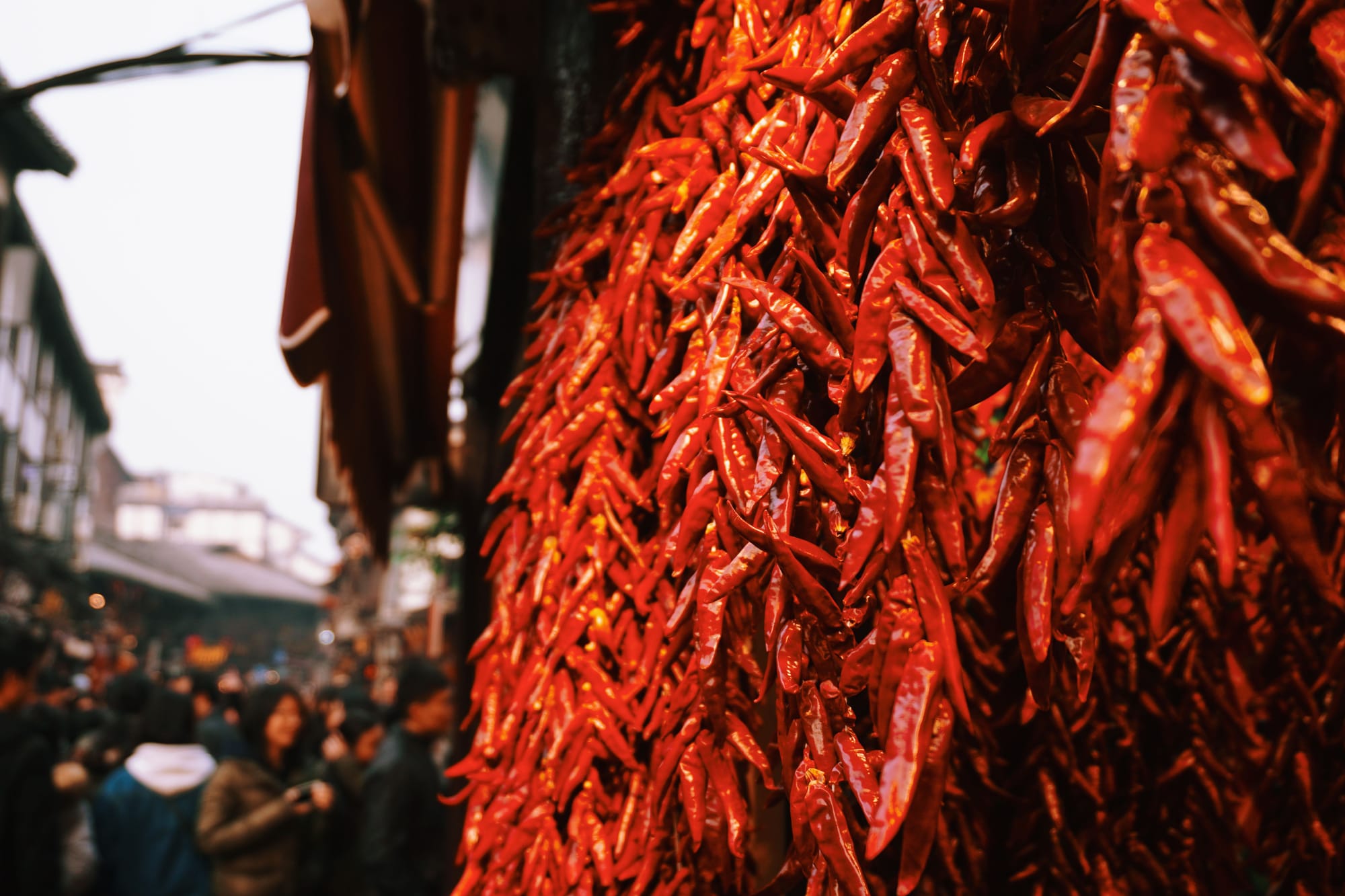
Order a plate of food in Chengdu, Nakhon Ratchasima and Gwangju and you'll hit chili heat that feels almost nothing alike — the first numbs your lips before it burns, the second builds slow and stays in the back of the throat, the third arrives sweet-first and sharp-second. All three trace back to a pepper that didn't even exist in Asia five hundred years ago. The chili arrived from the Americas with Portuguese traders in the sixteenth century, and in the few centuries since, it's been bred, fermented, dried and reinvented so many times across the continent that the "same" fruit barely resembles itself from one country to the next.
Sichuan's numbing trick isn't a chili at all
The defining sensation of Sichuan food — that buzzing, lip-tingling numbness locals call málà — doesn't actually come from a chili pepper. It comes from Sichuan peppercorn, the dried husk of the prickly ash tree, working alongside dried chilies rather than instead of them. The two ingredients do genuinely different jobs: the chili delivers straightforward capsaicin burn, while the peppercorn triggers a tactile numbing response through a completely different set of nerve receptors, and the combination is why Sichuan hotpot feels distinct from any other regional heat in Asia. Chongqing versions push the ratio further toward peppercorn than Chengdu's, which is part of why cooks from the two cities will argue for hours about whose málà is more authentic.
Dried facing heaven chilies — cháo tiān jiāo, named for the way the pods point upward on the plant rather than hanging down — carry most of the capsaicin load in classic Sichuan dishes, and they're toasted in oil before anything else goes into the wok, a step that changes their flavor from sharp to something closer to smoky-sweet. Skip that toasting step, which some quicker restaurant versions do, and the dish tastes hotter but noticeably flatter.
Thailand's heat is a moving target by region
Central Thai food, the version most familiar outside the country, tempers chili heat with sugar, fish sauce and lime in a way that keeps the burn balanced against sweetness and acidity. Head northeast into Isaan, though, and the calculus changes — som tam and larb there lean on prik kee noo, the tiny "mouse-dropping" chilies that deliver a sharper, more sustained burn with far less of the sugar that softens central Thai dishes. Northern Thai food takes yet another route, working dried chilies into pastes alongside fermented soybean and using heat as a background note rather than the headline.
What actually decides how hot a dish reads on the plate is rarely the chili variety alone — it's the ratio of seeds and membrane left in, since that's where most of the capsaicin concentrates, not in the flesh. A cook working with the exact same batch of prik kee noo can make one bowl of som tam mild and another blistering just by deciding how much of the interior to leave in, which is why the same dish at two stalls on the same street can land at completely different heat levels.
Korea's gochugaru built an entirely different chili culture
Korean chili heat runs on gochugaru, coarsely ground sun-dried chili flakes that carry a fruity, slightly smoky sweetness most other regional chili powders don't have, largely because the specific cultivar grown for gochugaru has a milder, rounder profile than the varieties used in Sichuan or Thai cooking. That sweetness is exactly why gochujang — the fermented chili paste built from gochugaru, glutinous rice, and fermented soybean — reads as savory-sweet rather than simply hot, even in dishes that use a heavy hand with it. Kimchi's heat comes from the same base ingredient, but months of fermentation mellow the raw chili bite into something rounder and more complex than the flake ever tasted on its own.
Korean cooks generally don't chase raw heat the way Sichuan or Isaan cooking does — the ceiling on how hot most standard Korean dishes get is genuinely lower, and dishes that do push into serious heat, like buldak fire chicken, are recent commercial inventions built for social media rather than continuations of an older culinary tradition. That's worth sitting with for a second, because it cuts against the assumption that all Asian chili cultures are racing toward the same finish line of maximum heat. They aren't. Korea largely opted out of that race a long time ago and built something else instead.
Indonesia's sambal isn't one sauce, it's hundreds
Say "sambal" in Jakarta and a cook will ask which one you mean, because the word covers an entire family of chili condiments rather than a single recipe. Sambal terasi builds its heat around fermented shrimp paste, giving it a funky depth that reads almost savory before the chili registers at all. Sambal matah, the raw Balinese version made with sliced shallot, lemongrass and lime, skips cooking entirely and delivers a bright, sharp heat that tastes closer to a salsa than anything simmered. Sambal bajak gets cooked down slowly with palm sugar and tamarind until it turns thick, dark and faintly sweet, closer in texture to a chutney than to the thin, vinegary sambals found in Malaysian and Singaporean kitchens next door.
What ties the hundreds of regional sambal variations together isn't a shared recipe but a shared logic: fresh red or bird's eye chilies pounded — traditionally with a stone mortar called an ulekan, not a blender, since the texture changes noticeably with each method — alongside garlic, shallot and usually a souring or fermented element. A home cook in West Sumatra and a home cook in East Java are working from the same basic method while landing on results that taste almost nothing alike, which is part of why claiming there's a single "authentic" sambal misses the point of the dish entirely. Padang restaurants, famous for arraying a dozen dishes on the table at once, will typically set down two or three different sambals alongside the meal without comment, expecting diners to know instinctively which one pairs with which protein. Get that pairing wrong — the fiery sambal ijo meant for grilled fish on a piece of rendang, say — and a Padang regular will usually say something about it, gently or otherwise. Restaurants outside Indonesia that serve one bottled sambal as the definitive version are flattening a condiment culture that locally spans easily fifty distinct regional variants.
Why the same pepper tastes different depending on where it grew
Terroir matters for chilies almost as much as it does for wine, though almost nobody outside the region talks about it that way. Facing heaven chilies grown in Sichuan's damp, low-sun climate develop differently from the same cultivar grown in a drier province, and Thai bird's eye chilies shift in heat and aromatics depending on soil and rainfall in ways local cooks track closely even if the variety name on the packet stays identical. A batch of dried chilies from a particular county in Sichuan can command a real price premium over otherwise identical-looking chilies from three provinces over, for exactly this reason.
The next time a dish across the region reads as "just spicy" without further thought, it's worth pausing on what's actually doing the work — a chili variety, a fermentation process, a ratio of seed to flesh, or an entirely different plant altogether standing in for what looks like the same red pepper on every plate.