Two Philosophies, One Country
China has eight major regional cuisines, officially recognized and categorized since the Republican era, but the two that dominate both domestic prestige and international recognition are Cantonese (Yue cuisine, from Guangdong province and Hong Kong) and Sichuan (Chuan cuisine, from Sichuan and Chongqing). They represent fundamentally different philosophies about what food should do. Cantonese cooking prioritizes the natural flavor of premium ingredients, using minimal seasoning and gentle techniques — steaming, poaching, quick stir-frying — to let the ingredient speak. Sichuan cooking prioritizes the transformation of ingredients through bold seasoning and aggressive technique, using chili, Sichuan peppercorn, fermented bean paste, and a vocabulary of 23 officially recognized flavor profiles to create dishes where the sauce is the star and the protein is the vehicle.
This isn't a competition with a winner. It's a fundamental tension in Chinese culinary philosophy that has persisted for centuries and shows no sign of resolving, because both approaches are correct on their own terms. The Cantonese argument — that great food starts with great ingredients and the cook's job is to not ruin them — produces dishes of extraordinary purity: steamed whole fish with nothing but ginger, scallion, and a splash of hot oil; white-cut chicken poached to exact doneness and served with a ginger-scallion oil; roast goose with skin so crisp it crackles audibly. The Sichuan argument — that cooking is alchemy, and the cook's job is to create flavors that the raw ingredients cannot produce alone — yields dishes of astonishing complexity: ma po tofu with its layered heat and numbness; kung pao chicken with its balance of sweet, sour, salty, and spicy; twice-cooked pork where the same piece of meat is boiled and then wok-fried to achieve textures neither method could produce independently.
The Cantonese Approach: Less Is Everything
Cantonese cuisine's reputation as China's most refined cooking tradition rests on a paradox: its greatest dishes are often its simplest. Steamed fish — a whole sea bass or grouper, steamed for exactly 8 minutes over high heat, then dressed with julienned ginger, scallion, a drizzle of light soy sauce, and a final pour of smoking-hot peanut oil that sizzles and sputters on contact — is the benchmark dish of Cantonese cooking. It requires precisely three ingredients beyond the fish, takes less than 15 minutes to prepare, and is virtually impossible to get right without years of practice. The fish must be impeccably fresh (Cantonese cooks buy fish live and kill it moments before cooking), the steaming time must be exact (a minute too long and the flesh goes from silky to chalky), and the final oil pour must be at the correct temperature (hot enough to release the aromatics of the ginger and scallion but not so hot that it burns them).
This obsession with ingredient quality drives Cantonese food prices higher than any other Chinese cuisine. At Lung King Heen in the Four Seasons Hong Kong — the first Chinese restaurant to receive three Michelin stars — a steamed grouper can cost HK$800 ($103) or more, with the price determined by the day's fish market auction. The fish itself does most of the work; the kitchen's job is to not interfere. This philosophy extends to Cantonese roast meats (siu mei), where the preparation is long and technical but the ingredient list is short: char siu (BBQ pork) uses pork collar marinated in honey, five-spice, hoisin, and red fermented tofu, roasted at high heat until the edges caramelize and the fat renders to a glossy sheen. The marinade enhances the pork's sweetness rather than replacing it with foreign flavors. At Yat Lok in Central, Hong Kong, the roast goose — the entire animal hanging in the window, skin burnished to mahogany — has a clean, goosey flavor amplified by the roasting process rather than masked by spice. You taste the goose. That's the point.
The Sichuan Approach: More Is the Point
Sichuan cuisine operates from a completely different premise: flavor is constructed, not extracted. The raw ingredients — pork, tofu, chicken, fish — are relatively modest. Sichuan doesn't rely on premium seafood or high-grade beef. What it relies on is technique, seasoning, and a spice vocabulary so extensive that it's been formally categorized into 23 distinct flavor profiles (wei xing), each defined by a specific combination of ingredients and the sensory effect they produce. Ma la (numbing-hot) is the most famous, but there's also guai wei (strange flavor — a combination of sweet, sour, salty, numbing, and hot that shouldn't work but does), yu xiang (fish-fragrant — no fish involved, but the sauce mimics the seasonings traditionally used with fish), and suan la (sour-hot), among many others.
The foundational seasoning of Sichuan cooking is doubanjiang — a paste of fermented broad beans and chilies, aged for one to three years in earthenware jars. Pixian doubanjiang, made in Pixian county near Chengdu using a specific variety of chili and a specific local water source, is considered the gold standard and is protected by geographical indication. It's the base of ma po tofu, twice-cooked pork, and dozens of other dishes, providing a deep, fermented heat that's more complex than fresh chilies. A spoonful of doubanjiang in a hot wok fills the room with an aroma that is simultaneously savory, spicy, and slightly sweet — the smell of Sichuan cooking in its purest form. At Chen Mapo Tofu in Chengdu — the restaurant that claims to have originated the dish in 1862 — the doubanjiang is sourced from a single producer in Pixian and forms the backbone of a tofu dish so intensely flavored that it regularly reduces first-timers to tears, sweat, and involuntary noises of pleasure.
Technique: Steam vs. Wok
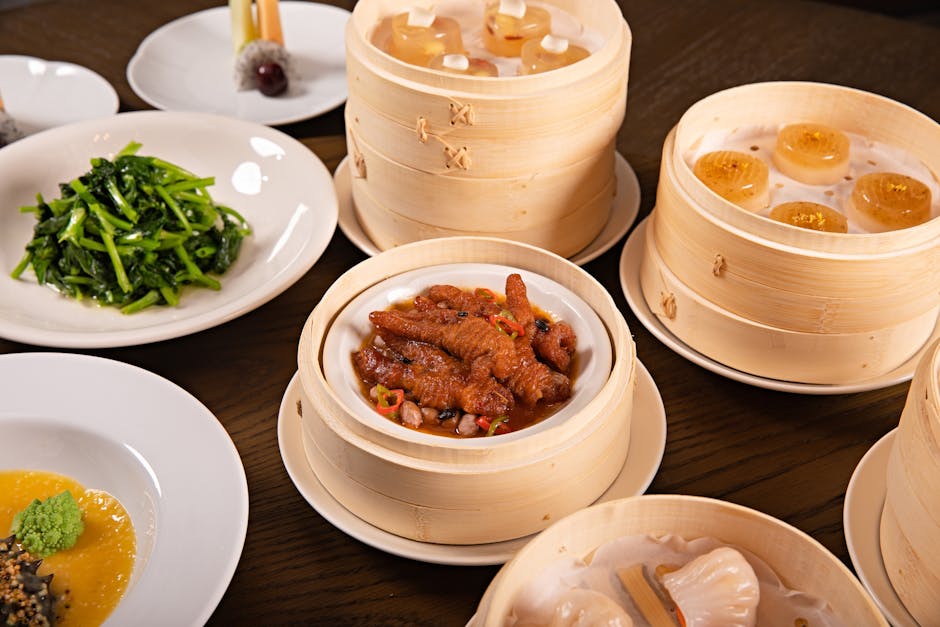
The dominant Cantonese technique is steaming — a gentle, moisture-preserving method that maintains the texture and flavor of delicate ingredients. Dim sum is almost entirely steamed: har gow, siu mai, cheung fun, char siu bao. The Cantonese steam with precision, using different steaming times and vessel types for different foods: bamboo steamers for dumplings (the bamboo absorbs excess moisture), metal trivets for whole fish (allowing steam to circulate completely around the fish), and ceramic bowls for custards and egg dishes. The result is food that's clean, light, and focused on the primary ingredient's flavor.
Sichuan's dominant technique is stir-frying in a seasoning-loaded wok, often with a preliminary step of poaching or deep-frying the main ingredient before it meets the sauce. Twice-cooked pork (hui guo rou) is the perfect example: pork belly is first boiled whole until just cooked, then sliced thin and stir-fried with doubanjiang, fermented black beans, leek, garlic, and sometimes cabbage. The initial boiling renders some fat and firms the meat; the subsequent stir-frying crisps the edges, infuses the sauce flavors, and creates a dish with three textures (crispy edges, tender meat, soft fat) that couldn't be achieved by either technique alone. This dual-cooking approach is characteristic of Sichuan's philosophy: the ingredient is a canvas, and the cooking process paints on it.
The Secret Shared Value
Despite their apparent opposition, Cantonese and Sichuan cooking share a fundamental principle that's easy to miss: both prioritize kou gan — mouthfeel. Cantonese cooking achieves ideal mouthfeel through precise timing (the exact moment when steamed fish transitions from raw to perfectly cooked), while Sichuan cooking achieves it through layered techniques (the simultaneous crispiness and tenderness of twice-cooked pork). Neither cuisine accepts mushy, one-dimensional texture. A Cantonese dim sum chef who serves a dumpling with a gummy wrapper has failed at the same fundamental level as a Sichuan chef who serves ma po tofu with tofu that's fallen apart. The paths diverge, but the destination — food that feels as good as it tastes — is the same.
The Modern Convergence
Contemporary Chinese cooking increasingly blurs the line between Cantonese and Sichuan, particularly in cosmopolitan cities where chefs trained in one tradition experiment with the other. In Shenzhen, a city that sits geographically in Guangdong but whose population is majority migrant from across China, restaurants serve Cantonese steamed fish topped with Sichuan chili oil, or dim sum with Sichuan peppercorn-infused fillings. In Chengdu, high-end restaurants like Yu Zhi Lan apply Cantonese attention to ingredient quality to traditional Sichuan preparations, sourcing premium proteins that the original home-cooking versions never used. And in Hong Kong, the Sichuan hot pot craze has introduced ma la flavors to a city that traditionally viewed anything spicier than white pepper as excessive.
Whether this convergence enriches or dilutes both traditions depends on who you ask. Cantonese purists argue that adding Sichuan peppercorn to steamed fish defeats the purpose of steaming it in the first place. Sichuan purists argue that using premium wagyu in ma po tofu misses the point of a dish that was invented to make cheap ingredients taste extraordinary. Both sides have valid positions, and the debate itself is valuable — it keeps both traditions sharp, defined, and conscious of what makes them distinct. The day Cantonese and Sichuan cooking fully merge is the day Chinese cuisine loses its most productive creative tension.