Turn off Hang Manh street around 11:40 on any weekday and you will smell Bún Chả Đắc Kim before you see it — a low, sweet-acrid haze of pork fat hitting charcoal, drifting three doorways in either direction and settling into the collars of everyone waiting on plastic stools. Nobody in that queue is looking at a menu. There is one dish, maybe two variations of it, and the only real decision left is how many extra herbs to grab from the tin bucket by the door. This is the strange thing about bún chả: for a dish this simple — grilled pork, cold noodles, a bowl of sweet-sour fish sauce — Hanoi has spent decades arguing about how to do it right, and the argument is exactly why the dish still matters. Even the queue itself runs on an order nobody wrote down anywhere, regulars sliding onto plastic stools their bodies seem to remember without being told, while first-timers hover near the grill trying to work out whether you pay at the register or just sit and someone eventually notices you.
The Smoke You Smell Before You See the Sign
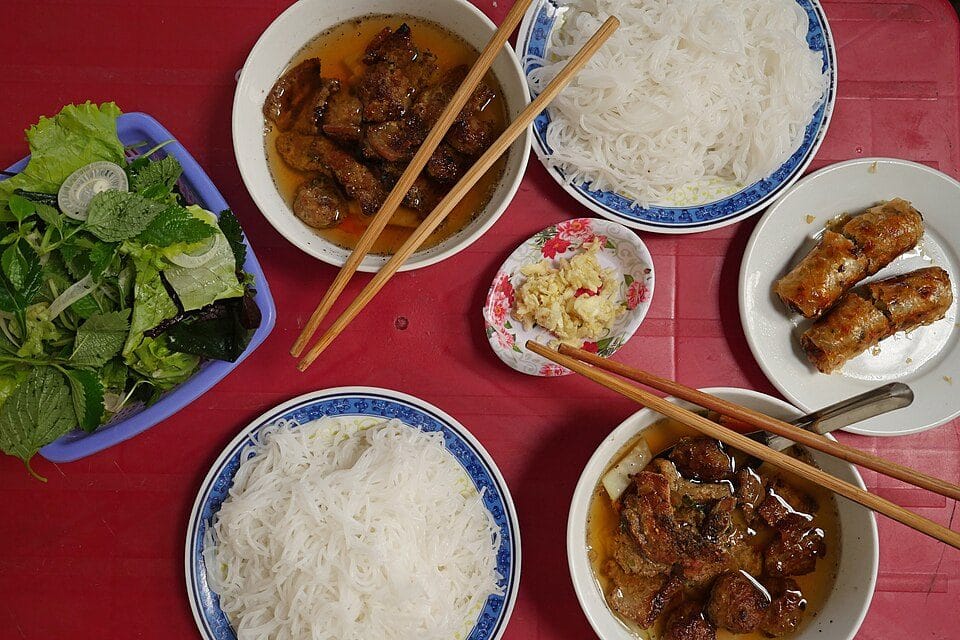
Bún chả is built from four things that, on paper, sound almost too plain to fight over: rice vermicelli (bún) served cool, grilled pork (chả) served hot, a bowl of nước chấm to dunk everything into, and a plate of herbs — perilla, Thai basil, mint, sometimes a shredded green papaya or star fruit thrown in for acidity. The pork goes onto a charcoal grill in two forms, and this is where the first real disagreement starts. Some stalls insist on chả miếng — thin slices of marinated pork shoulder or belly, laid flat so the fat renders and blisters at the edges. Others swear only by chả băm, hand-minced pork bound loosely and pressed into rough patties that char on the outside while staying custardy in the middle. The best stalls, and there is no polite way to put this, refuse to choose: they grill both, drop them into the same bowl of warm nước chấm, and let you decide which one you reach for first.
What you're not supposed to do, and what almost every visiting food writer gets wrong on the first try, is pour the sauce over the noodles like a soup. The bún stays dry on its own plate. You pick up a clump with your chopsticks, dunk it into the nước chấm along with a slice of pork and a torn herb leaf, and eat it in one motion before it has time to go soggy. Get this wrong and the dish reads as bland — which is exactly the complaint some travellers post online, not realising they built the bowl backwards.
Two Camps, One Bowl
Every Hanoi local has an opinion on which shop does it best, and the arguments get surprisingly heated for a lunch that costs less than a coffee. Bún Chả Hương Liên on Le Van Huu became a pilgrimage site after Anthony Bourdain brought Barack Obama there in 2016 — the table they sat at is now behind glass, and the "Combo Obama" (grilled pork, spring rolls, a Hanoi beer) still sits on the menu at around 100,000 VND, roughly four times what a local pays two streets over. Regulars will tell you, without being asked, that Hương Liên's fame outran its grill work sometime after 2017 and that the real standard-bearer is Đắc Kim, which has been feeding the same corner of Hang Manh since the 1960s and charges closer to 40,000–50,000 VND for a full bowl.
I don't think either camp is entirely right, and that's part of the fun of eating your way through this argument over a few days rather than settling it in one sitting. Đắc Kim's char is more aggressive — the fat catches fire more often, and the smoke carries more bitterness into the meat, which some people read as depth and others read as a mistake. Hương Liên leans sweeter in the marinade, less smoke-forward, which makes it a gentler introduction if it's your first bowl in the city. If you only have one lunch in Hanoi to spend on this, go to Đắc Kim; the queue moves fast, the pork is what the dish was built around, and paying tourist prices for a photo op two streets away misses the point entirely. Order at both places within the same trip if your schedule allows it, because tasting the two side by side settles the argument faster than any amount of reading about it ever could.
The Sauce Is the Argument, Not the Meat
Ask five bún chả cooks how they balance their nước chấm and you'll get five different ratios, all defended with total conviction. The base is fish sauce, sugar, lime or vinegar, water, and garlic-chilli, but the proportions shift by household, by neighbourhood, by which relative taught the recipe forty years ago. Some stalls serve it nearly clear and sharp, heavy on lime, meant to cut straight through the pork fat. Others make it darker and rounder, with enough sugar that it edges toward a caramel note before the chilli catches up. Phú Quốc fish sauce, the island-made kind with the higher nitrogen count, is what serious kitchens reach for — cheaper blended sauces taste flat and salty rather than savoury, and a good cook can spot the difference in one sip.
Here's the part that surprises people who've only had bún chả outside Vietnam: the sauce is meant to arrive lukewarm, not cold, because the fish sauce base is often warmed slightly with the pork drippings before serving. A cold, straight-from-the-fridge nước chấm is a giveaway that a kitchen is cutting corners, and once you've had it served properly warm, the cold version tastes almost like a different, lesser dish.
Charcoal or Nothing
Gas grills exist in plenty of Hanoi kitchens now, faster and cheaper to run, and a handful of newer bún chả spots have quietly switched over.
Every serious cook I've talked to about this treats it as close to sacrilege. Than hoa, the local charcoal, burns at an uneven, smoky heat that a gas flame simply can't fake — it's what gives the pork its bitter-sweet edge and the faint crackle on the fat. A dish built entirely around the word "chả," which specifically means grilled or roasted over open heat, loses its own name the moment you swap in a gas burner, even if the marinade and the meat cut stay identical. The counter-argument, when you can get someone to admit there is one, is that charcoal smoke in a cramped, poorly ventilated kitchen is a real health hazard for the cooks standing over it all day — which is a fair point that doesn't change many minds on Hang Manh street.
How Hanoi Eats It, and How Saigon Answers Back
Travel 1,700 kilometres south to Ho Chi Minh City and the family resemblance is obvious but the dish has drifted. Bún thịt nướng swaps the warm dipping bowl for noodles already tossed with sauce, herbs, pickled carrot and daikon, crushed peanuts, and sometimes a fried spring roll cut into pieces on top — a full composed bowl rather than an assemble-it-yourself lunch. Northerners tend to call this a cousin dish rather than a variant of bún chả, and there's a reasonable case for that distinction: the eating mechanics, the sauce temperature, and even the cut of pork used are different enough that treating them as interchangeable annoys people in both cities equally. That regional split says something true about Vietnamese food generally — the further a dish travels from its home street, the more it gets reshaped to fit a different rhythm of eating, and pretending otherwise flattens two genuinely different traditions into one.
None of this makes one version more "authentic" than the other; it just means a bowl labelled bún chả in Saigon and one on Hang Manh street are answering slightly different questions about what a lunch should feel like. What stays constant, wherever you order it, is the smoke hitting you before the plate does — and the fact that the person grilling it has almost certainly had the same argument about charcoal, ratio, and cut of pork that every cook before them has had, going back to whichever Hanoi household first decided this was worth fighting over.