Two Shops, One Claim, Zero Resolution
In 1986 — or possibly 1983, depending on whom you believe — someone in Taichung, Taiwan dropped tapioca balls into iced tea and created a drink that would eventually become a $4.3 billion global industry. The problem is that two different tea shops claim the honor, and after a decade-long legal battle that went to Taiwan's courts, the dispute was never definitively resolved. Chun Shui Tang tea house says its product development manager, Lin Hsiu Hui, poured sweetened tapioca balls into her iced Assam tea during a staff meeting in 1988, liked the result, and put it on the menu. Hanlin Tea Room, also in Taichung, says its founder Tu Tsong-he was inspired by the white tapioca balls he saw in a traditional market in 1986 and added them to tea, initially calling the drink "pearl tea" because the white balls resembled pearls.
The court case, which dragged through the Taiwanese legal system from 2004 to 2019, ultimately ruled that neither party could claim exclusive invention because adding tapioca to beverages was a sufficiently obvious culinary innovation that it couldn't be patented or attributed to a single inventor. This is probably correct and also deeply unsatisfying, like being told that nobody invented the sandwich. What's indisputable is that by the early 1990s, pearl milk tea — or bubble tea, or boba, depending on your geography and generation — had become a phenomenon in Taiwan, and within a decade it had colonized East Asia, Southeast Asia, and the Asian diaspora communities of North America, Europe, and Australia with a speed that no food trend before or since has matched.
The Anatomy of a Boba
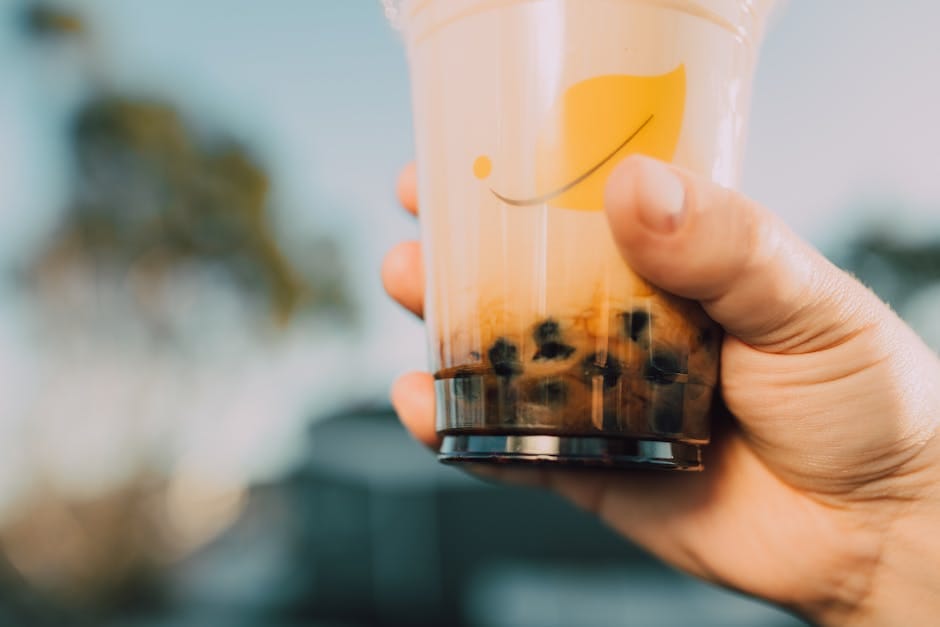
The "bubbles" in bubble tea are tapioca pearls — spheres made from tapioca starch (derived from cassava root), rolled into balls roughly 1 centimeter in diameter, boiled until they achieve a specific chewiness, and then soaked in a sugar syrup that gives them their characteristic dark color and sweetness. The texture — QQ in Taiwanese slang, meaning bouncy and chewy — is the entire point. A properly prepared tapioca pearl should resist your teeth for a fraction of a second before yielding with a satisfying squish. It should be uniformly chewy throughout, not hard in the center (undercooked) or mushy (overcooked). The window between perfect and wrong is narrow, maybe 5 to 10 minutes of cooking time difference, which is why boba quality varies so dramatically between shops.
The base drink is typically a strong-brewed black tea (Assam or Ceylon) mixed with milk or creamer, sweetened, and served cold over ice. The tea-to-milk ratio, sugar level, and ice amount are customizable at virtually every boba shop — a standardized ordering system developed in Taiwan that lets you specify sugar as 100%, 70%, 50%, 30%, or 0%, and ice as regular, less, or none. This customization system, now global, is so ingrained in boba culture that ordering a "regular sugar, regular ice" pearl milk tea feels like ordering a "tall" at a coffee chain — it's a language that transcends the specific shop. At Tiger Sugar in Taichung — a relative newcomer that launched in 2017 and sparked the "brown sugar boba" trend — the default sugar level is already lower than traditional shops, reflecting shifting Taiwanese preferences toward less sweetness.
Wave One: The Asian Diaspora (1990s-2000s)
Bubble tea's first international expansion followed existing patterns of Taiwanese emigration. Flushing, Queens in New York; Markham, Ontario near Toronto; the San Gabriel Valley east of Los Angeles; and the Chinatowns of Sydney, London, and Vancouver all developed thriving boba scenes in the late 1990s, serving primarily Asian customers. The shops were simple — often a counter in a food court or a small storefront with basic signage — and the menus focused on the core product: milk tea with tapioca pearls, available in a handful of tea flavors (black, green, oolong, taro). Prices hovered around $3-4 USD, and the drinks were made to order from brewed tea, not from powder or concentrate.
This first wave established boba as an essential part of Asian-American and Asian-diaspora social life. Boba shops became gathering places — the Asian-American equivalent of the Italian espresso bar or the British pub — where students studied, friends hung out, and first dates happened over shared drinks. The significance of this social function can't be overstated. In communities where many families didn't drink alcohol for cultural or religious reasons, the boba shop provided a casual, affordable "third place" that was neither home nor work. It was during this period that the term "boba" (derived from the Taiwanese slang for the pearls, which is itself slang for something anatomical that I'll leave to your imagination) became standard in California, while "bubble tea" remained dominant on the East Coast and internationally.
Wave Two: The Premium Reinvention (2010s)
The second wave of bubble tea, beginning around 2010 and accelerating through the decade, transformed the drink from a casual, inexpensive treat into a premium, Instagram-documented lifestyle product. Taiwanese chains like Gong Cha, CoCo, and The Alley expanded aggressively across Asia, bringing standardized quality, sleek store design, and expanded menus that went far beyond basic milk tea. Fruit teas with real fruit, cheese foam teas topped with a layer of whipped cream cheese, matcha lattes with boba, and brown sugar tiger milk — a drink where caramelized brown sugar syrup is streaked down the inside of the clear cup before milk and boba are added, creating an Instagram-friendly striped effect — all emerged during this period.
The price point shifted upward with the premiumization. A drink that cost $3 in 2005 now cost $5-7, and specialty drinks at places like Tiger Sugar or Xing Fu Tang could reach $8-9. The economics changed too: boba shops became some of the highest-revenue-per-square-foot food businesses in Asian malls, and the franchise model drove rapid expansion. By 2019, there were an estimated 40,000 boba shops in China alone, and the industry was drawing venture capital investment at levels usually reserved for tech startups. Heytea, a Chinese chain that pioneered cheese tea, was valued at $9 billion at one point — for a tea shop.
The Sugar Problem and the Response
The health critique of bubble tea is not wrong. A standard 500ml pearl milk tea with full sugar contains roughly 400 to 500 calories, with 50 to 70 grams of sugar — more than a can of Coca-Cola, and the tapioca pearls add another 150 calories of nearly pure starch. For a drink that many consumers have daily, this is a legitimate nutritional concern. Taiwan's government has required boba shops to display calorie information since 2019, and Singapore has classified high-sugar bubble tea under its mandatory nutrition labeling scheme. The industry's response has been multi-pronged: reduced-sugar options, alternative toppings (aloe vera, basil seeds, konjac jelly) with lower caloric loads, and the rise of fruit-based teas with no milk, which are inherently lower in calories.
The more interesting response has been the emergence of "tea-forward" boba shops that emphasize high-quality tea as the primary ingredient rather than sugar and toppings. % Arabica, a Kyoto-born chain, applies third-wave coffee principles to its tea-based drinks. Aunt Pearl's in Singapore sources single-origin tea from specific farms in Alishan and Nantou, Taiwan, and brews them with the precision of a specialty coffee shop. The boba is still there — it's hard to sell a "bubble tea" without the bubbles — but the emphasis has shifted from sweetness to tea flavor. Whether this represents the future of the industry or a niche within it depends on whether you believe consumers ultimately want a tea that tastes like tea or a dessert that happens to contain tea. My bet is on the latter, because the history of food shows that sweetness always wins in the mass market.
Wave Three: Total Global Saturation (2020s)
Bubble tea's third wave, still ongoing, has pushed the drink into markets where Asian diaspora communities are small or nonexistent. Nairobi, Lagos, São Paulo, Warsaw, and Dubai all have thriving boba scenes now, often driven by social media exposure rather than immigrant food culture. The drink's visual appeal — the colorful layers, the oversized straw, the satisfying sight of pearls being sucked up through the tube — makes it inherently shareable on Instagram and TikTok, and viral boba content regularly generates millions of views. The #bobadrink hashtag on TikTok has over 3 billion views as of 2026.
This global phase has also produced the most creative variations. In India, masala chai boba. In Mexico, horchata boba. In the Middle East, date-and-rose-flavored boba with pistachio toppings. In Nigeria, Chapman (a local fruit punch) with tapioca pearls. These localized adaptations mirror the way pizza, originally Italian, was reinvented by every culture it touched — and like pizza, the purists hate it and the markets love it. A Taiwanese boba traditionalist would probably not recognize or approve of a passion-fruit-and-tamarind boba with palm sugar and coconut jelly served in a market in Bangkok. But the fundamental concept — chewy things in a sweet, cold, flavored liquid, sipped through a wide straw — is so simple and so universally appealing that it adapts to virtually any flavor tradition. The tapioca pearl doesn't care what culture it lands in. It just needs to be chewy.