You walk into a Hong Kong cha chaan teng at half past one in the afternoon, and the noise is overwhelming — three Cantonese conversations at three tables, the kitchen calling orders, the cashier shouting back at the cashier, the silver kettles being slammed onto the steel counter for milk tea pours. Three hours later, in a chashitsu in Kyoto, the only sound is the iron kettle singing on the brazier and the brush whisking matcha in the bowl. Both are tea houses. Neither would recognise itself in the other. The architecture, the rhythm, the social contract are all different — and the tea, in each, is doing something the city around it has trained it to do.
This is the underrated pattern across East Asia: the tea house has become a structural element of urban life, but every culture has built it differently to meet the rhythms of its own metropolis. Hong Kong's cha chaan teng exists to hurry busy people through good cheap food and milk tea strong enough to wake an office. Tokyo's coffee shops and tea cafés (the boundary between them blurs in 2026) function as private booths inside the chaos. Kyoto and Seoul take the slow approach with chashitsu and modern Korean teahouses respectively, where the tea is the ritual and the city steps outside while you drink. Each of these spaces carries the city's compromise with itself.
The cha chaan teng: Hong Kong's loud sanctuary
The cha chaan teng (茶餐廳) emerged in 1950s Hong Kong as a halfway house between British tea rooms and Chinese tea stalls. The product was Hong Kong-style milk tea — black tea brewed strong, filtered through silk stockings (the famous 絲襪奶茶, "stocking tea"), poured back and forth between vessels to create the right viscosity, then mixed with evaporated milk. By the 1970s, every Hong Kong office worker had a regular cha chaan teng within five minutes' walk of their desk. By the 1990s, the cha chaan teng was the most quotidian Hong Kong space — entirely unromantic, entirely essential.
What you order at a Hong Kong cha chaan teng in 2026 has barely changed in three decades. The set lunch (常餐) at 7:30 am: a fried egg sandwich, instant noodles in soup with ham, milk tea, all served in 12 minutes. The afternoon tea set (下午茶餐) at 4 pm: French toast or pineapple bun with butter, milk tea, ten minutes total. The food isn't the point. The space is — a place where you can be alone with your phone or your newspaper while still being inside the rhythm of the city. The volume of conversation is part of the silence; if you can't hear yourself think, you don't think, and that's restful.
The best cha chaan teng in 2026 are still the survivors: Capital Café in Wan Chai, Mido Café in Yau Ma Tei, Australia Dairy Co. in Jordan. None of them are quiet. None of them are slow. None of them serve tea you'd describe as nuanced. And yet a Hong Kong without these places would not be Hong Kong. The cha chaan teng is the city's reset button — chaotic on purpose, stable in its chaos.
Kyoto's chashitsu: the room as instruction
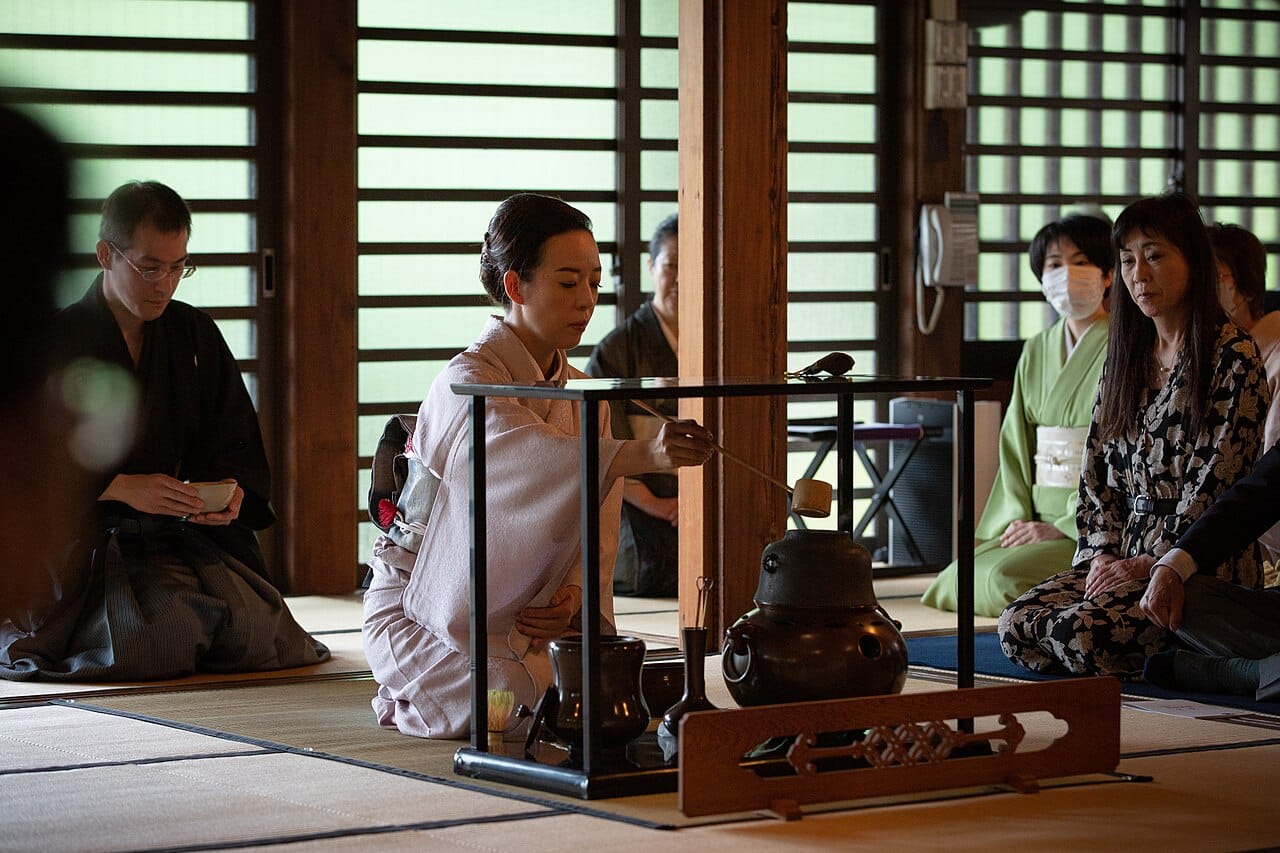
If the cha chaan teng is Hong Kong's loud reset, the chashitsu (茶室) is Kyoto's silent one. The traditional Japanese tea room is small — typically four-and-a-half tatami mats, around 7.4 square metres — with a low ceiling, a hidden charcoal pit, and a tokonoma alcove for a hanging scroll and seasonal flower. You enter through a 60-centimetre square doorway (nijiriguchi) that requires you to kneel and bow regardless of your status outside. The architecture itself is the first instruction: leave the city behind, leave your status behind, sit at the same height as everyone else.
Inside, a tea ceremony in the chashitsu can last from 20 minutes (a casual chakai) to four hours (a full chaji including kaiseki meal). The whisking of matcha into a fine green foam, the precise rotation of the bowl before drinking, the handling of the bamboo scoop — all of these are choreographed but not performative. They exist to slow the body and the mind to a tempo the city can never offer. Kyoto in 2026 has dozens of public chashitsu open to visitors, with bookings at Urasenke or Omotesenke schools running about ¥4,500-¥9,000 for a guided session. The price is for the room and the practitioner; the tea itself is incidental.
The modern Kyoto teahouses
Beyond the formal chashitsu, Kyoto's modern teahouse scene has flourished since 2018. Ippodo's Kaboku Tearoom in Teramachi serves matcha and gyokuro in a contemporary setting where the formality is loosened but the tea quality is maximised. Tsujiri Honten in Gion offers matcha experiences for tourists at a faster pace. The pattern is the same: the room asks you to slow. Even the modernised versions, with their phone-friendly tables and English-fluent staff, hold that core architectural instruction. Kyoto teaches by spatial design, not by lecturing.
Seoul's third generation: the modern Korean teahouse
Seoul's traditional dabang (다방) — coffee houses from the 1960s and 1970s — largely vanished by the 2000s, replaced first by chains and then by a third-generation Korean teahouse that emerged around 2015 and has matured by 2026. These spaces blend the contemplative architecture of the chashitsu with the social rhythms of the cha chaan teng. They serve high-grade Korean teas — green tea from Hadong, fermented hwangcha, traditional flower teas — alongside Korean traditional confections like dasik and yakgwa.
The leaders of this category in 2026 include Mindeullae in Bukchon (which only serves single-origin Korean green tea, no other beverages), Gancha in Hannam-dong (modernist architecture by an Aedas alumna, ceramic ware by Korean masters), and Tea Therapy in Insa-dong (the most accessible introduction to Korean tea culture for visitors). The price for a tea ceremony with snacks runs 15,000-35,000 won — about $11-$26 in 2026 — making this both an affordable indulgence and a structural part of how Seoul professionals decompress on weekends.
What these spaces share, and why it matters
The Asian tea house, in all its varieties, fulfils a function that Western coffee shop culture has been unable to replicate. It is a third place — neither home nor work — but with structural acoustic and ritual rules that make it possible to think, to talk, or simply to exist without producing anything. A Starbucks asks you to consume; a chashitsu asks you to be present; a cha chaan teng asks you to inhabit the city without engaging with it. All three of these are ways of resting. The Western model is mostly the first.
What Asian cities have done — at scale, across generations, with extraordinary local variation — is build the architectural infrastructure for thinking and pausing into the public realm. You pay for the tea; the room is the actual product. The price of a $4 milk tea in Hong Kong or a ¥1,200 matcha in Kyoto includes the right to occupy a chair in a room that has been designed for your pause. Western cities tend to charge separately for the chair (co-working, $30/day) or to gate access through expense (the hotel lounge, the members' club). Asia made the tea house quasi-democratic, accessible to almost everyone almost every day, and consequently tea houses became part of the daily life of the urban resident in a way Western analogues rarely manage.
How to use these places when you visit
For travellers, the most rewarding use of an Asian tea house is to spend more than expected. A 25-minute cha chaan teng visit gives you the food but not the experience; sitting for 90 minutes, watching the regulars order, watching the tempo, watching the orchestrated chaos of the kitchen, is the actual visit. A 30-minute Kyoto matcha drop-in is functional; a two-hour booking with a single conversation about the season is closer to what the room was built for. A Seoul teahouse visit of 20 minutes is a coffee break; one of two hours, with deliberate phone-off time, is the city teaching you something it has been teaching its own residents for centuries.
The tea will not change you. The room might. That's the trade Asia has been making with itself for several hundred years, and the tea houses across the region in 2026 are still — quietly, loudly, contemplatively, urgently — keeping that trade alive in cities that otherwise rarely permit it.