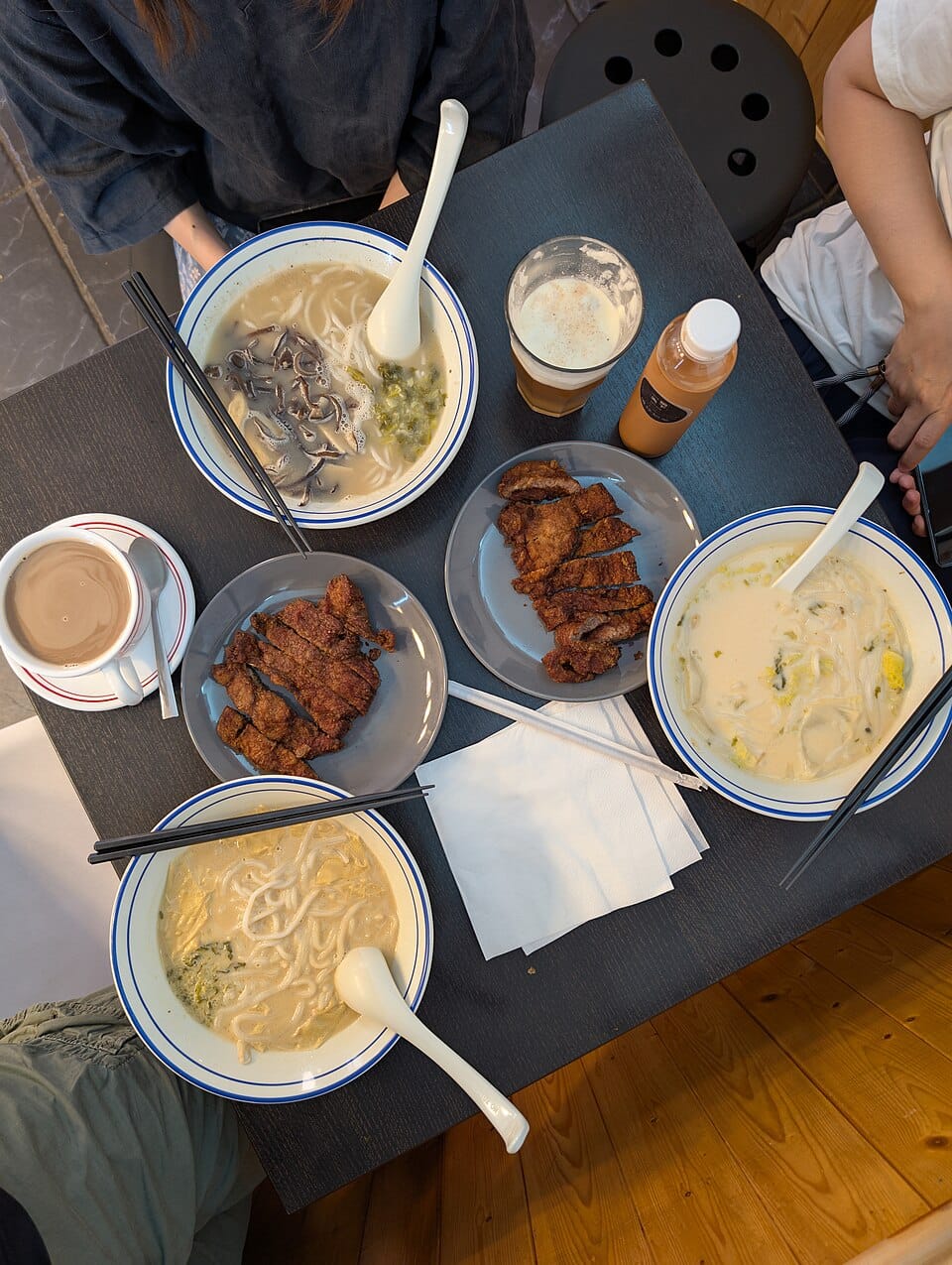
Walk into a 24-hour porridge shop on Bonham Strand in Hong Kong at 3am and you will find a particular crowd. Taxi drivers ending their night shift. A young couple in club clothes finishing the long evening with something that tastes like home. An elderly woman in pyjamas who walked over from her flat upstairs because she could not sleep. They are eating the same dish, but to each of them it means something slightly different. That is the gift and the puzzle of Asian rice porridge.
Across the continent, rice slow-cooked into a thick, savoury cream is the food that quietly defines the start of the day, the recovery from illness, the meal for the very young and the very old, and the late-night solace after the rest of the city has eaten. China calls it congee or jook. Japan calls it okayu. Korea calls it juk. The Philippines calls it lugaw. Indonesia and Malaysia call it bubur. Vietnam calls it cháo. Thailand calls it jok. The vocabulary changes; the soul of the dish does not.
The architecture of a good bowl
What makes rice porridge work is not technique. It is patience. A bowl of properly cooked congee is rice broken down so completely that the grains have surrendered their structure to the liquid, becoming something between soup and pudding. The rice-to-water ratio runs from 1:8 for thicker breakfast porridge to 1:14 for the silken Cantonese style. Cooking time runs from 90 minutes at low heat for Korean juk to four hours for the iconic Hong Kong overnight congee where rice grains are fully dissolved.
The trick that separates ordinary rice porridge from a genuinely satisfying bowl is the broth base. Plain water gives a vegetal, slightly thin result. A chicken bone broth, gently simmered with ginger and dried scallop, transforms the porridge into something dense and meaty. A pork bone broth gives Korean abalone juk its richness. A katsuobushi-and-kombu dashi base in Japanese okayu gives the porridge a delicate seaside note that rice alone cannot produce.
What goes on top
The toppings are where regional identity announces itself. In Hong Kong, century egg and shredded pork (pei dan sau yuk juk) sits on a bed of softly cooked rice with chopped scallions, a drizzle of sesame oil and fresh white pepper. The pairing is so iconic that "century egg congee" is a signal of homesickness for diaspora Chinese around the world.
In Seoul, a winter bowl of pumpkin juk with sweet red beans is what you bring to a friend recovering from surgery. The texture is smoother, almost like a savoury custard. The same kitchens make abalone juk for postpartum women — the so-called sanhujori dish — at five times the price, with the abalone considered restorative for new mothers in Korean folk medicine.
Tokyo's takeaway konbinis sell instant okayu in plastic bowls aimed at the tray-table comfort of someone with a cold. The version is plainer than Chinese congee, often served with a single umeboshi (pickled plum) and a scattering of sesame and shio kombu. The intent is not to dazzle but to soothe.
Manila's lugaw shifts in another direction entirely. The morning bowl is yellow with turmeric, garlicky, garnished with crispy fried garlic, hard-boiled egg and chopped spring onion. It is a hangover food, a market-day food, a cheap and democratic meal that costs 30 pesos and fills you for half a day.
The recovery food question
Why is rice porridge the food of recovery across so much of Asia? The simplest answer is digestibility. The starch granules in slow-cooked rice are gelatinised to a degree that makes them readily absorbable; the water content is high; the protein and salt content from the broth replenishes what illness, exertion or alcohol depletes. Traditional Chinese medicine has treated congee as a primary therapeutic food for at least two thousand years, with regional cookbooks listing variations for specific complaints — ginger congee for chills, pumpkin congee for diabetes, lily bulb congee for insomnia.
The science behind those folk associations is uneven. The carbohydrate-electrolyte mix in a salted broth-based porridge does aid recovery from gastroenteritis in a way comparable to oral rehydration solutions, which is partly why Korean kitchens default to juk for stomach bugs. The specific therapeutic claims around lily bulb or pumpkin congee are harder to defend with modern evidence, but the comfort effect — the warm bowl, the slow eating, the sense of being looked after — is itself part of why people get better.
The professional restaurant tradition
Hong Kong's congee houses are arguably the highest expression of the dish. A serious Cantonese congee shop will simmer its base for 12 hours overnight, using a 1:14 ratio with white rice and a few grains of glutinous rice for body. The result is liquid silk, not a single rice grain visible. Mui Kee in Sham Shui Po and Sang Kee Congee Shop on Queen's Road West both serve versions that have not changed in their recipe for fifty years.
The price spectrum at a Hong Kong congee specialist starts at HK$45 for a basic salted egg and pork version and runs to HK$280 for a luxurious abalone congee with dried fish maw. The high-end versions are not theatre — the underlying broth genuinely costs more to produce, and the toppings are sourced from specific suppliers in Wan Chai's dried seafood district. Most of the best congee shops do not hand out menus to first-time visitors. The waiter will ask, in Cantonese, what you feel like eating, and the answer to that question shapes the bowl.
The home version
The home congee experience is gentler. A weekend Cantonese family will set the rice cooker the night before, with rice, water, ginger and a chicken carcass, and wake up to a kitchen smelling of broth. Toppings are whatever is in the fridge — leftover roast pork, a chopped salted egg, a handful of fried wontons, a few sliced spring onions. The bowl is built at the table by each eater. The whole thing takes twenty minutes from waking to first spoon.
Late-night porridge culture
And then there is the late-night dimension. Across Hong Kong, Taipei, Bangkok and parts of Manila, 24-hour congee shops serve a specific clientele: shift workers, taxi drivers, office workers leaving karaoke at 2am, hospital staff between rounds. The food is cheap, the chairs are plastic, the lighting is fluorescent, and the bowls are warm. There is something honest about a city that maintains this infrastructure. It says, quietly, that the city looks after the people who work through the night.
The closest Western equivalent — the diner, the late-night kebab shop, the all-night bakery — never quite achieves the same thing. Rice porridge at 3am does not pretend to be exciting. It is exactly what it needs to be: warm, soft, salty, easy to eat, and gone in fifteen minutes. You leave the shop and the night feels less long. The bowl has done its job. That is the quiet power of the food, and the reason it has persisted, almost unchanged, across so many of Asia's cities for so many centuries.