Stand outside a mamak restaurant in Kuala Lumpur just after six in the morning and you will watch the same motion repeated at a dozen counters: a ball of dough stretched paper-thin between two hands, slapped onto a blackened griddle, folded into itself, and flipped again before it is even fully set. Travel two thousand kilometres north to Kashgar and the motion changes completely — the dough goes onto a stamping tool instead, gets studded with black onion seed, and is slapped onto the scorching inner wall of a clay jar buried in the ground. Both doughs start from the same three ingredients: wheat, water, and something to decide whether it rises. What happens to that dough afterward — which oven, which fire, whose hands shape it — is really the story of how Asia traded, migrated and remade itself over the last two thousand years, one flatbread at a time.
Two Ovens, One Grain
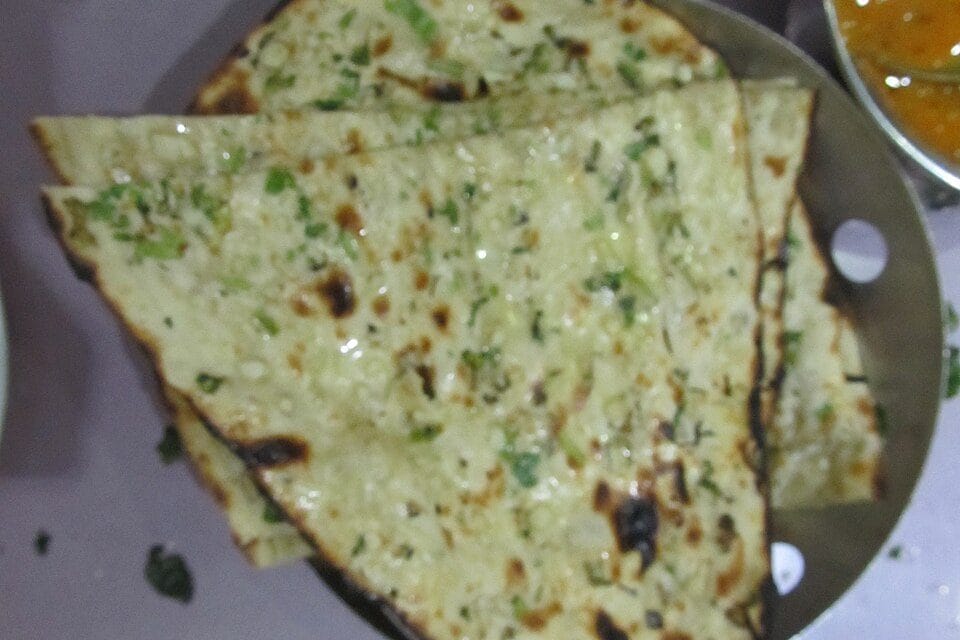
India settled the naan-versus-roti argument the hard way, by keeping both breads and never picking a winner. Naan's story runs through Persia, not the subcontinent — the word itself comes from the Persian nân-e sangak, and the earliest Indian reference to it appears in the memoirs of the Sufi poet Amir Khusrau, writing in the 1300s about two styles nobles ate at the Delhi court. It only became a Mughal breakfast fixture two centuries later, baked in the vertical clay tandoor that Turkic and Afghan rulers brought with them, and it has stayed a special-occasion bread ever since — built on refined maida flour, yeast and yoghurt, rather than something a household bakes on a Tuesday. Roti and chapati are the opposite kind of bread entirely: whole wheat, unleavened, rolled thin and cooked on a bare tawa with no oven at all, tracing back to wheat farming in the Indus Valley some three thousand years before naan's name even existed anywhere near India. Skip the naan if you actually want to taste the wheat — the yeast and yoghurt in that dough are built to soften and mask the grain, not showcase it, and roti is where you taste what the flour is actually doing. At a proper Punjabi dhaba, ordering naan gets you ceremony, while asking for roti instead gets you an ordinary Tuesday, the bread nobody in the house ever had to think twice about making.
When Migration Rewrites a Recipe
Roti canai never existed in India, which is the detail most visitors never notice while eating one. Between the 1880s and the 1930s, the British Empire moved hundreds of thousands of Tamil labourers from the Madras Presidency to work Malaya's rubber estates and railways, and among them came traders and cooks who eventually built the coffee shops that Malaysians now call mamak stalls. What they were originally selling was parotta, the layered flatbread of South India, but a century of frying it in Malaysian kitchens changed the dish: condensed milk crept into the dough, the dhal on the side turned sweeter, and the flipping technique sped up until the food stopped being Indian cooking done in Malaysia and became something else entirely. Today a plain roti canai costs somewhere between RM1.50 and RM2.50 at an ordinary mamak, and a full breakfast of roti, dhal and a glass of pulled tea — teh tarik — rarely tops RM6, which is a large part of why Malaysia now counts more than ten thousand mamak stalls, more of that single business type than any other in the country. Even the name is still disputed: some food historians trace "canai" to the Malay verb for rolling dough thin, others insist it is a corruption of Chennai, and neither camp has managed to settle the argument in over a century of trying.
The Clay Jar of Xinjiang
The oven does the accent work here, not the flour.
Uyghur nan comes out of a tonur, a barrel-shaped clay oven sunk halfway into the ground with a wood or coal fire burning at the bottom, and watching a baker work one is closer to performance than cooking. Before it ever touches fire, the dough gets stamped with a spiked tool called a chekich, which stops it ballooning in the heat, then dusted with sesame or black onion seed, and the baker leans deep into the pit to slap it directly onto the scorching clay wall, where it clings until it is done. A single piece runs one to three yuan from a street bakery in Kashgar or Urumqi, and restaurants buy it wholesale for three to six yuan apiece from bakeries that have turned nan-making into a genuine regional industry — Urumqi's dedicated naan park alone employs more than a thousand workers, many recruited from poorer counties in the south of the region. Locals will tell you the smell of a wood-fired tonur is simply the background scent of any Uyghur neighbourhood, baked outdoors rather than in a kitchen, and that detail says something real about how communal the bread is: nobody in Kashgar owns a tonur for their own household alone.
The Crepe That Is Not Really a Bread
Call jianbing a pancake and a Tianjin native will correct you immediately, because the batter is the whole point, and it is not wheat flour working on its own. Legend credits the dish to the Three Kingdoms general Zhuge Liang, whose cooks supposedly poured grain batter onto shields over an open flame after the army lost its woks — a fine story, though the first hard documentation of the Tianjin version, ground mung beans thinned into batter, only turns up in a 1942 magazine called Jinjin Monthly. Ladling that batter onto a hot iron, the vendor spreads it paper-thin with a T-shaped tool, cracks an egg straight onto the still-wet surface, and finishes it with scallion, cilantro, a crushed length of fried dough called youtiao, and a smear of fermented bean paste, folding the whole thing into a rectangle eaten standing up. A basic jianbing runs somewhere between five and fifteen yuan from an honest street cart in Beijing or Tianjin, and anything past thirty yuan, piled with sausage and mozzarella for tourists, has usually stopped being jianbing and started being a photo prop. Buy it from the cart with the longest line of people actually eating breakfast — not the one with a laminated English menu taped to the side.
Yesterday's Bread, Tonight's Ritual
Kottu roti exists because someone in eastern Sri Lanka, sometime in the 1970s, refused to throw away leftover flatbread. Carried into Sri Lanka through Tamil and Muslim trading communities around Batticaloa and Trincomalee, godamba roti — the same family of stretched, oil-laminated dough as Malaysia's roti canai and South India's parotta — went stale within a day, and someone worked out that chopping it fine and stir-frying it with egg, vegetables and curry gravy on a hot griddle turned a throwaway ingredient into a meal in its own right. What made kottu a national dish rather than a regional fix was the country's Night Kade culture: roadside eateries that sprang up around railway stations, hospitals and construction sites to feed people working odd hours, where the rhythmic taka-taka sound of two metal blades chopping roti against a hot iron announced a stall was open before anyone could even read the menu. That sound is not incidental and it is not for show either — Colombo cooks genuinely time the chop by ear, listening for the moment the roti stops clumping and starts frying properly, a point that arrives well before the dish looks finished to anyone who has never made it. Order it from a known chain like Pilawoos, or from a stall with no name at three in the morning, and either version sits closer to the original impulse than anything plated in a hotel restaurant with a fork and a folded napkin.
Six regions, one grain, and not one of these breads would survive being swapped into another region's oven. Slap wet jianbing batter onto a scorching tonur wall and it slides straight into the coals below; try baking Uyghur nan with a five-minute wok flip instead of a clay jar and it comes out raw in the middle, burnt at the edges. The wheat crossed every one of these borders. The fire never did.