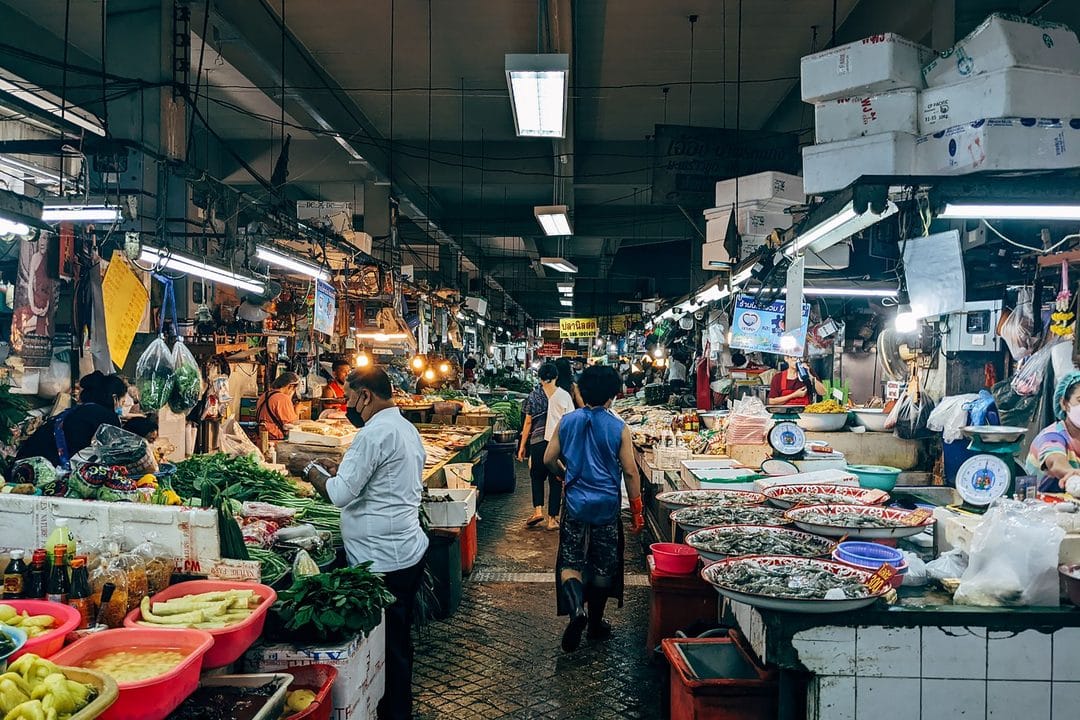
There is a smell that hits you the moment you step into a wet market before seven in the morning, and it is nothing like the sterile chill of a supermarket. It is wet concrete, crushed lemongrass, the iron tang of a fishmonger hosing down his slab, frying garlic drifting from the breakfast stalls at the edge, and somewhere a vendor splitting a jackfruit open with a cleaver. If you want to understand how Asia actually eats — not the restaurant version, the daily one — you go to the market at dawn, before the heat and the tour groups arrive.
I have done my early-morning rounds in Bangkok's Or Tor Kor, in the lanes behind Geylang in Singapore, in a Hanoi alley market that exists for about four hours and then vanishes back into a residential street. They look chaotic. They are not. There is a logic to where everything sits, a rhythm to the haggling, and an unspoken etiquette that, once you learn it, makes you feel like you finally belong to the place.
Follow your nose, then follow the aunties
The first rule of any Asian market is that the busiest stall with the longest line of local grandmothers is the one you want. Aunties do not queue for mediocre produce or a stall that overcharges. When I am somewhere new, I find the noodle or tofu vendor with three women in their seventies waiting patiently, and I join the back of that line without even knowing what I am buying yet.
The layout tells a story once you read it. Leafy greens and herbs cluster near the entrance because they wilt fastest and need to move first — morning glory, Thai basil, sawtooth coriander, the bundle of pandan leaves nobody back home can ever find. Deeper in sits the protein: live fish in shallow tanks, crabs with their claws tied, chickens that were clucking an hour ago. The dry goods — dried shrimp, fermented bean pastes, the wall of chilli pastes in every shade of red and brown — hold the back, where they keep without refrigeration.
The breakfast at the edge is the whole point
Here is the part nobody tells you: the real reason to come at dawn is not the shopping. It is the ring of breakfast stalls that wakes up to feed the vendors themselves. These are the cooks feeding the people who feed everyone else, and the food is fast, unfussy and exactly right.
In Bangkok it is a bag of jok, rice porridge with a raw egg cracked in and ginger on top, eaten standing up from a plastic stool. In a Penang market it is char kway teow fired in a wok so hot the noodles carry that smoky char locals call wok hei, served before eight in the morning without anyone blinking. In Hanoi it is bun rieu, a crab-paste noodle soup that arrives a bright tomato-orange, the broth sour and savoury at once, the kind of bowl that resets your whole morning.
The coffee at these stalls deserves its own paragraph. None of it is gentle. A Vietnamese market vendor will hand you ca phe sua da so strong and so sweet it functions as breakfast, lunch and a small electric shock. In a Thai market it arrives the old way — dark roast dripped through a cloth sock filter, poured over a mountain of ice and condensed milk. You drink it fast, before the ice melts and dilutes the whole thing.
Learn the etiquette and the market opens up
Haggling exists, but it is gentler and more relational than outsiders expect. You do not bark a number and walk. You ask the price, you smile, you suggest a little less, and very often the vendor throws in an extra handful of chillies or a stalk of lemongrass instead of dropping the price — a small gift that means you are now a regular in the making. Push too hard over a few coins and you mark yourself as someone who does not understand the game.
Bring your own bag, because the vendors will quietly respect you for it, and carry small notes — nobody at five-thirty in the morning wants to break a large bill for a bunch of coriander. And do not photograph the fish lady's face without a nod first; the produce is fair game, the people deserve the courtesy.
The one mistake I made for far too long was treating the market as an errand. It is not. It is the closest thing most Asian cities have to a daily town square, a place where the recipes are decided by what looked good on the slab that morning rather than by any menu. The mango vendor will tell you which variety is sweetest this week. The fish man will tell you what came in fresh and what to leave alone.
By the time the heat rolls in around nine and the greens start to wilt, the best of it is already gone — sold to the aunties who got there at six, eaten by the vendors at the breakfast stalls, carried home in a hundred reused plastic bags. Come late and you get the leftovers. Come at dawn and you get the city's whole appetite laid out in front of you, still dripping.