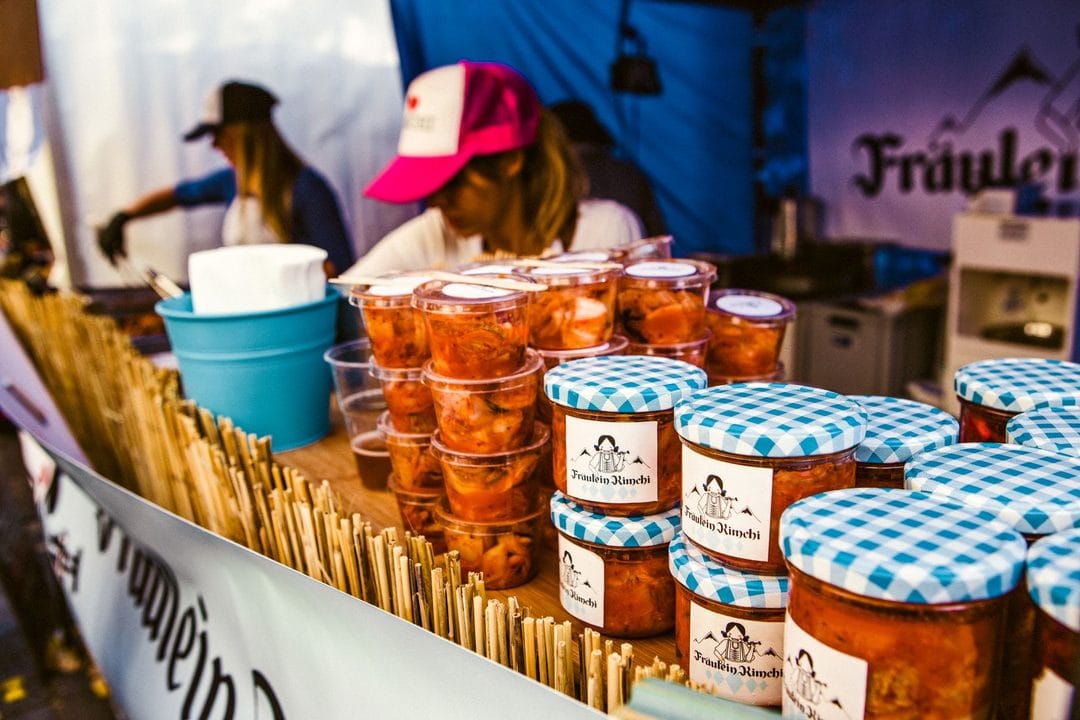
Walk into any Korean grandmother's kitchen in November and you'll find the real cooking has already finished. It happened weeks earlier, in a jar nobody opened, at a temperature nobody measured with anything more precise than a hand pressed against the ceramic. Fermentation is the quiet engine behind an enormous share of Asia's most recognisable flavours, from Korean kimchi to Japanese miso to the fish sauce that seasons half of Southeast Asian cooking, and almost none of it depends on a stove at all. What holds these traditions together isn't a shared recipe; it's a shared patience, and a willingness to let bacteria and mould do work that heat can't replace. A restaurant kitchen can sear a steak in four minutes and reduce a sauce in twenty, but nobody has ever found a way to rush a barrel of miso or a vat of fish sauce: the jar decides how long the process takes, not the cook standing over it.
Korea's kimchi and the temperature nobody agrees on
Ask five Korean households how long napa cabbage kimchi should ferment before it's ready, and you'll get five different answers, and all five will be right for what that household actually wants. A kimchi left at room temperature for two or three days develops the sharp, faintly effervescent tang that younger eaters tend to prefer, still crunchy enough to hear when you bite into it. Left in a traditional onggi clay pot buried partly underground, or in a modern kimchi refrigerator set to a steady 0 to 4°C, the same cabbage turns into a completely different food after two or three months: softer, sourer, and prized specifically for jjigae and fried rice rather than eaten straight from the jar. The clay-pot version isn't better than the fridge version; it's simply chasing a different endpoint, and most Korean cooks keep both going at once, one jar for eating this week and one for eating in February.
For anyone experimenting with kimchi at home for the first time, skip the quick three-day version and go straight for a longer, cold ferment. The extra month of patience produces a far more balanced sourness than the sharp, one-note tang of an impatient batch, and it holds up far better once it's cooked into a stew.
Japan's slow ferments: miso, shoyu, and the years hiding in a barrel
Miso and shoyu operate on a completely different timescale, measured in years rather than weeks. A basic white miso, shiro miso, can be ready in a matter of months, but the darker, more intensely savoury red miso favoured in Nagoya and much of Aichi prefecture typically ages for one to three years in cedar barrels, developing a depth that no amount of added seasoning can fake. Hatcho miso, made by the Kakukyu and Maruya Hatcho breweries that have operated in Okazaki since the twelfth century, is aged for a minimum of two full summers in barrels weighted down with river stones stacked in a specific spiral pattern that took brewers generations to settle on.
Two years, sometimes three, before a single spoonful is ready to sell.
Southeast Asia's fish sauce and the smell that means it's working
Vietnamese nước mắm and Thai nam pla both start the same way: anchovies layered with salt in wooden barrels or ceramic vats, left to break down under their own enzymes for anywhere from nine months to two years. Phú Quốc island's fish sauce producers, protected under a geographical-indication status similar to Champagne's, insist that only their specific combination of black anchovy and wooden barrels ages into the deep amber colour and rounded, almost caramel-like saltiness that mass-produced sauces can't replicate through faster chemical hydrolysis. The smell during the first few months puts off nearly every first-time visitor to a fish-sauce facility, sharp and almost aggressively fishy, but that smell mellows dramatically by month six, which is exactly how experienced producers judge progress without opening a single vat to taste it.
If you're buying fish sauce for home cooking, first-press nước mắm nhĩ is worth the extra cost over a second-press blend. The difference in a simple dipping sauce is obvious in a way it almost never is in a heavily spiced stir-fry, where the fish sauce is one flavour among many rather than the entire point.
Indonesia's tempeh and the mould you're supposed to want
Tempeh flips the usual fermentation instinct on its head: instead of guarding against mould, Indonesian tempeh makers cultivate exactly that. Soybeans inoculated with Rhizopus oligosporus spores are wrapped in banana leaf or perforated plastic and left at around 30°C for 24 to 48 hours, during which the mould's white mycelium threads bind the beans into the dense, sliceable cake found in nearly every Javanese market. Malang and Bandung both have neighbourhoods built almost entirely around small-batch tempeh production, with some family workshops operating out of the same courtyard for three generations, selling fresh tempeh within hours of the mould finishing its work because the texture changes noticeably once it starts to go beyond ripe.
Leave tempeh a day too long and it turns from firm and nutty to soft, ammonia-scented and genuinely unpleasant. The same mould that made it delicious keeps working long after the ideal window closes, which is the one hard rule tempeh makers across Central Java agree on without exception.
Bringing this home without losing what makes it work
Home cooks outside Asia trying to replicate any of this run into the same obstacle again and again: climate control. A Seoul apartment's ondol-heated floor in winter and a humid Vietnamese coastal town in summer create fermentation conditions that a centrally heated apartment in London or a dry kitchen elsewhere simply doesn't match, and the bacterial cultures that make kimchi, miso and fish sauce work are more sensitive to ambient temperature swings than most home cooks expect. A wine fridge set to 4 to 8°C solves the kimchi problem reasonably well, holding a steady cold environment that mimics the onggi pot without the burial. Miso and fish sauce are harder to fake at home: both benefit from a large thermal mass that a small jar in a kitchen cupboard just can't replicate, which is why most serious home fermenters buy their miso and fish sauce rather than attempting a barrel-scale project in a studio apartment.
Sichuan's doubanjiang and the batches aged longer than a marriage
Pixian County outside Chengdu holds its own geographical-indication status for doubanjiang, the fermented broad-bean and chilli paste that underpins much of Sichuan cuisine, including mapo tofu and the hotpot bases sold across the region. Traditional producers ferment the paste in open-air earthenware urns for a minimum of one year, though the most prized batches age for three to five years, developing a deep reddish-brown colour and a complexity that younger, mass-market versions simply labelled "doubanjiang" on supermarket shelves rarely reach. The urns sit uncovered under the sun during the day and get covered against rain and dew overnight, a daily ritual that some family producers in Pixian have kept unchanged for well over a century.
Cheap supermarket doubanjiang works fine for a weeknight mapo tofu, but it isn't really the same product as a three-year urn-aged paste, and treating the two as interchangeable is the most common mistake home cooks outside China make with this ingredient.